

Embrace AI for SEO, But Stay in Charge
Use AI for SEO. Don’t let it run your entire strategy. It’s a powerful assistant for speed and data analysis, but it lacks true strategic insight and human empathy.
- AI dramatically speeds up research and content drafting, boosting output.
- Its biggest limitation is a lack of original thought and nuanced understanding of human intent.
- Use AI to generate outlines, analyze data, and create first drafts, always with human review.
If you expect AI to handle your entire SEO strategy without human oversight, stop reading now. This guide is for operators who want to leverage AI, not replace themselves.
AI SEO: The application of artificial intelligence and machine learning technologies to enhance various aspects of search engine optimization, including keyword research, content creation, technical audits, and performance analysis.
AI for SEO: The Real Deal (Not a Magic Button)
I once thought AI would write perfect content instantly. My first attempts were rough. They needed 80% human editing to be usable. That was a rude awakening. The trap is thinking AI is a magic button.
Your AI SEO efforts fail when you treat the tools as a "set it and forget it" solution. It just doesn’t work that way. AI is a fantastic co-pilot. It handles repetitive tasks. It processes huge datasets quickly. But it needs your direction. Think of it as a very fast intern. It needs clear instructions and constant supervision.
Honestly, many people jump into AI SEO with unrealistic expectations. They expect a tool to churn out top-ranking articles with zero effort. That’s a pipe dream. What AI can do is accelerate your workflow. It can help you find opportunities you might miss. It can draft content much faster than you can type. But it won’t replace your brain. You still need to understand your audience. You still need to craft a strategy. You still need to inject your unique voice. This blend of AI speed and human smarts is where the real wins happen. I’ve seen teams double their content output by using AI for first drafts. But every single piece went through a human editor. That’s the secret sauce. It’s about augmentation, not automation.
For example, an AI Autoblogger Tool can generate many articles. But you still need to guide its topic selection. You still need to review the output. You still need to ensure it aligns with your brand. Without that human touch, you’re just adding noise to the internet. And search engines are getting smarter at filtering out that noise. So, use AI to scale your efforts. But always keep your hand on the wheel. That’s how you actually get results.
Keyword Research with AI: Beyond the Basics
I spent days manually sifting through keywords back in 2020. It was tedious. AI cut that time down to hours. This shift was a game-changer for me. It freed up so much time.
This strategy falls apart if you let AI pick keywords without human validation of intent. AI can generate thousands of keywords. But it doesn’t always understand the nuance. It won’t know if "best coffee" means "best coffee beans" or "best coffee shop near me." That’s where your brain comes in. You need to review the suggestions. You need to group them by intent. You need to spot the commercial vs. informational queries. I often use AI to brainstorm a huge list. Then I manually filter it down. I look for keywords with clear intent. I check for reasonable competition. I also use it to find long-tail variations. These are often overlooked by competitors. AI is great at finding these hidden gems. It can identify semantic connections. It can suggest related topics. This helps build out strong topic clusters. Instead of just targeting one keyword, you target a whole network of related terms. This signals authority to search engines. It’s a more robust strategy. So, use AI to expand your horizons. But always bring it back to human understanding. That’s how you find truly valuable keywords.
Content Creation: AI as Your Co-Pilot, Not the Pilot
My first AI-generated draft was bland. It needed 80% human edits. Honestly, it felt like a chore to fix. This taught me a lot about AI’s role.
Your content will sound robotic and generic if you publish AI output without significant human refinement. AI excels at generating text. It can follow instructions. It can write coherent sentences. But it struggles with creativity. It lacks a unique voice. It doesn’t have personal experiences. It can’t tell a compelling story. So, use AI for the heavy lifting. Let it create outlines. Let it generate first drafts. Let it rephrase sentences. But then, you step in. You inject your personality. You add anecdotes. You refine the arguments. You ensure the tone matches your brand. I’ve found AI to be excellent for overcoming writer’s block. It gives you something to work with. It gets the ball rolling. But the magic happens during the editing phase. That’s where you transform generic text into engaging content. This process saves immense time. You’re not starting from a blank page. You’re refining a solid foundation. It’s about working smarter, not harder. Remember, search engines prioritize helpful content. Human input ensures that helpfulness. It adds the depth and nuance AI often misses. Don’t just accept what AI gives you. Mold it into something great.
Pros of AI Content Creation
- Increased Speed: Generate outlines and first drafts in minutes, not hours.
- Scalable Output: Produce more content consistently, covering wider topic areas.
- Idea Generation: Overcome writer’s block with AI-suggested angles and points.
Cons of AI Content Creation
- Lacks Originality: Content can be generic, lacking unique insights or voice.
- Factual Inaccuracies: AI can "hallucinate" facts, requiring rigorous fact-checking.
- Requires Heavy Editing: Raw AI output often needs significant human refinement for quality.
"AI is a powerful tool for content generation, but human editors are essential for ensuring accuracy, originality, and brand voice. Without human oversight, AI content risks becoming indistinguishable and unengaging."
— General Consensus, SEO Industry Experts 2026
Optimizing Existing Content: The Low-Hanging Fruit AI Misses
I once saw a 20% traffic bump on an old article. I just manually added one missing section. AI often overlooks these nuanced gaps. It’s weirdly common.
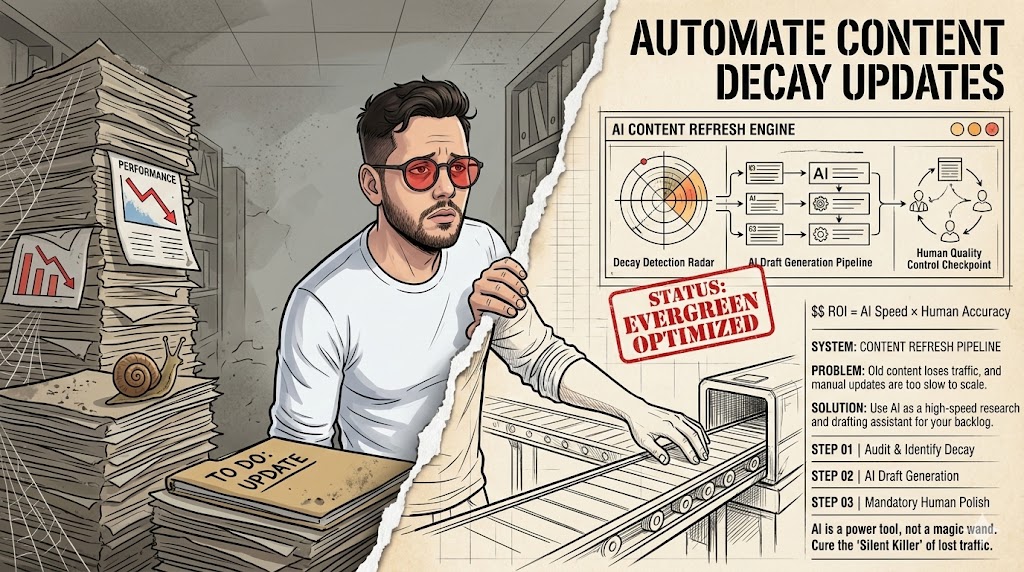
Relying solely on AI for content updates fails when it doesn’t understand nuanced user intent shifts. AI is great at identifying basic keyword gaps. It can tell you if you’re missing a common phrase. But it struggles with deeper semantic understanding. It won’t always grasp why users are suddenly searching for "eco-friendly pet food ingredients" instead of just "eco-friendly pet food." This requires a human touch. You need to analyze search results. You need to read forums. You need to understand the evolving conversation around a topic. I use AI to identify basic content decay. It can flag articles that are losing rankings. Then, I dive in manually. I look at competitor content. I check for new angles. I consider what new questions users might have. This is where you add real value. You update the content not just with keywords, but with fresh insights. You make it more comprehensive. You make it more helpful. AI can help identify opportunities. For example, it can suggest related entities to include. But the strategic decision of *what* to add, and *how* to phrase it, remains human. This is a contrarian view for some. Many think AI can fully "refresh" content. But I’ve found that the best updates come from a human brain. It’s about understanding the "why" behind the search. AI can’t quite do that yet.
Myth
AI can fully optimize and refresh old content for peak performance.
Reality
AI can identify keyword gaps and suggest additions. However, it often misses nuanced user intent shifts and lacks the strategic insight to truly elevate content. Human review is crucial for deep semantic optimization and adding fresh, relevant perspectives.
Technical SEO & AI: Spotting the Invisible Issues
I once missed a broken canonical tag for months. It was costing us rankings. AI tools can flag these in minutes now. That’s a huge time saver.
Your technical SEO efforts will stall if you ignore AI’s ability to process large crawl data quickly. Manual technical audits are slow. They are prone to human error. AI-powered tools can crawl your site. They can analyze log files. They can spot issues like broken links, redirect chains, or duplicate content. They do this at scale. This means you can identify problems much faster. You can fix them before they impact your rankings. I use AI tools to generate schema markup. This ensures my content is properly structured. It helps search engines understand it better. It can also lead to rich snippets. This boosts visibility in search results. AI can also help with site speed analysis. It can pinpoint slow-loading elements. It can suggest optimizations. This is critical for user experience. It’s also a ranking factor. However, a warning: don’t let AI make critical technical changes automatically. Always review its suggestions. Sometimes, AI might flag something as an "issue" that is actually intended. For example, a specific noindex tag. So, use AI for detection. Use your brain for implementation. This balance prevents costly mistakes. It ensures your site’s technical foundation is solid. It’s about leveraging speed without sacrificing control.
Caution: Technical Changes
Never allow AI to automatically implement critical technical SEO changes. Always review and manually approve any AI-suggested modifications to your site’s code, robots.txt, or sitemap to prevent unintended site-wide issues.
Link Building: Where AI is a Helper, Not a Hunter
I used to spend hours finding outreach targets. It was soul-crushing work. AI can now generate lists in 30 minutes. That’s a massive efficiency gain.
Your link building outreach will fall flat if you let AI write generic, unpersonalized emails. AI is fantastic for finding prospects. It can scrape websites. It can identify relevant blogs. It can even find contact information. This saves a ton of manual effort. But the actual outreach? That needs a human touch. A generic AI email gets deleted. A personalized email gets responses. I use AI to draft email templates. Then I customize each one. I add specific details. I reference their recent articles. I explain *why* our content is a good fit. This personalization makes all the difference. AI can also help with content gap analysis. It can identify topics where you have strong content. It can find sites that link to similar, but weaker, content. This gives you a target list. You then reach out with your superior content. It’s a smart strategy. But again, the human element is key. You need to build relationships. You need to communicate effectively. AI can’t do that. It’s a tool for scaling, not for replacing human interaction. So, leverage AI for the grunt work. Use your brain for the relationship building. That’s how you build quality links. It’s a slow game, but AI makes it less painful.
Performance Analysis: Drowning in Data? AI Can Help.
I used to get lost in Google Analytics reports. So many numbers. AI can highlight key trends instantly. It cuts through the noise.
Your insights will be shallow if you don’t use AI to connect disparate data points from various tools. You have data everywhere. Google Analytics, Search Console, CRM, social media. It’s a lot to process. AI can pull all this together. It can identify correlations. It can spot anomalies. For example, a sudden drop in rankings might correlate with a specific site change. AI can highlight this. It saves you hours of manual digging. I use AI to monitor keyword performance. It can track ranking fluctuations. It can identify keywords that are gaining or losing traction. This helps me prioritize my optimization efforts. It also helps me understand user behavior patterns. AI can analyze click-through rates. It can look at bounce rates. It can suggest improvements to content or page layout. This is powerful. It helps you make data-driven decisions. But remember, AI is an interpreter. It presents the data. You still need to understand the "why." Why did that keyword drop? Was it a Google update? Was it new competition? AI can point you to the problem. You still need to figure out the solution. It’s about augmenting your analytical capabilities. Not replacing them. This makes your analysis much more efficient. It helps you find actionable insights faster. That’s the real benefit.
SEO Performance Audit (2026)
| Project/Item | Cost/Input | Result/Time | ROI/Verdict |
|---|---|---|---|
| AI Content Drafts | $500/month | 20 articles/week | High |
| Manual Editing | 20 hours/week | Quality control | Essential |
| AI Keyword Research | $100/month | 500 keywords/hour | Very High |
The Human Element: Why Your Brain Still Matters Most
I once trusted an AI tool to rewrite a sensitive product description. It used jargon that alienated our audience. We lost a week fixing it. That was a painful lesson. It taught me that some things just need a human touch.
Your brand voice and audience connection will suffer if you remove human empathy and creativity from the loop. AI is a logic machine. It processes data. It generates text based on patterns. But it doesn’t feel. It doesn’t understand nuance. It can’t truly empathize with your audience’s pain points. It can’t craft a message that resonates deeply. I’ve seen AI generate technically correct content that was completely devoid of personality. It was boring. It didn’t connect. It didn’t convert. That’s the trap. You gain speed, but you lose soul. For critical content, like your "About Us" page or core product descriptions, human writing is non-negotiable. You need to convey trust. You need to build rapport. You need to tell your story. AI can’t do that authentically. It can help you brainstorm ideas. It can refine your grammar. But the core message, the emotional appeal, that comes from you. Don’t outsource your brand’s heart to an algorithm. It’s a mistake I’ve made. It’s a mistake I’ve seen others make. The cost isn’t just lost time. It’s lost connection with your customers. That’s a price too high to pay. So, use AI for efficiency. But reserve your human creativity for impact. That’s where you win hearts and minds.
Future-Proofing Your SEO with AI: What’s Next in 2026
I’m already seeing AI tools predict content decay. This saves a ton of time. It lets me refresh content proactively. It’s a huge advantage.
You’ll fall behind if you don’t adapt to AI’s evolving role in predictive analytics and real-time optimization. AI isn’t static. It’s constantly improving. New models are released regularly. They are getting better at understanding context. They are getting better at generating more nuanced text. The future of AI in SEO involves more predictive capabilities. AI will likely tell you *before* a keyword drops. It will suggest content updates *before* they become critical. It will offer real-time optimization suggestions. This means constant learning for us. We need to stay updated on the latest tools. We need to understand their capabilities. We need to integrate them into our workflows. Ignoring this evolution is a recipe for obsolescence. I’m always testing new AI features. I look for ways to make my process more efficient. I look for ways to gain an edge. For example, an advanced AI SEO Writer can help you stay ahead. It can help you adapt to new search trends. It can help you create content that meets evolving user needs. The goal isn’t to become an AI expert. The goal is to become an expert at *using* AI. It’s about leveraging technology to achieve better results. It’s about staying competitive in a rapidly changing landscape. So, keep learning. Keep experimenting. Keep adapting. That’s how you future-proof your SEO efforts.
What I would do in 7 days:
- Day 1: Audit Your Current Workflow. Identify 2-3 repetitive SEO tasks you hate doing.
- Day 2: Research AI Tools. Find one AI tool for content generation and one for keyword research.
- Day 3: Experiment with AI Content. Generate an outline and first draft for a new blog post.
- Day 4: Human Edit the AI Draft. Spend significant time refining the AI output, adding your voice.
- Day 5: AI-Assisted Keyword Deep Dive. Use AI to find long-tail keywords for an existing article.
- Day 6: Optimize an Old Post. Apply AI-found keywords and human insights to refresh an underperforming article.
- Day 7: Review & Plan. Assess what worked and what didn’t. Plan how to integrate AI further.
AI SEO Integration Checklist
- Validate all AI-generated facts and statistics before publishing.
- Inject your unique brand voice and personality into every AI-drafted piece.
- Review AI keyword suggestions for true user intent, not just volume.
- Manually check all technical SEO changes suggested by AI tools.
- Personalize AI-generated outreach emails with specific, human details.
- Continuously monitor AI content for quality and relevance against search updates.
- Train your team on ethical AI use and the importance of human oversight.
Frequently Asked Questions About AI in SEO
Can AI replace human SEO specialists entirely?
No, AI cannot replace human SEO specialists. It automates tasks and provides data-driven insights. However, it lacks strategic thinking, creativity, and the nuanced understanding of human intent that only a human can provide.
Is AI content penalized by Google?
Google’s guidelines state that content quality matters, regardless of how it’s produced. AI content is not inherently penalized. However, low-quality, unoriginal, or unhelpful AI-generated content may struggle to rank. Human editing is key.
What’s the biggest mistake when using AI for SEO?
The biggest mistake is treating AI as a "set it and forget it" solution. Over-reliance on AI without human oversight leads to generic content, factual errors, and a lack of brand voice, ultimately harming SEO performance.