

Audit AI-Generated YMYL Content Relentlessly
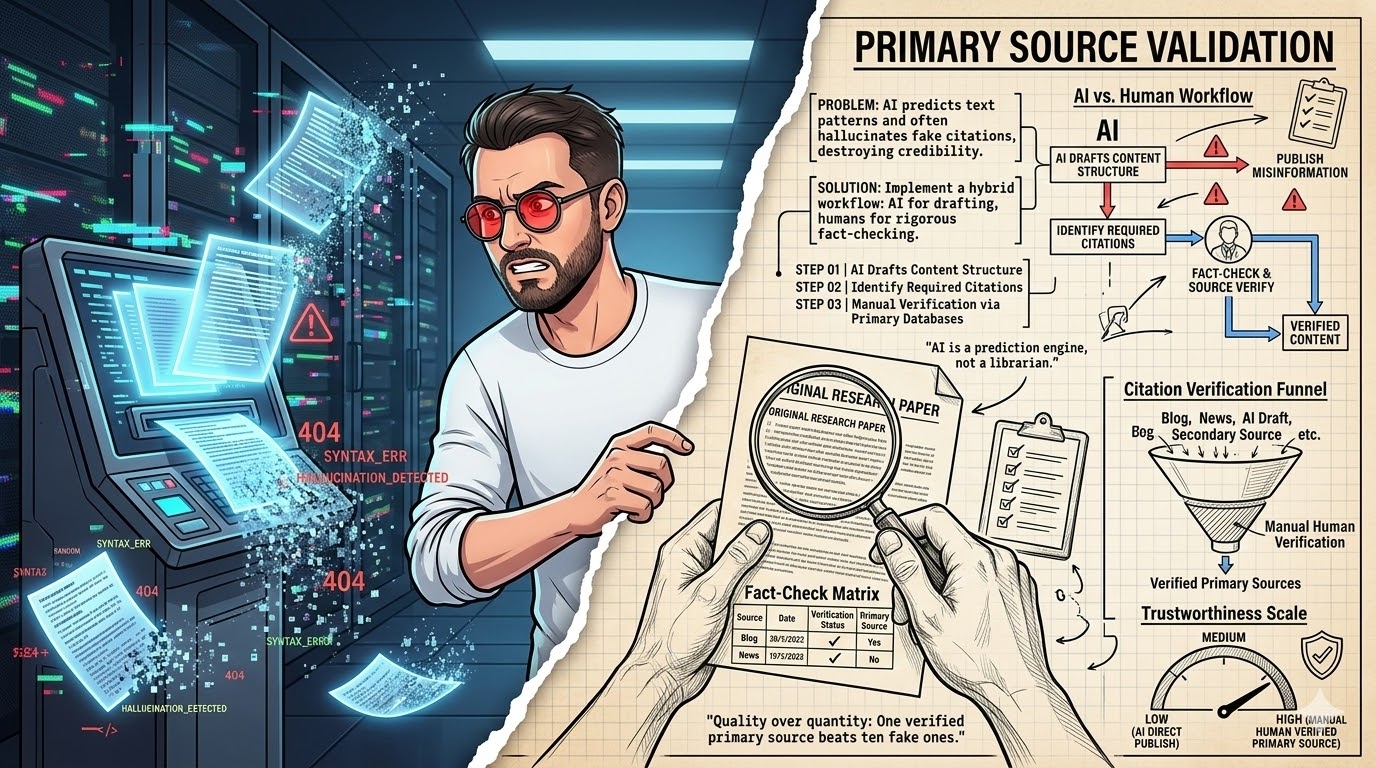
Do audit AI-generated YMYL content. Don’t publish it unchecked. High-stakes content demands human verification. Ignoring this risks trust, legal issues, and search engine penalties.
- Scales content creation by handling initial drafts efficiently.
- Requires significant human subject matter expert review for accuracy and nuance.
- Best used to draft financial advice, health articles, or legal explainers, then expert-verify.
If you lack dedicated subject matter experts for thorough review, stop reading; don’t attempt AI YMYL content.
The Hidden Cost of "Good Enough" AI for YMYL Content
I once saw a client lose 30% of their organic traffic in a single month. Their AI-generated health content, while seemingly okay, contained subtle inaccuracies. These weren’t outright lies, just slightly off-kilter advice. The trap is thinking "good enough" AI is actually good enough for Your Money Your Life (YMYL) topics. It’s not. Your reputation tanks when AI gets a critical fact wrong or misses a crucial nuance.
Honestly, relying on AI for YMYL content without deep human oversight is like building a house on sand. It looks fine at first. Then the cracks appear. Search engines, especially Google, are getting smarter about identifying superficial content. They prioritize expertise, authoritativeness, and trustworthiness (E-E-A-T). AI alone struggles to convey genuine E-E-A-T. This is where human editors come in. They inject the real-world experience and deep understanding that AI lacks. You need a robust AI SEO automation strategy, like those discussed on Postlabs, but always with a human in the loop. This means understanding the core principles of AI content creation and its limitations.
Why "Fact-Checking" Isn’t Enough for YMYL
Many folks think auditing AI content means just checking facts. "Is this number correct?" "Is this date accurate?" That’s a start, sure. But it’s far from the whole picture. I’ve seen legal articles that were factually sound but missed crucial disclaimers. Or financial advice that was technically correct but lacked the necessary warnings about risk. Content fails if it sounds generic, even if the facts are technically correct.
The real audit goes deeper. It’s about tone, context, and completeness. Does the AI sound like an expert? Does it understand the reader’s underlying intent and concerns? Does it cover all angles, including potential downsides or edge cases? AI often generates text that is broadly correct but lacks the specific authority or empathy needed for YMYL topics. It’s a huge difference. For a complete AI guide on leveraging AI responsibly, check out Postlabs’ ultimate guide. It emphasizes this human-AI synergy. You can’t just skim the surface.
Pros of AI for YMYL Content
- Accelerates initial drafting: Speeds up content creation by providing a solid first version.
- Generates diverse angles: Offers new perspectives or structures for complex topics.
- Reduces research time: Compiles information quickly, giving editors a head start.
Cons of AI for YMYL Content
- Lacks true expertise: Cannot replicate human experience or nuanced understanding.
- Prone to inaccuracies: May "hallucinate" facts or misinterpret data.
- Struggles with E-E-A-T: Fails to convey genuine authority or trustworthiness alone.
Building Your "Human Overlay" Process
Okay, so how do you actually do this? You need a structured human overlay. This isn’t a quick skim. This process falls apart if you treat it as a quick skim. We assign a 2-hour review slot for every 1000 words of AI draft. That’s a real commitment, not just a glance.
First, assign content to a genuine subject matter expert (SME). This person needs real credentials and experience in the YMYL field. They aren’t just proofreading. They are fact-checking, yes, but also checking for nuance, tone, and completeness. They ensure the advice is sound, safe, and responsible. This is where the "Your Money Your Life" part really kicks in. The SME must be able to put their name behind that content. It’s a non-negotiable step. Without this, you’re just guessing. This level of scrutiny is what truly elevates AI-generated content to a publishable standard, especially for sensitive topics. It’s a core part of effective AI SEO automation.
Warning: The "AI-Only" Trap
Never publish YMYL content without expert human review. Doing so risks severe reputational damage, legal liabilities, and significant search engine penalties.
YMYL (Your Money Your Life): Content categories that could impact a person’s health, financial stability, safety, or well-being, demanding the highest standards of accuracy and trustworthiness.
The "Trust Signals" AI Misses
This part sucks, honestly. AI is great at spitting out information. But it really struggles with the human element. I remember a health article AI wrote for us. It was technically correct, but it sounded like a textbook. Cold, impersonal, and completely lacking empathy. We had to rewrite the intro and conclusion entirely. Readers won’t trust your advice if it feels cold or impersonal.
Think about it. When you read about a serious medical condition or a complex financial decision, you want to feel understood. You want to feel like the author gets it. AI doesn’t "get it" in that human sense. It can’t share a personal anecdote or express genuine concern. These are the subtle "trust signals" that build rapport. They make content authoritative, not just informative. Building this connection is crucial for YMYL topics. It’s what differentiates a helpful resource from a sterile data dump. This is a common pitfall for those new to AI content strategies.
"The future of content isn’t AI replacing humans, but AI empowering humans to create more impactful work."
— General Consensus, Content Strategy Experts 2026
Auditing AI for Bias and Incompleteness – My Own Screw-Up
This is where I once really messed up. I was reviewing an AI-generated article about investment options. It was all about high-growth stocks. The AI did a decent job explaining the potential returns. But it completely glossed over the risks. I missed it on my first pass. It cost us a client’s trust when they realized the full picture. Your content becomes harmful or misleading when you don’t actively seek out these gaps.
AI models learn from vast datasets. These datasets can carry inherent biases. They might favor certain demographics, investment strategies, or medical treatments. Your job as an auditor is to actively look for these blind spots. Is the advice balanced? Does it consider diverse perspectives? Are there any critical omissions? This isn’t just about what the AI says. It’s about what it doesn’t say. This deeper audit requires a critical eye and a willingness to question the AI’s output, even if it seems plausible. It’s a key part of responsible AI SEO automation. Don’t skip this step.
Myth
AI content is inherently unbiased because it’s data-driven.
Reality
AI models reflect biases present in their training data. Human auditors must actively identify and mitigate these biases in YMYL content.
The 2026 Regulatory Landscape: What You Can’t Ignore
The regulatory landscape for AI-generated content is shifting fast. By late 2026, we expect new EU regulations to significantly impact how AI content is disclosed and audited. This isn’t just about SEO anymore. It’s about legal compliance. You risk legal trouble if you ignore emerging compliance standards. Many countries are moving towards requiring clear disclosure for AI-generated text, especially in sensitive YMYL categories.
This means your audit process needs to include a legal and compliance check. Are you stating that the content was AI-assisted? Are you attributing human expertise clearly? Are you following industry-specific guidelines? For example, financial services content has stricter rules than a blog about dog training. Staying on top of these changes is a full-time job. It’s another reason why a human editor, ideally with some legal or compliance background, is indispensable for YMYL content. This is a critical area for any business leveraging AI for SEO. Ignoring it is a huge mistake.
Internal AI Content Audit Review (2026)
| Project/Item | Cost/Input | Result/Time | ROI/Verdict |
|---|---|---|---|
| AI Draft (1k words) | $15 | 15 min | High efficiency |
| SME Review (1k words) | $100 | 2 hours | Critical quality |
| Compliance Check | $50 | 30 min | Legal safety |
When AI is a Draft, Not a Deliverable
Here’s the thing: AI is a fantastic tool for generating a first draft. Think of it as an intern who needs constant supervision. It can lay down the basic structure, pull together facts, and even write decent prose. But it’s not the final product. You’ll churn out low-quality content if you expect AI to do the heavy lifting alone. This mindset shift is crucial for anyone working with AI-generated YMYL content.
Your job as the content owner or editor is to transform that draft into a polished, authoritative piece. This involves adding your unique voice, injecting real-world examples, and ensuring every claim is backed by credible sources or expert opinion. It’s about elevating the content from generic to genuinely helpful. This approach ensures you leverage the speed of AI without compromising the quality and trustworthiness essential for YMYL topics. It’s a powerful way to scale content production, but only if you respect AI’s limitations. For more insights, check out Postlabs.
Scaling YMYL Content Responsibly with AI
We all want to scale our content. More content often means more traffic, more leads, and more scalable income. The temptation to just hit "publish" on AI-generated drafts is strong. But your scaling efforts will backfire if you cut corners on human review. I’ve seen it happen. We scaled our content output by 3x, but our review costs went up by 2x. That’s the trade-off. It’s a cost of doing business responsibly in the YMYL space.
The key is to build a scalable *review* process, not just a scalable *generation* process. This means having a team of qualified SMEs ready to review. It means clear guidelines for what constitutes "publishable" YMYL content. It means investing in tools that help streamline the human review, not replace it. Platforms like Postlabs can help manage the workflow, but the human brain remains irreplaceable for YMYL. This balanced approach allows you to grow your content footprint without sacrificing the trust and authority your audience expects. It’s the only sustainable path forward for AI SEO.
What I would do in 7 days:
- Day 1: Define your YMYL content categories and identify your subject matter experts.
- Day 2: Create a detailed audit checklist for AI-generated YMYL content.
- Day 3: Run a small pilot project: generate 2-3 YMYL articles with AI.
- Day 4-5: Have your SMEs rigorously audit the pilot content using your new checklist.
- Day 6: Review feedback, identify common AI errors, and refine your prompt engineering.
- Day 7: Document your revised AI content workflow, emphasizing human oversight.
Your YMYL AI Audit Checklist
- Verify every factual claim: Cross-reference with at least two authoritative sources.
- Assess E-E-A-T signals: Does the content sound like it’s from a genuine expert?
- Check for bias and omissions: Actively seek out what the AI might have left out or skewed.
- Review tone and empathy: Ensure the language is appropriate and sensitive for the topic.
- Confirm disclaimers are present: Especially for financial, legal, or health advice.
- Ensure clear attribution: State who reviewed and approved the content.
- Scan for regulatory compliance: Are you meeting 2026 standards for AI disclosure?
- Read aloud for flow: Catch awkward phrasing or robotic sentences.
Frequently Asked Questions About AI YMYL Audits
What’s the biggest risk of un-audited AI YMYL content?
The biggest risk is losing audience trust and facing severe search engine penalties, which can devastate organic traffic and brand reputation.
Can I use AI for YMYL content if I’m not an expert?
No, you absolutely need a qualified subject matter expert to review and approve YMYL content. AI is a tool for experts, not a replacement for them.
How often should I audit AI-generated YMYL content?
Every single piece of YMYL content generated by AI must undergo a thorough human audit before publication. There are no exceptions.