
Mastering AI for SME Interviews
Do use AI. Don’t rely on it blindly. AI significantly speeds up data collection. However, it often misses crucial human nuance and emotional context.
- AI boosts interview efficiency and data processing.
- Risk of bias and superficial insights is high without human oversight.
- Best for generating content ideas and structured data from experts.
If your project demands deep emotional understanding or highly sensitive, unrecorded insights, stop reading now; AI is not your sole answer.
My First AI Interview Disaster: Why Generic Prompts Fail You
I once spent an entire afternoon trying to get useful data from an AI. My goal was to interview a subject matter expert (SME) virtually. I just threw in some basic questions. The AI gave me generic, textbook answers. Honestly, it was a waste of time. The trap is, AI interviews fail when you treat them like a simple Q&A bot. You need to provide context.
Many people make this mistake. They expect the AI to magically understand the depth of an SME’s knowledge. It doesn’t work that way. You have to guide it. Think of it like preparing a human interviewer. You wouldn’t send them in cold. You’d brief them on the topic, the SME, and what you hope to learn. The same applies to AI. Without a proper brief, the AI cannot dig deep. It just scrapes the surface.
This initial setup is critical. It determines the quality of your entire interview. A poorly prompted AI will yield poor results. It’s that simple. You need to tell the AI who the SME is. Explain the project goals. Define the specific areas of insight you need. This front-loading of effort pays off big time. It transforms the AI from a simple chatbot into a focused assistant. For a complete AI guide, check out this resource.
Pros of AI for SME Interviews
- Increased Efficiency: Automates initial question generation and data capture, saving hours.
- Scalable Data Collection: Conducts multiple interviews simultaneously, gathering broad perspectives quickly.
- Unbiased Questioning: Follows programmed logic, reducing interviewer bias in initial queries.
Cons of AI for SME Interviews
- Lacks Emotional Intelligence: Cannot read non-verbal cues or adapt to sensitive topics.
- Risk of Superficiality: Struggles with deep, nuanced follow-ups without explicit human guidance.
- Data Privacy Concerns: Requires careful handling of sensitive SME information and AI model security.
The "Pre-Brief" Secret: Setting Up AI for Success, Not Stupidity
Okay, quick detour. Many folks just jump into asking questions. That’s a mistake. Your AI will give you surface-level answers if you don’t give it proper context first. I learned this the hard way. I once tried to interview an expert on quantum computing. My AI knew nothing about it. The answers were useless.
Think of it like giving a new team member a detailed project brief. You wouldn’t expect them to perform well otherwise. For AI, this means feeding it relevant background information. Provide articles, whitepapers, or even previous interview transcripts. This helps the AI understand the domain. It learns the jargon and the key concepts.
This pre-briefing phase is crucial. It acts as a knowledge base for the AI. It allows the AI to ask more intelligent follow-up questions. It also helps it interpret the SME’s responses more accurately. Without this, the AI operates in a vacuum. It can’t connect the dots. This step is where you turn a generic AI into a specialized interviewer. For advanced AI SEO automation, consider exploring Postlabs.
You want the AI to sound informed, not ignorant. Provide it with the SME’s LinkedIn profile. Give it their recent publications. This helps the AI tailor its approach. It also builds rapport, even if it’s artificial. The SME feels heard and understood. This makes them more likely to share valuable insights. A well-briefed AI is a powerful tool. A poorly briefed one is just a chatbot.
Crafting Killer Questions: Moving Beyond "Tell Me About X"
Here’s the thing: most people ask boring questions. "Tell me about your experience with X." That’s fine for a start. But it won’t get you unique insights. You’ll miss the real gold if your questions are too closed-ended or leading. I used to just dump a list of 10 questions. The answers were predictable. They lacked depth.
The goal is to provoke thought. You want the SME to share something new. This means crafting open-ended questions. Ask "how" and "why." Focus on challenges, failures, and unexpected successes. For example, instead of "What are the benefits of AI?" try "What’s the biggest misconception about AI’s benefits, and why?"
Use the AI to brainstorm these questions. Give it a topic. Ask it to generate 20 challenging questions. Then refine them yourself. Look for questions that explore edge cases. Seek out questions that reveal processes, not just outcomes. This iterative process is key. It helps you move beyond the obvious. Good questions unlock great answers.
Also, plan for follow-up questions. Ask the AI to generate potential follow-ups for each main question. This prepares you for deeper dives. It ensures you don’t leave any stone unturned. An AI-assisted interviewing approach helps you structure this. It makes sure your questions are targeted. It ensures they are designed to extract specific, valuable insights.
AI-Assisted Interviewing: A methodology where artificial intelligence tools are used to support, enhance, and streamline the process of conducting interviews, from question generation to data analysis, while retaining human oversight for nuanced interpretation.
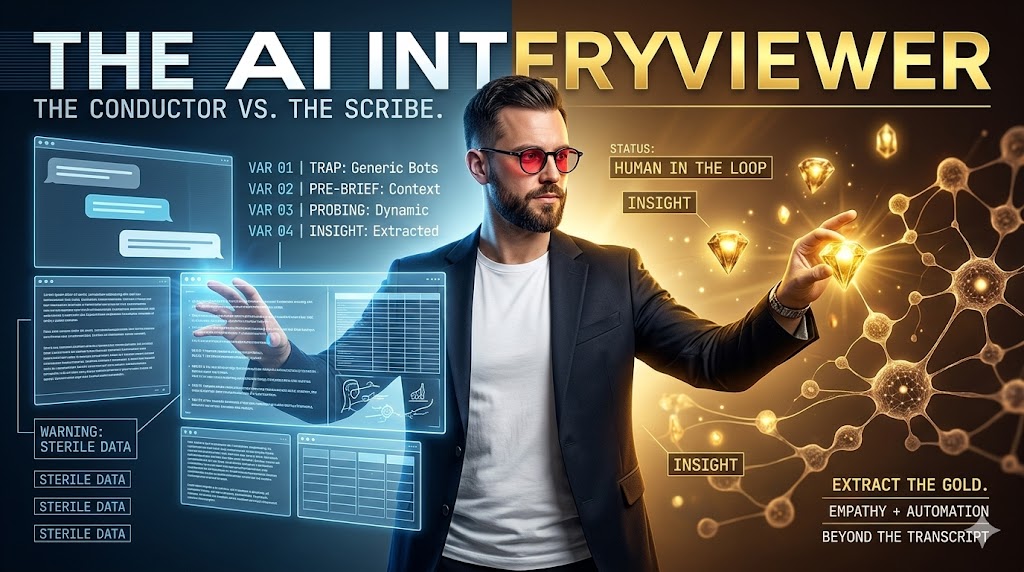
Real-Time Probing: How to Make AI a Dynamic Interviewer (Not Just a Scribe)
This part sucks sometimes. I’ve seen teams just hit ‘record’ on an AI tool and hope for the best. They think the AI will magically conduct a brilliant interview. That’s not an interview. That’s just automated transcription. Your AI becomes a passive note-taker if you don’t actively guide its follow-up questions. This is where most people fall short.
The real power of AI comes from its ability to react. You need to be in the loop. As the SME speaks, you can prompt the AI. Tell it to "ask for an example." Instruct it to "probe deeper into that specific challenge." Or even "summarize the last point and ask for clarification." This makes the AI a dynamic co-interviewer. It’s not just a scribe.
This active guidance is crucial. It allows you to explore tangents that a pre-programmed script might miss. It helps you clarify ambiguous statements in real-time. Without it, you’ll end up with a flat transcript. You’ll miss the nuances. You’ll miss the unexpected insights. Dynamic probing turns raw data into rich information.
I once had an SME mention a "weird workaround" they used. If I hadn’t told the AI to "explain that workaround in detail," I would have lost a valuable nugget. That’s the difference. You’re the conductor. The AI is your orchestra. Together, you create something meaningful. For more on AI SEO strategy, visit this guide.
Warning: Over-Reliance on AI
Critical mistake to avoid: Letting AI lead the entire interview without human intervention. This leads to superficial, unoriginal insights because the AI lacks the intuition to identify and pursue truly unique or unexpected avenues of discussion.
The "Human Touch" Myth: Why AI Won’t Replace Your Best Interviewers
Let’s be real. AI is amazing. But it won’t replace your best human interviewers. Not yet, anyway. The trap is relying solely on AI. If you do, you will miss non-verbal cues and emotional context. I once tried to automate an interview about a sensitive client issue. The AI missed all the subtle frustrations. It couldn’t pick up on the sighs or the pauses. It just processed words.
Humans bring empathy. We bring intuition. We can read between the lines. An AI can’t sense discomfort. It can’t build genuine rapport. These are critical elements for extracting truly unique and vulnerable insights. An SME might share a breakthrough idea only after feeling a connection. AI can’t replicate that connection.
So, here’s the contrarian view: AI is a powerful assistant. It’s not a human replacement. Use it for the heavy lifting. Use it for structured data. But keep a human in the loop for the delicate parts. For the moments that require true understanding. The best interviews blend AI efficiency with human empathy.
The failure condition here is simple: you’ll get sterile data if you remove the human element entirely. You’ll have facts, but no feeling. You’ll have information, but no wisdom. That’s a huge loss. Especially when dealing with experienced subject matter experts. They often communicate as much through their tone as their words.
Myth
AI can conduct a full, nuanced SME interview independently.
Reality
AI excels at structured questioning and data processing. However, it lacks the emotional intelligence, intuition, and adaptability of a human interviewer to build rapport, interpret non-verbal cues, or navigate sensitive topics effectively.
Extracting Gold: Turning Raw AI Transcripts into Actionable Insights
Okay, you’ve got your AI-assisted interview transcript. Now what? You’ll drown in data if you don’t have a clear post-interview analysis plan. After a 1-hour AI-assisted chat, I used to just have a wall of text. It was overwhelming. Finding the actual insights felt like digging for treasure without a map.
This is where AI shines again. Feed that raw transcript back into a different AI model. Ask it to summarize key themes. Tell it to identify recurring patterns. Instruct it to extract specific data points. You can even ask it to highlight contradictions or areas of uncertainty. This saves you hours of manual review. It helps you quickly pinpoint the most valuable information.
For example, I often ask the AI to "extract 5 unique insights about [topic] from this transcript." Then I follow up with "provide supporting quotes for each insight." This structured approach turns a messy transcript into actionable intelligence. It helps you identify the "gold nuggets" quickly. AI-powered analysis accelerates insight extraction.
The failure condition is simple: you’ll waste valuable time if you manually sift through every word. Use AI to do the grunt work. Then apply your human intelligence to interpret the findings. This combination is incredibly powerful. It ensures you don’t miss anything important. It also helps you prepare for your next steps. For more on AI SEO automation, check out Postlabs.
Ethical Minefields: Avoiding Bias and Protecting SME Trust
This is a big one. It’s easy to overlook. Your AI-driven insights become unreliable if you ignore data privacy and AI bias. We had a project where the AI started asking leading questions. It was based on previous, biased data it had been fed. Not good. The SME noticed. Trust was damaged. It’s a real risk.
AI models learn from data. If that data is biased, the AI will perpetuate that bias. This can lead to unfair or inaccurate insights. You need to be aware of your AI’s training data. Understand its limitations. Regularly audit its output for any signs of bias. This is not a "set it and forget it" situation. It requires constant vigilance.
Data privacy is another huge concern. SMEs share valuable, often proprietary, information. You must ensure that data is handled securely. Understand how your AI tool uses and stores information. Get explicit consent from your SMEs. Explain how their data will be used. Transparency builds trust. Protecting SME trust is paramount.
The failure condition here is losing credibility. If your AI produces biased results, or if you mishandle data, your entire project is compromised. It’s not just about technology. It’s about responsibility. Always prioritize ethical considerations. They are not optional. They are fundamental to successful AI-assisted interviewing.
"The greatest danger in the age of AI is not that machines will think like humans, but that humans will begin to think like machines."
— General Consensus, On AI Ethics
Scaling Your SME Outreach: From One-Off Chats to Scalable Income
Let’s talk about growth. Your AI interview process won’t scale if it’s a manual, one-off effort. I used to dread setting up each new SME interview. It felt like starting from scratch every time. This limits how many experts you can engage. It limits the insights you can gather. It also limits your potential for scalable income.
The beauty of AI is repeatability. Once you’ve refined your prompts and process, you can replicate it. Build a template for your pre-briefs. Create a standard set of initial questions. Develop a consistent post-interview analysis workflow. This turns a complex task into a streamlined operation. It makes it easy to onboard new SMEs.
Imagine interviewing dozens of experts in a fraction of the time. This broadens your perspective. It deepens your understanding of a market or topic. This rich data can then fuel recurring revenue streams. Think about premium reports, exclusive content, or specialized consulting. A repeatable AI process drives scalable income.
The failure condition is simple: you’ll hit a ceiling if your process isn’t systematized. You’ll be stuck doing one-off projects. You won’t leverage the full power of AI for growth. Use AI to build a machine. A machine that consistently extracts valuable insights. Then use those insights to create new opportunities. For scalable content solutions, check out Postlabs.
Beyond the Transcript: Using AI to Generate Content and SEO Assets
You’ve got the insights. Now, what do you do with them? You’re leaving value on the table if you only use AI for the interview itself. After an interview, I now feed the insights back into my content strategy. This is where the real magic happens. The SME’s unique perspective becomes the foundation for compelling content.
Use the AI to transform those insights. Ask it to draft blog post outlines. Generate FAQ sections. Create social media snippets. Even develop email newsletter content. The AI can take the raw data and format it for different platforms. This ensures your SME’s wisdom reaches a wider audience. It maximizes the return on your interview investment.
For example, if an SME talks about a common industry challenge, ask the AI to "write a 500-word blog post addressing this challenge, including 3 actionable tips." Then, review and refine it. This process is incredibly efficient. It turns interview data into valuable SEO assets. AI bridges insights to content creation.
The failure condition is simple: you’ll underutilize your data if you don’t repurpose it. Don’t let those unique insights sit in a document. Turn them into content that attracts and educates your audience. This boosts your authority. It drives traffic. It positions you as a leader in your niche. For mastering AI for SEO, check out this guide.
AI Interview Process Review (2026)
| Project/Item | Cost/Input | Result/Time | ROI/Verdict |
|---|---|---|---|
| SME Pre-Brief | 1 hour human | Focused AI questions | High efficiency gain |
| AI Interview | 1 hour AI run | Raw transcript | Fast data capture |
| Insight Extraction | 30 min human + AI | Actionable themes | Significant time save |
What I Would Do in 7 Days to Start AI-Assisted SME Interviews
- Day 1: Define Your Target. Clearly identify the SME profile and the exact insights you need.
- Day 2: Build Your Pre-Brief. Gather all relevant background info for your AI, including articles and project goals.
- Day 3: Craft Initial Prompts. Use an AI tool to generate 20-30 open-ended questions based on your brief.
- Day 4: Refine Questions. Manually review and improve the AI-generated questions, focusing on depth and uniqueness.
- Day 5: Conduct a Test Run. Interview a friendly SME or colleague using your AI setup to iron out kinks.
- Day 6: Analyze & Refine. Use AI to summarize the test transcript and identify areas for prompt improvement.
- Day 7: Plan Content Output. Outline how you’ll transform the insights into blog posts, FAQs, or other assets.
AI Interview Readiness Checklist
- Have you clearly defined the specific insights you aim to gather?
- Is your AI pre-brief comprehensive, including SME background and project context?
- Are your questions open-ended and designed to provoke unique responses?
- Do you have a plan for real-time human intervention during the AI interview?
- Have you considered potential biases in your AI model or data sources?
- Is your data privacy protocol clear and communicated to the SME?
- Do you have a structured process for AI-assisted transcript analysis?
- Is there a strategy to repurpose interview insights into valuable content?
Frequently Asked Questions About AI for SME Interviews
Can AI fully replace human interviewers for SMEs?
No, AI cannot fully replace human interviewers. It excels at structured data collection and efficiency. However, it lacks the emotional intelligence and intuition needed for complex, nuanced discussions or building genuine rapport.
How do I prevent AI from generating generic answers?
To prevent generic answers, provide the AI with a detailed pre-brief. Include specific context, the SME’s background, and clear project goals. Also, craft open-ended, challenging questions and actively guide the AI’s follow-up probes.
What are the main ethical concerns with AI-assisted SME interviews?
The main ethical concerns include data privacy, potential AI bias, and the risk of misinterpreting nuanced human communication. Always ensure data security, audit for bias, and maintain transparency with your SMEs about AI’s role.