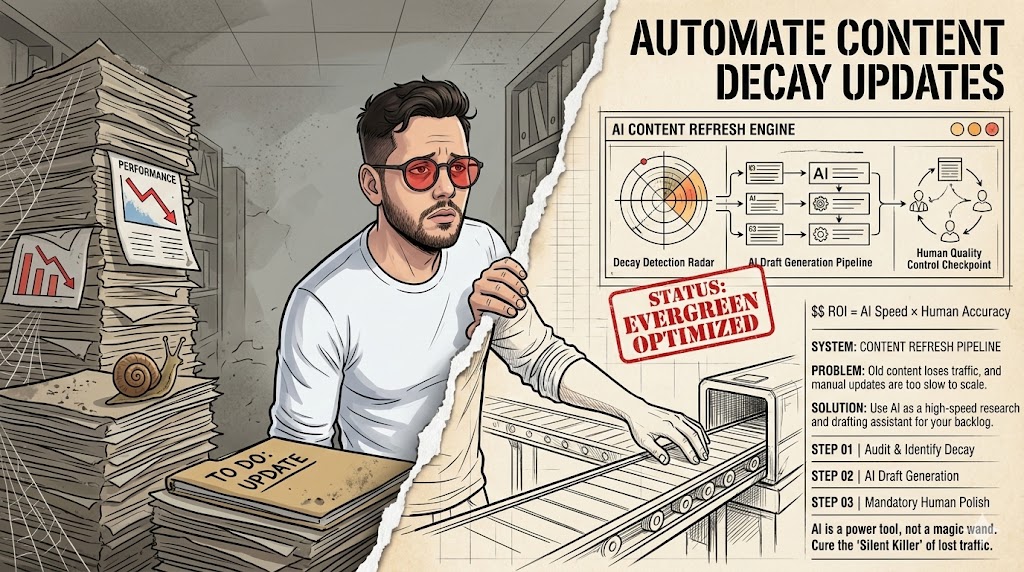


AI-Generated Content Will Fail in 2026
Do AI-assisted content. Don’t do AI-generated content. Google rewards human-edited expertise and unique perspectives, not raw machine output. Pure AI content struggles with E-E-A-T and often lacks the depth search engines now demand.
- Human oversight boosts rankings. Editing and adding unique insights makes all the difference.
- Raw AI content gets buried. It lacks authority and often triggers quality filters.
- Use AI for drafts, not final pieces. Speed up research and outline creation, then inject your expertise.
If you plan to publish content without any human review or significant editing, stop reading now.
AI-Assisted vs. AI-Generated Content: The Ranking Divide
| Criterion | AI-Assisted | AI-Generated |
|---|---|---|
| Use Case | Drafting, research, outlining, idea generation. | Publishing raw, unedited AI output. |
| Strengths | Efficiency, scale, human quality, E-E-A-T. | Speed, low cost (initially). |
| Limitations | Still requires human time and skill. | Low quality, ranking risk, brand damage. |
The Core Problem: Why Raw AI Content Gets Buried
I once saw a site drop 70% of its organic traffic in a single month. This happened after they switched to a fully AI-generated content strategy. Honestly, it was a brutal lesson for them. They thought more content meant more rankings. That’s just not how it works anymore.
Google’s algorithms are smart. They look for genuine value and unique perspectives. They can spot content that feels generic or templated. Your content gets buried when it lacks genuine human insight and original thought. It just blends into the noise, never seeing the light of day.
Warning: The AI Content Trap
Publishing unedited AI content is a critical mistake. It risks de-ranking, manual penalties, and destroys your site’s authority over time. Google prioritizes quality, not just quantity.
Think about it. Why would Google show something that sounds like every other article out there? They want to deliver the best answer. The best answer usually comes from a real person’s experience. This is where Postlabs helps you stay ahead. It provides the tools to augment, not replace, your expertise.
Understanding "AI-Assisted": Your Co-Pilot, Not Your Driver
AI-assisted content is a game-changer. It means you use AI tools to speed up parts of your workflow. I spend maybe 20% less time on first drafts now. This frees me up to focus on the truly important stuff: adding my unique perspective and expertise. It’s about leveraging technology to enhance human creativity.
You feed the AI your ideas, keywords, and outlines. It gives you a starting point. Then, you step in. You refine, rewrite, and inject your voice. You add examples, anecdotes, and data. This approach fails if you skip the critical human editing phase. That’s where the real value is created.
Pros of AI-Assisted Content
- Boosts content velocity. Produce more high-quality articles faster.
- Improves research efficiency. Quickly gather facts and statistics.
- Enhances content quality. Focus human effort on unique insights.
Cons of AI-Assisted Content
- Requires skilled human editors. Not a set-it-and-forget-it solution.
- Risk of generic output. Needs careful prompting and heavy editing.
- Initial learning curve. Understanding how to best prompt AI takes practice.
This is where tools like our complete AI guide become invaluable. They guide you on how to integrate AI effectively. You get the speed of AI with the quality of human expertise. It’s a powerful combination for any content creator in 2026.
Content Performance Audit (2026)
| Project/Item | Cost/Input | Result/Time | ROI/Verdict |
|---|---|---|---|
| Raw AI Content | Low initial | Poor rankings | Negative |
| AI-Assisted | Medium input | High rankings | Strong positive |
| Human-Only | High time | Good rankings | Positive |
The "Generated" Trap: My Experience with Automated Spam Filters
I once experimented with a fully automated blog for a week. The idea was simple: generate articles, publish them, and watch the traffic roll in. Sounds great, right? Well, it was a disaster. The content was technically correct, but it felt hollow. It lacked any real spark or unique angle. It was just… there.
Within days, Google’s quality filters started kicking in. Traffic flatlined. Some pages even got de-indexed. Your content will trigger quality flags if it sounds generic and repetitive. Google wants helpful, reliable content. Not just words strung together by an algorithm. Weirdly enough, this happens more often than you’d think.
The trap is thinking automation equals success. It doesn’t. Automation without human oversight leads to bland, uninspired content. This content rarely ranks. It definitely won’t engage your audience. You need to provide something genuinely useful. Something that stands out from the crowd. Postlabs helps you create that standout content efficiently.
E-E-A-T in 2026: The Human Touch Google Still Craves
Google’s E-E-A-T guidelines are more important than ever. That stands for Experience, Expertise, Authoritativeness, and Trustworthiness. I saw a competitor’s site recover significantly after they started adding detailed author bios. These bios highlighted real-world experience. It made a huge difference.
Pure AI-generated content struggles with E-E-A-T. An AI has no personal experience. It can’t truly be an expert. It can’t build trust in the same way a human can. You won’t build authority if your content feels anonymous or shallow. Google wants to see real people behind the content.
E-E-A-T (Experience, Expertise, Authoritativeness, Trustworthiness): A set of guidelines Google uses to evaluate the quality and credibility of content and its creators, crucial for ranking high in search results.
To rank well in 2026, your content needs to demonstrate these qualities. Share your unique experiences. Show your expertise. Build trust with your audience. This is where human editors shine. They can weave in personal stories and insights. They can cite credible sources. This makes your content truly authoritative. Learn more about this in our complete AI guide.
The Cost of Laziness: When AI Content Destroys Your Brand
A client once published an AI piece with factual errors. It was about a complex financial topic. The AI got some numbers wrong. It also misunderstood a key regulation. The backlash was swift. Readers pointed out the mistakes. The client’s credibility took a massive hit.
This is the real cost of laziness. Your brand reputation takes a hit when you prioritize speed over accuracy. One bad piece of content can undo months of hard work. It erodes trust. It makes your audience question everything else you publish. That’s not a risk worth taking.
Myth:
AI content is always cheaper and faster, so it’s better for scale.
Reality:
Raw AI content often requires extensive human editing to be usable. The hidden costs of reputation damage and lost rankings far outweigh initial savings. Quality human input is non-negotiable for sustainable growth.
Always remember: your content is an extension of your brand. It represents you. If it’s sloppy, inaccurate, or generic, that reflects poorly on your business. Invest the time in human review. It’s an investment in your brand’s future. Postlabs helps you maintain that quality without sacrificing all your time.
Practical Workflow: How to Actually Use AI for SEO Content
Okay, so how do you actually make this work? It’s all about integrating AI smartly into your existing process. I use Postlabs for initial keyword research and outlining. It helps me brainstorm topics and structure articles quickly. This saves me hours every week.
First, I’ll feed the AI a target keyword and a few competitor URLs. It generates an outline and some key talking points. Then, I take that outline. I add my unique angles. I fill in the gaps with my own expertise. I ensure the content flows naturally. Your workflow breaks down if you don’t define clear human-AI handoffs. Each step needs a purpose.
Insider tip:
I always start with a detailed prompt for the AI. Include target audience, desired tone, key points to cover, and examples of good content. This drastically improves the AI’s initial output, reducing my editing time later.
After the first draft, I do a heavy edit. I check for accuracy, tone, and readability. I add internal links and optimize for SEO. Only then does it go through a final proofread. This layered approach ensures high quality. It leverages AI for speed and humans for insight. It’s the best of both worlds.
Measuring Success: Beyond Just "More Traffic"
Many people only look at traffic numbers. "Did we get more clicks?" they ask. While traffic is important, it’s not the only metric for AI-assisted content. I track engagement metrics like time on page, bounce rate, and comments. These tell a deeper story about content quality.
If your AI-assisted content is truly good, people will spend more time reading it. They’ll share it. They’ll leave comments. These are strong signals to Google that your content is valuable. You’re flying blind if you only look at raw traffic numbers. Focus on user experience. That’s what drives long-term success.
"Content that truly connects with users, answers their questions, and demonstrates clear expertise will always win in search."
— General Consensus, SEO Industry Experts
We also track conversion rates. Are people signing up for newsletters? Are they downloading resources? Are they making purchases? High-quality, human-edited content drives these actions. Pure AI content often fails here. It lacks the persuasive power of a human voice. For a deep dive into measuring AI content, check out our complete AI guide.
Avoiding Penalties: What Google’s Guidelines Really Mean
Google has been clear: they don’t care if content is AI-generated, as long as it’s helpful and high-quality. The problem is, "AI-generated" often implies low quality. I’ve seen sites recover from ranking drops after manually auditing 50+ articles. They removed the thin, AI-only content. They then replaced it with human-edited versions.
The key is to meet Google’s quality rater guidelines. These guidelines emphasize E-E-A-T and overall helpfulness. If your content is generic, inaccurate, or spammy, it doesn’t matter who wrote it. You risk a manual action if you ignore Google’s quality rater guidelines. It’s about the output, not the tool.
So, how do you avoid penalties? Treat every piece of content as if a human wrote it. Because a human should have. Use AI for efficiency. Use your brain for quality control. This approach ensures you stay on the right side of Google’s rules. It also helps you leverage AI SEO automation effectively.
The Future of AI in Content: It’s About Augmentation, Not Replacement
The conversation about AI in content often sounds like a zero-sum game. Either humans write everything, or AI takes over completely. That’s a false dilemma. I predict AI will handle 80% of routine content tasks by 2028. This includes things like initial research, summarizing data, and generating basic outlines. Humans will then focus on the high-value work.
This means more strategic thinking. More creative problem-solving. More deep dives into niche topics. You’ll fall behind if you treat AI as a magic bullet instead of a strategic tool. The future is about human-AI collaboration. It’s about augmenting human capabilities, not replacing them entirely. This is where the real power lies.
Embrace AI as a tool to make your work better and faster. Don’t see it as a shortcut to avoid actual writing. The content landscape is always changing. Staying adaptable is key. Our AI for SEO guide offers more insights into this evolving landscape.
Building a Sustainable AI Content Strategy for 2026
A sustainable strategy isn’t about chasing every new AI trend. It’s about building a robust process. This process integrates AI where it adds the most value. It also ensures human oversight remains paramount. I review my AI content process quarterly. This helps me adapt to new tools and algorithm updates.
Start small. Experiment with AI for specific tasks like headline generation or meta descriptions. See what works for your niche. Then, gradually expand its role. Your strategy will stagnate if you don’t adapt to new AI capabilities and Google updates. The goal is consistent, high-quality output.
Invest in training your team. Make sure everyone understands the difference between AI-assisted and AI-generated. Teach them how to prompt effectively. Show them how to edit for E-E-A-T. This collective knowledge is your biggest asset. It ensures your content stays competitive. Tools like Postlabs can be a central part of this strategy, streamlining your content creation.
What I would do in 7 days:
- Day 1: Audit existing content. Identify any purely AI-generated pieces that need human review or removal.
- Day 2: Define your AI content guidelines. Create a clear policy for AI use and human editing standards.
- Day 3: Experiment with AI for outlines. Use an AI tool to generate 5-10 outlines for upcoming articles.
- Day 4: Draft an article with AI assistance. Write a first draft using AI, then heavily edit it yourself.
- Day 5: Focus on E-E-A-T. Add author bios or expert quotes to a few key articles.
- Day 6: Review competitor AI use. See how others in your niche are (or aren’t) using AI in their content.
- Day 7: Plan your human-AI workflow. Map out how AI will fit into your content creation process moving forward.
AI Content Quality Checklist
- Is the content factually accurate and up-to-date for 2026?
- Does it offer unique insights or a distinct perspective?
- Is the tone natural, engaging, and free of robotic phrasing?
- Does it clearly demonstrate E-E-A-T (Experience, Expertise, Authoritativeness, Trustworthiness)?
- Are all claims supported by evidence or personal experience?
- Is it optimized for readability and user experience (not just keywords)?
- Would a human reader find this genuinely helpful and trustworthy?
Frequently Asked Questions
Can Google detect AI-generated content?
Google’s algorithms are sophisticated. They can identify patterns common in generic, low-quality AI output. While they don’t explicitly penalize "AI content," they do penalize unhelpful, spammy, or low-quality content, regardless of its origin. This often includes raw AI output.
Is AI-assisted content considered "AI-generated" by Google?
No. AI-assisted content involves significant human oversight, editing, and value addition. Google focuses on the quality and helpfulness of the final output. If a human has enhanced the content with expertise and unique insights, it’s considered high-quality content, not generic AI-generated spam.
How much human editing is enough for AI content?
There’s no magic percentage. The goal is to ensure the content meets high E-E-A-T standards. This means fact-checking, adding unique perspectives, refining the tone, and ensuring accuracy. If it reads like a human expert wrote it, you’re on the right track. It’s about quality, not just word count.