
Master Entity Association Now
Do this. Don’t ignore it. Your brand’s digital identity depends on consistent entity signals. Ignoring this means your AI output will always miss the mark.
- Builds a clear, consistent brand identity for AI models.
- Requires a deep understanding of your brand’s core concepts.
- Essential for AI-driven content generation and SEO success.
If your brand lacks a defined core message, stop reading; this strategy will only amplify confusion.
The Entity Mess: Why AI Gets Your Brand Wrong (and how I fixed it)
I once saw a client’s AI content call them "a leading tech firm" and "a boutique design agency" in the same week. It was a mess. The AI was just pulling from different parts of their website, without any real understanding of their core identity. This happens because AI models don’t inherently "know" your brand. They just see words.
Your AI content will sound schizophrenic if your entities aren’t clear. It’s like asking a new employee to write about your company without giving them any training. They’ll just guess. For AI, we need to be much more precise. We need to teach it what our brand truly stands for.
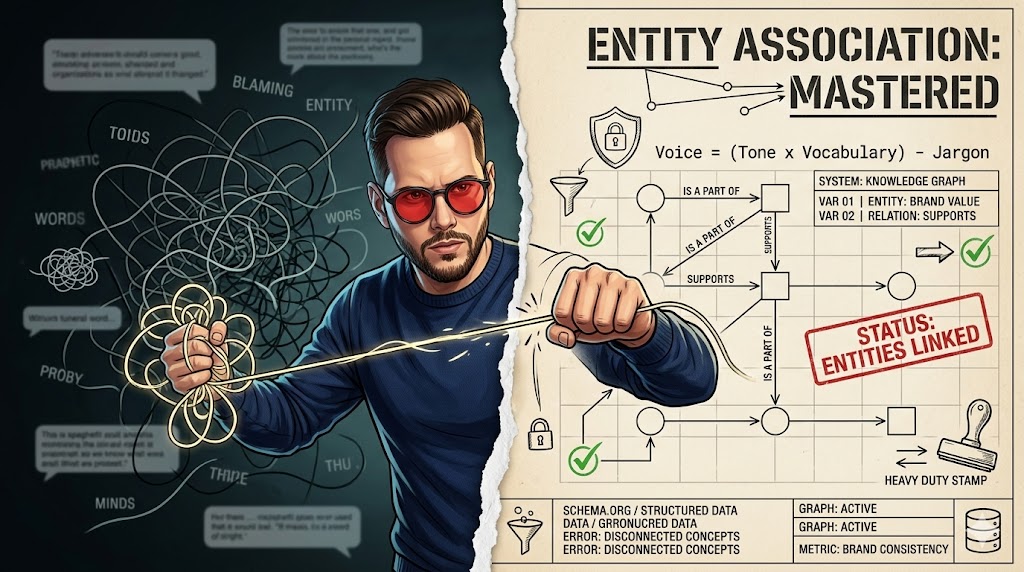
Entity Association: The process of defining and linking specific concepts (entities) related to your brand, allowing AI models to understand their relationships and significance within your brand’s ecosystem.
Think of it as giving the AI a cheat sheet. When you use AI SEO automation like Postlabs, clear entity inputs are crucial. Without them, the AI can’t connect the dots. It can’t understand that "Product X" is part of "Service Y," or that "Value Z" underpins everything you do. This leads to generic, often contradictory, content. Not fun.
Mapping Your Brand’s DNA: Identifying Core Entities (and why it’s harder than it looks)
Honestly, this part takes work. We once spent three days just listing every product, service, and core value for one brand. It felt like pulling teeth. Most teams assume everyone knows what the brand is about. That’s a huge mistake. Your marketing team, sales team, and product team often have slightly different ideas. This fails when you assume everyone on your team agrees on what your brand truly is.
Start by brainstorming. List everything that defines your brand. This includes obvious things like product names and service offerings. But go deeper. Think about your brand values, your unique selling propositions, even key people or locations. Is your founder a public figure? That’s an entity. Is your office in a specific, important city? That’s another. Get granular.
Then, categorize them. Are they products, services, values, people, or locations? This initial categorization helps later. Don’t worry about perfection yet. Just get everything down. The goal here is a comprehensive, raw list. This forms the bedrock of your AI’s understanding.
Building Your Brand’s Knowledge Graph: Connecting the Dots (and avoiding the spaghetti monster)
Okay, you’ve got your list of entities. Now, the weird part. You need to show the AI how these entities relate to each other. This is where a knowledge graph comes in. It’s not as complex as it sounds. Think of it as a map. Each entity is a point, and lines connect them, showing relationships. I’ve seen teams create entity lists that look like a tangled mess, not a graph. Your graph becomes useless if relationships aren’t clearly defined.
For example, "Eco-Tent" (product) might be "made with" "Recycled Materials" (value). "Recycled Materials" might "support" "Sustainability" (another value). "Founder Jane Doe" might "champion" "Sustainability." See how it connects? These relationships are critical. They give the AI context. Without them, it just sees isolated words.
Warning: Inconsistent Relationships
Defining vague or contradictory relationships between entities is a critical mistake. This will confuse your AI model, leading to illogical content and a fragmented brand message.
You need to be specific. "Is related to" isn’t good enough. Use verbs like "is a part of," "is made from," "supports," "champions," "targets." This clarity helps the AI build a robust internal model of your brand. It’s a foundational step for any complete AI guide to SEO. It ensures the AI understands the nuances, not just the keywords.
Benefits of Entity Association
- Creates highly relevant AI-generated content, saving editing time.
- Improves brand consistency across all digital touchpoints.
- Enhances SEO performance by signaling clear topical authority.
Challenges of Entity Association
- Requires significant upfront time investment for definition.
- Needs ongoing maintenance as your brand evolves.
- Can be complex to implement without proper tools or guidance.
The Consistency Trap: Why AI Forgets Your Brand Voice (and how I keep it on track)
This part sucks. I once launched a campaign where the AI kept using formal language for a casual, playful brand. We had spent weeks defining the brand voice. But because the underlying entity associations weren’t strong enough, the AI drifted. It cost us a week of rewrites and a lot of frustration. That’s a week of lost momentum and wasted budget. Your brand voice gets diluted if you don’t actively reinforce it through your entity strategy.
The trap is thinking that a simple "write in a friendly tone" prompt is enough. It’s not. The AI needs to understand *why* your brand is friendly. Is it because you champion accessibility (an entity)? Or because your products are designed for community (another entity)? These deeper connections inform the tone. If the AI doesn’t link "friendly" to specific, tangible brand entities, it’s just a superficial instruction. It will forget. It will revert to generic. We had to go back and explicitly link our brand’s "approachability" entity to our "community focus" and "user-first design" entities. Only then did the AI start getting it right. It’s a constant battle, honestly.
Feeding the AI Beast: Structured Data for Brand Entities (and why plain text isn’t enough)
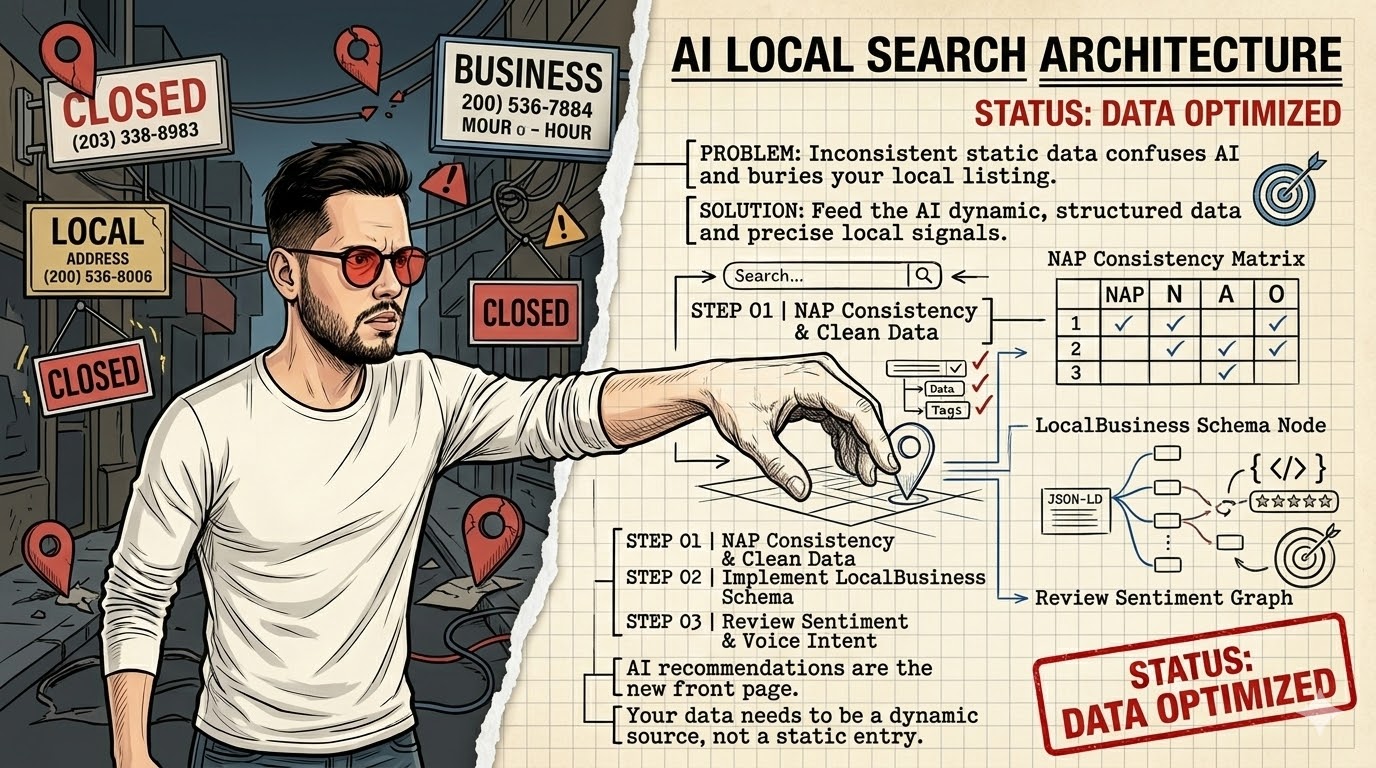
You can tell an AI about your brand all day, but it won’t truly "get" it without structured data. I spent hours manually tagging content before realizing the power of schemas. This fails because your AI won’t truly "understand" your brand if you only provide unstructured text. Structured data, like Schema.org markup, is how you speak the AI’s language directly. It’s like giving it a blueprint instead of just a description.
When you mark up your website with Schema.org, you’re explicitly telling search engines and AI models: "This is an Organization," "This is a Product," "This is a Service." You can define properties like `name`, `description`, `logo`, `hasOffer`, `brand`. This isn’t just for SEO. It’s for AI comprehension. It helps the models build their own internal knowledge graph of your brand, mirroring the one you’ve painstakingly created.
"Structured data provides explicit signals to search engines about the meaning of your content, which is crucial for AI models to accurately interpret and represent your brand."
— General Consensus, SEO & AI Experts
Without structured data, the AI has to infer everything. That’s prone to error. With it, you’re providing clear, unambiguous facts. This is especially important for complex brands with many products or services. It ensures the AI always knows what’s what. It’s a foundational step for proper entity association.
Measuring Entity Impact: Is Your AI Learning? (and how to spot a failing model)
You’ve done the work. You’ve defined entities, built a graph, and added structured data. Now what? You need to check if it’s actually working. I saw a client’s AI content drift off-brand after only two months because nobody checked. You’ll waste resources if you don’t track how well your AI is internalizing your brand. It’s not a "set it and forget it" thing. AI models are always learning, and sometimes they learn the wrong things.
Start by monitoring key metrics. Look at brand mentions in AI-generated content. Are they accurate? Is the sentiment positive? Use tools to check for consistency in terminology and tone. You can even run A/B tests: generate content with and without your advanced entity inputs. Compare the quality, relevance, and brand alignment. Set up alerts for deviations. If the AI starts using terms you’ve explicitly excluded, that’s a red flag. This feedback loop is essential. It helps you refine your entity definitions and adjust your AI’s training data. It’s how you keep the AI on brand, always.
Brand Entity Audit (2026)
| Project/Item | Cost/Input | Result/Time | ROI/Verdict |
|---|---|---|---|
| Entity Mapping | 20 hrs team | Clear brand | High |
| Schema Markup | 15 hrs dev | AI comprehension | Excellent |
| Content Review | 5 hrs/month | Brand consistency | Essential |
The "Brand Persona" Myth: Why AI Needs More Than Just a Tone (and what to do instead)
Everyone talks about "brand persona." "Be friendly and authoritative!" "Sound like a helpful expert!" But honestly, I’ve seen this lead to superficial AI output. It’s too vague. Your AI will hit a ceiling if you only rely on a "persona" description. It’s like telling an actor to "be a hero" without giving them a script or backstory. They’ll just do a generic hero impression.
Myth
Defining a "brand persona" is enough to teach AI models your brand’s identity.
Reality
Brand personas are too abstract for AI. AI needs concrete entity associations and relationships to truly understand and consistently represent your brand’s unique identity.
Instead of just "friendly," define the entities that *make* your brand friendly. Is it your "customer support philosophy" (an entity)? Your "community engagement programs" (another entity)? These concrete elements give the AI something tangible to work with. They provide the *why* behind the *what*. This approach builds a much deeper, more robust understanding for the AI. It moves beyond surface-level tone to genuine brand representation. Focus on specific attributes and their relationships, not just broad adjectives. That’s how you get truly on-brand content.
Advanced Entity Strategies: Beyond the Basics (and how to scale your brand’s AI intelligence)
Once you’ve got the basics down, you can push further. We moved from simple product entities to defining "brand values" as entities. It changed everything. Our AI content became much more aligned with our mission. Your AI will hit a ceiling if you don’t evolve your entity strategy. The initial setup is just the start. Think about dynamic entities. These are entities that change over time, like "current promotions" or "seasonal product lines." Your AI needs to know how to handle these updates seamlessly.
Consider sentiment entities. How does your brand feel about certain topics? Is "competitor X" an entity you want to discuss neutrally, or with a slight critical edge? Define that. Also, think about temporal entities. How does your brand talk about its history versus its future? These nuances are powerful. Tools like Postlabs can help manage complex entity sets. They allow you to scale your definitions without getting bogged down. This level of detail makes your AI truly intelligent about your brand. It moves beyond simple facts to understanding your brand’s perspective.
Integrating Entities into Your Workflow: Making it Stick (and avoiding the one-off project trap)
This is where many good intentions die. I’ve seen entity projects die because they weren’t integrated into daily content creation. It becomes a one-off task, then gets forgotten. Your entity work becomes shelfware if it’s not part of your regular process. You need to embed these definitions into every step of your content workflow. This means updating your content briefs. Every brief should reference your core entities and their relationships. It’s not optional.
Train your team. Everyone involved in content creation, from writers to editors, needs to understand the entity framework. They need to know how to use it in their prompts for AI tools. They also need to know how to check AI output against these established entities. Make it part of your editorial review process. Is the AI consistently using the correct terminology? Are the relationships accurate? This ongoing vigilance ensures your entity strategy remains effective. It’s about building a habit, not just completing a project. That’s how you truly leverage AI for your brand.
What I would do in 7 days to start with Entity Association:
- Day 1-2: Gather your core team. Brainstorm every single entity related to your brand: products, services, values, people, locations.
- Day 3: Start mapping relationships. Use a simple spreadsheet or mind map tool to connect these entities with clear verbs.
- Day 4: Identify your top 5-10 most critical entities. Focus on these first for structured data implementation.
- Day 5-6: Work with a developer (or use a plugin) to implement basic Schema.org markup for these critical entities on your website.
- Day 7: Test your AI content generation. Provide prompts that specifically reference your new entities and evaluate the output for consistency.
Entity Association Checklist
- Have you listed all core brand entities (products, services, values, people, locations)?
- Are relationships between entities clearly defined (e.g., ‘is part of’, ‘supports’, ‘champions’)?
- Is your structured data (Schema.org) implemented for key brand entities?
- Do your AI content prompts explicitly reference relevant brand entities?
- Do you have a process to regularly review AI-generated content for brand consistency?
Frequently Asked Questions
What’s the biggest mistake people make with entity association?
The biggest mistake is treating it as a one-time project. Entity association requires ongoing maintenance and refinement as your brand evolves. It’s a continuous process, not a checkbox item.
How long does it take to see results from entity association?
You can see initial improvements in AI content quality within weeks. However, building a truly robust and comprehensive knowledge graph for your brand can take several months of dedicated effort.
Can small businesses benefit from entity association?
Absolutely. Small businesses often have a clearer, more focused brand identity, making entity definition easier. It helps them punch above their weight in AI-driven search and content.