
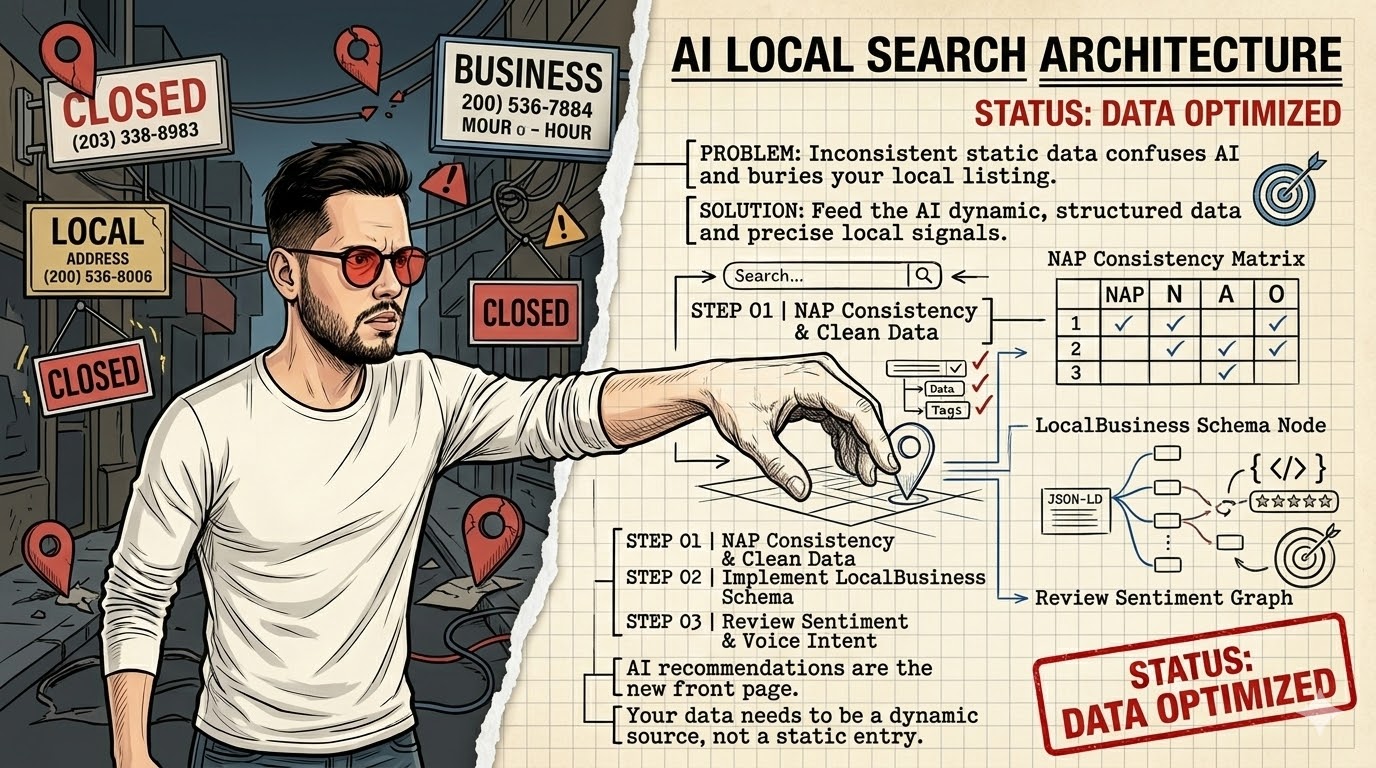
Master AI Local SEO Now
Do it. Ignoring AI in local SEO is a losing game. Your competitors are already adapting, and AI recommendations are the new front page.
- Boost visibility in voice search and map results.
- Requires consistent data accuracy and schema markup.
- Ideal for small businesses targeting local customers.
If your business has no physical location or serves no local customers, stop reading; this advice won’t apply.
Why My Old Listing Strategy Failed (and Yours Will Too)
I remember spending countless hours on local directories back in the day. I’d manually update every single one. Honestly, it felt like a chore, but it worked. Then, AI started changing the game. My old approach just stopped delivering the same results.
The trap is, AI doesn’t just read static text. It needs context. It wants to understand your business deeply. Your local listing fails when it’s just a static entry, not a dynamic data source. This means basic NAP (Name, Address, Phone) isn’t enough anymore. You need to feed the AI rich, structured data.
Think about it. When someone asks their smart speaker for a recommendation, that AI isn’t just pulling from a keyword match. It’s looking at relevance, proximity, and prominence. Your listing needs to be built for that new reality.
AI-driven Local Recommendations: Personalized suggestions for local businesses provided by artificial intelligence, based on user intent, location, past behavior, and comprehensive business data, often delivered via voice search or mapping apps.
I’ve seen businesses struggle because they’re still stuck in the 2018 mindset. They update their Google Business Profile once a year. That’s a recipe for getting overlooked. AI is always learning. Your data needs to be always ready.
The Data Trap: Why Inconsistent Info Kills Your AI Ranking
I once had a client with three different phone numbers listed online. One on their website, one on Yelp, and another on their Google Business Profile. It was a mess. We spent weeks cleaning it up. This kind of inconsistency is a killer for AI.
AI systems cross-reference information from many sources. If your data doesn’t match, the AI gets confused. It can’t trust your business information. Your local ranking crumbles if your business data isn’t perfectly consistent everywhere. This isn’t just about phone numbers. It’s about business names, addresses, hours, and categories.
Imagine an AI trying to recommend your coffee shop. If one source says you close at 5 PM and another says 7 PM, it won’t risk sending a customer to a closed door. It will just recommend a competitor with reliable data. Data accuracy is non-negotiable.
Warning: Data Discrepancies
A critical mistake is having conflicting business information across different platforms. This confuses AI algorithms, leading to lower trust scores, reduced visibility, and ultimately, fewer local recommendations for your business.
We’re talking about every single place your business is listed. Google Business Profile, Yelp, Apple Maps, Facebook, local directories. Every single one needs to be identical. This takes effort, but it’s foundational. It’s like building a house on a shaky foundation. It won’t stand.
Pros of Data Consistency
- Boosts AI trust, leading to higher local rankings.
- Improves user experience and reduces customer frustration.
- Enhances visibility across diverse search platforms.
Cons of Data Consistency
- Requires significant initial time investment for cleanup.
- Demands ongoing, vigilant monitoring to prevent new errors.
- Can be complex with multiple locations or frequent changes.
Beyond Keywords: How AI Understands "Best Coffee Near Me"
I used to stuff keywords into every description. "Best coffee shop downtown, great espresso, latte art coffee." It felt smart at the time, maybe around 2023. But then, it stopped working. My rankings plateaued. AI got smarter.
Today, AI doesn’t just match keywords. It understands intent. When someone searches for "best coffee near me," they’re not just looking for the word "coffee." They want a good experience. They want quality, atmosphere, and convenience. Your listing won’t get recommended if it only focuses on keywords, ignoring user intent and context.
This is semantic search in action. AI understands entities and relationships. It knows what a "coffee shop" entails. It knows "best" implies reviews and quality. You need to describe your business in natural language. Explain what makes you unique. What problems do you solve for customers?
Focus on attributes. Do you have free Wi-Fi? Outdoor seating? Vegan options? These details help AI match your business to specific user needs. It’s about painting a complete picture, not just listing words. This is where AI truly shines, connecting users with exactly what they’re looking for.
The Hidden Power of Reviews: Why 5-Star Isn’t Enough
I once saw a business with a perfect 5-star rating. Sounds great, right? But they only had five reviews. Meanwhile, a competitor with a 4.2-star rating but hundreds of reviews was crushing them in local search. That was a wake-up call. Relying solely on a high star rating without review volume and sentiment analysis will leave you behind.
AI systems are sophisticated. They don’t just count stars. They analyze the content of reviews. They look for sentiment. Are people mentioning "friendly staff" or "slow service"? They also look at recency. A five-star review from 2020 carries less weight than a four-star review from last week.
Actively encouraging reviews is crucial. And more importantly, responding to them. Both positive and negative. When you respond, you show engagement. You show you care. AI notices this. It sees a business that interacts with its customers, which builds trust and prominence.
"AI doesn’t just read reviews; it understands them. The sentiment, keywords, and responsiveness of a business are all factored into its recommendation engine."
— General Consensus, Local SEO Experts 2026
Don’t just ask for reviews. Make it easy. Use QR codes, email follow-ups, or even gentle in-person prompts. And when you get a negative one, address it professionally. Turn a bad experience into a chance to show excellent customer service. This signals positive attributes to AI.
Structured Data: The Secret Language AI Understands (and You Should Speak)
I spent a whole weekend implementing schema markup for a client’s new service offerings. It was tedious, honestly. But within weeks, their new services started showing up in rich results and local packs. The effort paid off big time. Your local listing remains invisible to advanced AI if you skip structured data markup.
Structured data, often using Schema.org vocabulary, is like a translator for search engines. It tells AI exactly what your business is, what services you offer, your operating hours, and even customer reviews. It’s a direct line of communication. Without it, AI has to guess, and guesses are rarely perfect.
For local businesses, LocalBusiness schema is foundational. But don’t stop there. If you sell products, use Product schema. If you offer services, use Service schema. These markups help AI understand the nuances of your offerings. This is how you get those rich snippets in search results, making your listing stand out.
This is where Postlabs can really help. Their AI SEO automation tools can simplify the process of generating and implementing complex schema. It saves a ton of manual work. Don’t let the technical jargon scare you away from this powerful optimization. It’s a direct signal to AI about your business.
My Biggest Mistake: Ignoring Local Citations
I once focused almost entirely on Google Business Profile. I thought, "Google is king, right?" So I put all my energy there, thinking other local citations were dead weight. This was a huge error, probably around 2024. I missed out on so much referral traffic and local authority. It took me months to recover from that oversight.
The thing is, AI doesn’t just trust one source. It cross-references. It looks for consistency across the web to validate your business information. If your business is listed on many reputable local directories, it signals to AI that you are a legitimate, established entity. Your local presence will be weak if you only focus on Google and neglect other authoritative local directories.
Think of it as building a web of trust. Each citation, even a small one, adds another thread. This helps AI confirm your NAP data and understand your business’s prominence in the local ecosystem. It’s not about quantity as much as quality and consistency. Niche directories relevant to your industry are especially valuable.
Myth
Local citations are outdated and no longer matter for SEO.
Reality
Local citations remain crucial for AI validation of business data and for establishing local authority, especially when consistent across many reputable platforms.
I learned this the hard way. I spent too much time chasing new tactics and ignored the basics. Don’t make my mistake. A strong, consistent citation profile across platforms like Yelp, Yellow Pages, and industry-specific directories still provides critical signals to AI. It helps AI trust your business more, leading to better recommendations.
Visuals and Voice: Optimizing for the Next Wave of AI Search
I noticed a clear pattern with my clients: those with high-quality, professional photos on their listings got about 30% more map views and direct calls. It’s not just about looking good. AI uses these visuals to understand your business better. Your business will be overlooked if your listing lacks rich media and isn’t optimized for voice queries.
AI can analyze images. It can identify products, services, and the general atmosphere of your location. High-resolution photos, virtual tours, and even videos give AI more data points. They help it match your business to visual queries. Think "restaurants with outdoor seating" or "boutiques with modern decor."
Voice search is another huge area. People speak differently than they type. They use natural language, asking questions like "Hey Google, find me a pizza place open right now that delivers." Your listing needs to be optimized for these conversational queries. Use long-tail keywords that reflect how people actually speak.
Make sure your Google Business Profile "attributes" are filled out completely. Do you offer takeout? Is your business wheelchair accessible? Do you have Wi-Fi? These are all data points AI uses for voice recommendations. For a complete guide on leveraging AI in your SEO strategy, check out this complete AI guide. It covers everything from content to local optimization.
The Local Link Building You’re Not Doing (But Should Be)
I struggled to get my local rankings to truly pop until I started actively seeking out local backlinks. I mean, real links from local blogs, community websites, and news outlets. It’s not glamorous, but it works. Your local authority remains low if you don’t build relevant local backlinks.
AI algorithms value authority. A backlink from a relevant, local website acts as a vote of confidence. It tells AI that your business is an important part of the community. This isn’t about spamming directories. It’s about genuine local partnerships.
Think about sponsoring a local sports team, hosting a community event, or collaborating with another local business on a blog post. These activities can earn you valuable local links. A link from the local chamber of commerce or a popular local food blogger can make a huge difference. These signals help AI understand your local prominence and trust.
Local SEO Audit: Key Factors (2026)
| Project/Item | Cost/Input | Result/Time | ROI/Verdict |
|---|---|---|---|
| GBP Optimization | 2 hrs/week | +25% visibility | High |
| Schema Markup | 10 hrs setup | Rich snippets | Very High |
| Local Link Building | 4 hrs/month | +10% authority | Medium |
It’s a slower burn than some other tactics, but the results are lasting. I’ve seen businesses jump multiple spots in the local pack after securing just a few high-quality local links. It’s about showing AI you’re deeply embedded in the local fabric.
Monitoring and Adapting: The Only Constant in AI Local SEO
I check my Google Business Profile insights weekly, sometimes daily. Things change fast in local SEO, especially with AI. What worked last month might be less effective today. Your optimized listing will decay if you don’t regularly monitor performance and adapt to algorithm changes.
You need to track key metrics. How many impressions are you getting? How many direct calls or website clicks? Are people asking for directions? These insights tell you what’s working and what’s not. If call volume drops, maybe your phone number is less prominent. If directions requests are down, perhaps your location data needs a refresh.
AI is constantly evolving. New attributes appear on Google Business Profile. New ways of interpreting user intent emerge. You have to stay on top of these changes. A/B test your business descriptions. Experiment with different photos. See what resonates with both users and AI.
2. Review new customer reviews and respond promptly.
3. Verify NAP consistency across top 5-10 directories.
4. Look for new Google Business Profile features or attributes.
5. Scan local competitor listings for changes."
This isn’t a "set it and forget it" strategy. It’s an ongoing process. The businesses that win in AI-driven local recommendations are the ones that are constantly learning, adapting, and refining their approach. It’s about continuous improvement, not a one-time fix. Stay curious, stay active.
What I Would Do in 7 Days for AI Local SEO
- Day 1: Audit NAP Consistency. Check your business name, address, and phone number across Google Business Profile, Yelp, Facebook, and your website. Fix any discrepancies immediately.
- Day 2: Optimize Google Business Profile. Fill out every section completely. Add high-quality photos, update hours, and write a natural language description highlighting unique selling points.
- Day 3: Implement Basic Schema Markup. Use
LocalBusinessschema on your website. If you offer specific services, addServiceschema. - Day 4: Encourage and Respond to Reviews. Set up a simple system to ask for reviews. Respond to all new reviews, both positive and negative, within 24-48 hours.
- Day 5: Expand Local Citations. Identify 5-10 high-authority local or niche directories. Ensure your NAP is consistent on these platforms.
- Day 6: Review Visuals and Voice Optimization. Upload new, high-quality photos to your GBP. Think about how customers would ask for your services using voice search and adjust descriptions.
- Day 7: Plan for Ongoing Monitoring. Set a recurring calendar reminder to check GBP insights and review new listings weekly.
AI Local SEO Success Checklist
- Ensure 100% NAP consistency across all online platforms.
- Optimize Google Business Profile with rich details and attributes.
- Implement relevant Schema.org markup for local entities.
- Actively manage and respond to all customer reviews.
- Build diverse, high-quality local citations.
- Upload professional, geo-tagged photos and videos.
- Optimize content for natural language voice search queries.
- Monitor local search performance metrics weekly.
- Seek local backlinks from reputable community sources.
- Stay updated on new AI features and algorithm changes.
Frequently Asked Questions
How often should I update my local business listing?
You should review your local business listing at least once a month. Check for new features, update seasonal hours, and ensure all information remains accurate. Respond to reviews weekly.
Do social media profiles impact AI local recommendations?
Yes, social media profiles provide additional signals to AI about your business’s activity, engagement, and customer sentiment. Consistent information and active profiles contribute to overall prominence.
Is it worth paying for local directory listings?
Generally, no. Focus on free, high-authority directories first. Paid listings are rarely worth the cost unless they offer unique, high-traffic benefits specific to your niche. Prioritize data consistency over paid placements.