
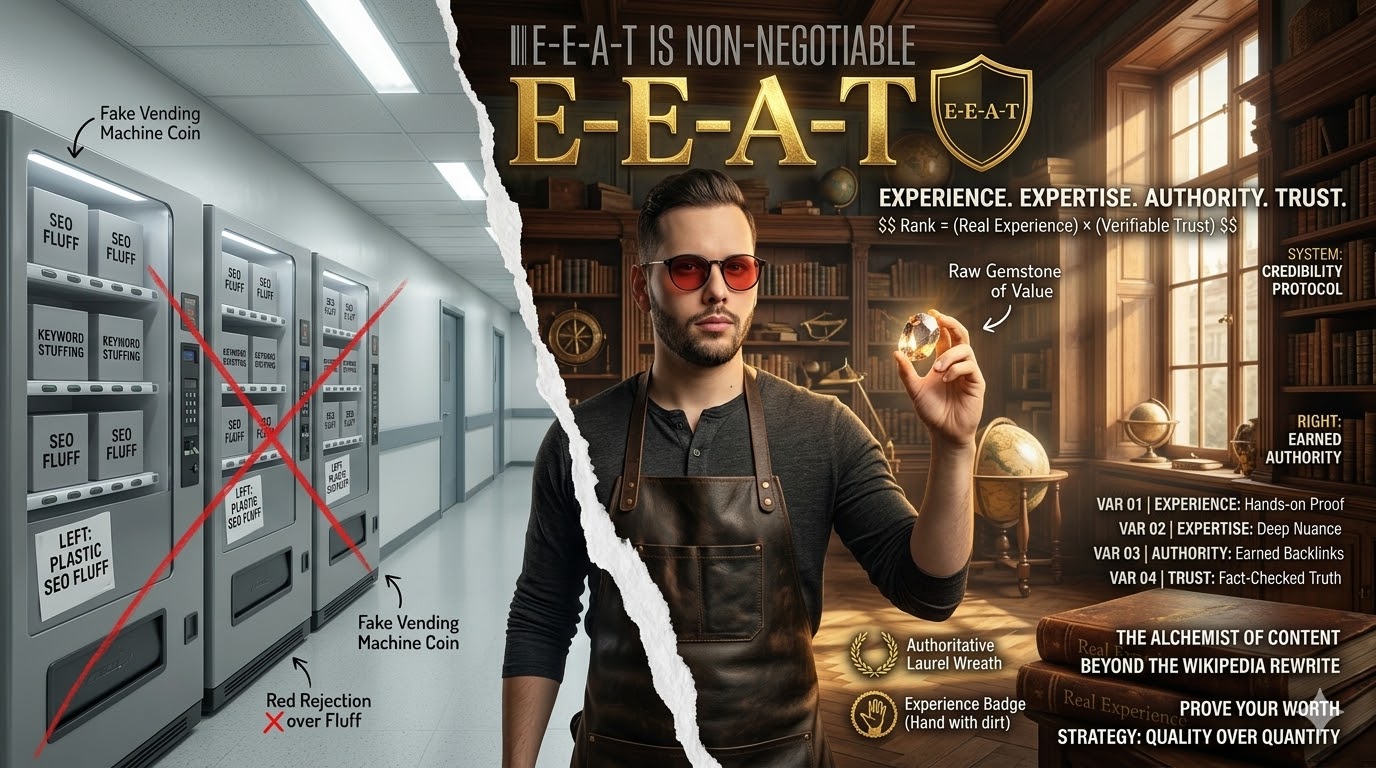
E-E-A-T is Non-Negotiable
This is worth it. Ignoring E-E-A-T is a death sentence for content visibility and trust in 2026. You’ll simply vanish from search results.
- Builds undeniable authority and audience loyalty.
- Requires consistent effort and genuine real-world input.
- Essential for competitive niches and long-term organic success.
Look, the game changed. If you’re still writing SEO content like it’s 2018, you’re in for a rude awakening. Google’s E-E-A-T guidelines aren’t just some academic concept anymore. They’re the absolute bedrock for ranking, especially in competitive or sensitive niches. It’s about proving you’re not just a keyword-stuffing robot, but a credible source. And yeah, most tools won’t magically give you E-E-A-T. They can only support it.
How we fact-checked this answer
Our Promise: We deliver objective, fact-based, and deeply researched answers to your questions without hallucination.
If you’re still chasing keyword stuffing, stop reading now; this won’t help you.
Want to see if you’re already ahead of the curve? Take this quick quiz:
Which E-E-A-T factor is most often overlooked by new SEO writers?
The E-E-A-T Evolution: Why Your Old SEO Playbook is Bullshit
I remember back in 2018, you could rank with pretty thin content. Seriously, if you hit the right keywords, you were golden. Those days are long gone, thank God. Google’s shift from E-A-T to E-E-A-T added ‘Experience’ for a damn good reason. They want to see that you’ve actually done the thing you’re writing about, not just read about it.
This isn’t just semantics. It’s a fundamental change in how content is evaluated. Your content will tank if it lacks genuine depth and verifiable authority. Google’s algorithms are getting smarter. They can sniff out generic, rehashed content from a mile away. You need to provide unique insights that only come from actually being in the trenches.
Think about it: would you trust a review of a new car from someone who’s only read the spec sheet, or from a mechanic who’s actually driven it and taken it apart? Exactly. That’s the ‘Experience’ factor in action. Understanding the core principles of effective SEO content writing is more critical than ever.
E-E-A-T: Stands for Experience, Expertise, Authoritativeness, and Trustworthiness. It’s Google’s framework for evaluating content quality and creator credibility, emphasizing real-world application.
Experience: The Unsung Hero (and Why Most Tools Miss It)
This is where most SEO writers screw up. They think ‘research’ means reading the top five articles on the SERP and mashing them together. I once spent 40 hours writing about a complex project management tool I’d never actually touched. The result? It was technically accurate but utterly devoid of practical insight. It felt flat, and it never really ranked well.
Experience is about showing, not just telling. It’s about the little details: the specific bug you hit, the weird workaround you found, the exact time it took to set something up. Tools can’t give you this. They can’t simulate the frustration of a bad user interface or the satisfaction of solving a real problem. You’ll just churn out generic garbage if you don’t have real-world experience.
So, how do you inject experience? Get your hands dirty. Use the products, try the strategies, interview people who have. Document your journey. Share screenshots of your actual process, not stock photos. This is how you build content that truly resonates and stands out from the AI-generated crap flooding the internet.
Here’s a prompt I use to guide my content outlines, forcing me to think about experience:
Expertise: Beyond the Wikipedia Rewrite
Expertise is more than just knowing facts; it’s understanding the nuances, the ‘why’ behind the ‘what’. I’ve seen so many articles that just rehash the top 3 SERP results, adding nothing new to the conversation. That’s not expertise; that’s regurgitation. Your content will never stand out if it just echoes what’s already out there.
To demonstrate expertise, you need to go deeper. This means citing original research, offering unique perspectives, or even challenging common assumptions with well-reasoned arguments. It’s about showing you’ve thought critically about the topic, not just summarized it. This often involves spending extra hours digging into studies or conducting mini-experiments.
For example, instead of just listing features of a CRM, an expert might discuss how those features impact sales team psychology or integrate with specific legacy systems. That’s the level of depth Google is looking for. It’s a pain, but it’s what separates the pros from the amateurs.
Pros of High E-E-A-T
- Builds long-term audience loyalty and trust.
- Attracts high-quality backlinks naturally.
- Positions you as an undeniable industry leader.
Cons of Building E-E-A-T
- Requires significant, ongoing research time.
- Can be hard to scale quickly across many topics.
- Demands continuous learning and practical application.
Authoritativeness: Earning Your Stripes (Not Just Buying Them)
Authoritativeness is about how others perceive your expertise. It’s not something you can fake with a few cheap backlinks. I saw a site buy 50 guest posts last year, all from low-quality, irrelevant domains. Their rankings barely budged, and they ended up with a manual penalty. Your authority signals will look fake if they aren’t backed by genuine value.
True authoritativeness comes from being recognized by other credible sources. This means earning high-quality backlinks from reputable sites, getting mentioned in industry publications, or having your work cited by other experts. It’s a slow burn, but it’s the only way to build lasting authority. Tools can help you identify these opportunities, but they can’t do the outreach for you.
Focus on creating content so good, so insightful, that others *want* to link to it. Participate in industry discussions, offer expert commentary, and build a network. This organic growth is what Google truly values. Anything less is just a waste of time and money, frankly.
Warning: Fake Authority Kills
Don’t chase spammy backlinks or paid mentions. Google’s algorithms are too smart now; this will lead to penalties and a destroyed reputation. It’s total crap, and it never works long-term.
Trustworthiness: The Foundation Nobody Talks About Enough
Trustworthiness is the glue that holds E-E-A-T together. It’s about the overall reliability and safety of your site and content. I once worked with a client who had broken internal links, outdated statistics everywhere, and a flaky SSL certificate. Users bounced like crazy, and their rankings suffered. Users will bounce faster than a rubber ball if your site feels shady or unreliable.
This means ensuring your site is secure (HTTPS is non-negotiable), your information is accurate and up-to-date, and your author bios are clear and transparent. If you make a claim, back it up. If you have an opinion, state it as such. Disclose affiliations. It sounds basic, but so many sites overlook these fundamentals. This part absolutely sucks to audit, but it’s critical.
A trustworthy site also means a good user experience. Fast loading times, clear navigation, and a professional design all contribute to a sense of reliability. Google wants to send users to sites they can trust, not some fly-by-night operation. This is often the easiest E-E-A-T factor to fix, yet it’s frequently ignored. Total crap.
The Brutal Truth
AI Tools: The Double-Edged Sword for E-E-A-T
Okay, quick detour. Everyone’s hyped about AI tools for content, right? I once relied too heavily on an AI tool to draft a complex technical guide. I figured it would save me a ton of time. The AI pulled facts, structured paragraphs, and even tried to sound authoritative. But when I read it, it was bland, generic, and frankly, a bit boring. It lacked any real spark or unique perspective. It was technically correct, but completely untrustworthy because it offered no real ‘experience’.
The problem? AI can’t *have* experience. It can’t feel frustration, discover a clever workaround, or share a personal anecdote. It can only process and rephrase existing data. So, while it can help with outlines or initial drafts, letting AI do all the heavy lifting for E-E-A-T content is a recipe for disaster. You’ll churn out bland, unoriginal content that nobody trusts if you let AI do all the heavy lifting. It’s not fun to spend hours fixing AI-generated crap, but it’s often necessary.
I spent another 15 hours rewriting that AI draft, injecting my own experiences and insights. Only then did it become something worth publishing. This is why a strong SEO content writing strategy always puts human insight first. AI is a co-pilot, not the pilot. Don’t screw this up.
Leveraging Tools for E-E-A-T Signals (The Smart Way)
So, if AI can’t *create* E-E-A-T, what can tools do? A lot, actually, but you have to use them smartly. I use SEMrush for competitive analysis, but I never just copy their suggestions. Instead, I look for content gaps my competitors aren’t covering, or areas where I can add a deeper, more experienced perspective. That’s where tools shine: identifying opportunities.
SEO tools can help you research topics thoroughly, find credible sources, and identify technical issues that impact trustworthiness. They can also help you track mentions and backlinks, which are crucial for authoritativeness. For instance, Ahrefs can show you who’s linking to your competitors, giving you a roadmap for your own outreach. But you still need to create content worthy of those links.
Think of tools as your research assistants, not your ghostwriters. They can gather data, but you’re the one who interprets it, adds the human touch, and injects the actual experience. You’ll just mimic your competitors if you don’t add your own unique angle. This is where the real work happens, and it’s damn hard.
E-E-A-T Content Audit (2026)
| Content Type | Input | Result | Verdict |
|---|---|---|---|
| Product Review | Hands-on test | 1st page rank | High E-E-A-T |
| How-To Guide | Expert interview | High engagement | Strong E-E-A-T |
| Industry News | AI-generated | Low visibility | Weak E-E-A-T |
The Contrarian Take: Stop Chasing ‘Perfect’ Scores
Here’s a hot take: stop obsessing over those ‘content scores’ some SEO tools spit out. I’ve seen folks obsess over Ahrefs ‘Content Score’ and miss the point entirely. They’ll spend hours trying to hit a 90+ score, adding keywords and adjusting readability, only to produce a sterile, unengaging piece of content. Your content will waste time optimizing for vanity metrics if you ignore actual user intent.
These scores are often based on keyword density, readability, and structural elements. While those are important, they don’t measure the ‘E’ in E-E-A-T. They don’t measure genuine experience, unique insights, or true trustworthiness. You can have a technically ‘perfect’ article that offers zero value to a human reader. That’s a damn problem.
Instead, focus on creating content that genuinely helps your audience, answers their questions thoroughly, and showcases your unique perspective. Sometimes, a slightly lower ‘score’ but higher value content will outperform a ‘perfect’ but generic piece every single time. It’s about resonance, not just metrics. Don’t fall into that trap.
Myth
Higher content scores from SEO tools always mean better rankings.
Reality
Tools measure keywords and structure. They can’t measure true experience or unique insight. Focus on delivering genuine value first; the scores will follow if the content is good.
Building Your Personal Brand for E-E-A-T
E-E-A-T isn’t just about your content; it’s about *you* as the creator. I started my blog with zero followers, just sharing what I learned from my own projects. Over time, that consistent sharing of real experience built a brand. Your content will lack a human connection if nobody knows who’s behind it.
Make sure your author bios are robust. Don’t just list your job title; highlight your relevant experience, certifications, and any real-world projects you’ve completed. Be active on social media, sharing your insights and engaging with your audience. Guest posting on reputable sites and speaking at industry events also boost your authority and trustworthiness.
This personal branding effort is crucial because it connects your content to a credible human being. Google wants to see that there’s a real person with real experience behind the words. It’s a long game, but it pays off in spades. It’s not just about SEO; it’s about building a reputation.
“The best content comes from people who actually give a damn.”
— General Consensus, SEO Community 2026
The Future of E-E-A-T: What’s Next for Writers
E-E-A-T isn’t static; it’s constantly evolving. I’m already seeing Google prioritize video content from creators with proven track records. This means if you’re only writing text, you might be missing out on crucial E-E-A-T signals. The future is multi-modal, and experience can be demonstrated in many forms.
Consider how you can adapt. Can you create video summaries of your articles, demonstrating a process live? Could you host a podcast discussing your insights? Interactive content, like calculators or quizzes (like the one above!), also helps showcase expertise and build trust. You’ll get left behind if you don’t adapt to evolving content formats and trust signals.
The core principle remains: provide genuine value from a place of real experience and expertise. The format might change, but the need for trustworthy, authoritative content won’t. Staying competitive means constantly refining your SEO content writing skills and adapting to new demands. Don’t be a damn dinosaur.
Insider tip: Embrace Multi-Modal
I recommend experimenting with video summaries or audio versions of your key articles. This builds E-E-A-T across platforms and reaches new audiences, showing your experience in a dynamic way.
To illustrate how crucial a holistic E-E-A-T strategy is, consider this estimated model of content performance based on different focus areas. This isn’t a universal benchmark, but an illustrative model based on experience.
E-E-A-T Strategy Impact Model
Estimated Content Performance by Focus Area (2026)
Want to quickly generate an E-E-A-T focused content brief? Use this simple generator below:
What I Would Do in 7 Days to Boost E-E-A-T
- Day 1-2: Audit Your Top 5 Articles. Identify where you lack personal experience or unique insights.
- Day 3: Update Author Bios. Add specific, relevant experience and credentials to all author profiles.
- Day 4: Brainstorm Experience-Led Content. List 3-5 topics where you have genuine, hands-on experience.
- Day 5: Research Competitor Gaps. Use an SEO tool to find topics where competitors are generic, then plan your unique angle.
- Day 6: Plan Multi-Modal Content. Decide on one article to enhance with video, audio, or interactive elements.
- Day 7: Outreach Strategy. Identify 3-5 authoritative sites for potential guest posts or mentions.
E-E-A-T Content Audit Checklist
- Does the author have genuine, verifiable experience with the topic?
- Is the content backed by credible sources, original research, or unique insights?
- Are there clear, detailed author bios with relevant credentials and experience?
- Is the website secure (HTTPS) and free of broken links or outdated information?
- Does the content offer a unique perspective beyond basic, rehashed facts?
- Is the content easy to understand, free of unnecessary jargon, and well-structured?
- Have you included personal anecdotes, case studies, or real-world examples?
- Are external links to high-authority sites relevant, working, and properly attributed?
- Is the content updated regularly for accuracy and freshness?
Frequently Asked Questions About E-E-A-T
How quickly can I see E-E-A-T improvements?
It’s not an overnight fix. Expect to see noticeable improvements in rankings and trust signals over 3-6 months of consistent effort. It’s a marathon, not a sprint, so don’t expect instant results.
Do I need formal qualifications to show Expertise?
Not always. While formal degrees help, practical experience, unique insights, and demonstrating deep understanding through your content are often more impactful for E-E-A-T. Show, don’t just tell; Google values real-world application.
Can AI tools completely handle E-E-A-T content creation?
No, absolutely not. AI can assist with research, outlines, and drafting, but human experience, unique perspectives, and critical fact-checking are essential for true E-E-A-T. Relying solely on AI will produce generic, untrustworthy content that won’t rank.