

AI for ‘Alternative To’ Articles: Do This, Not That
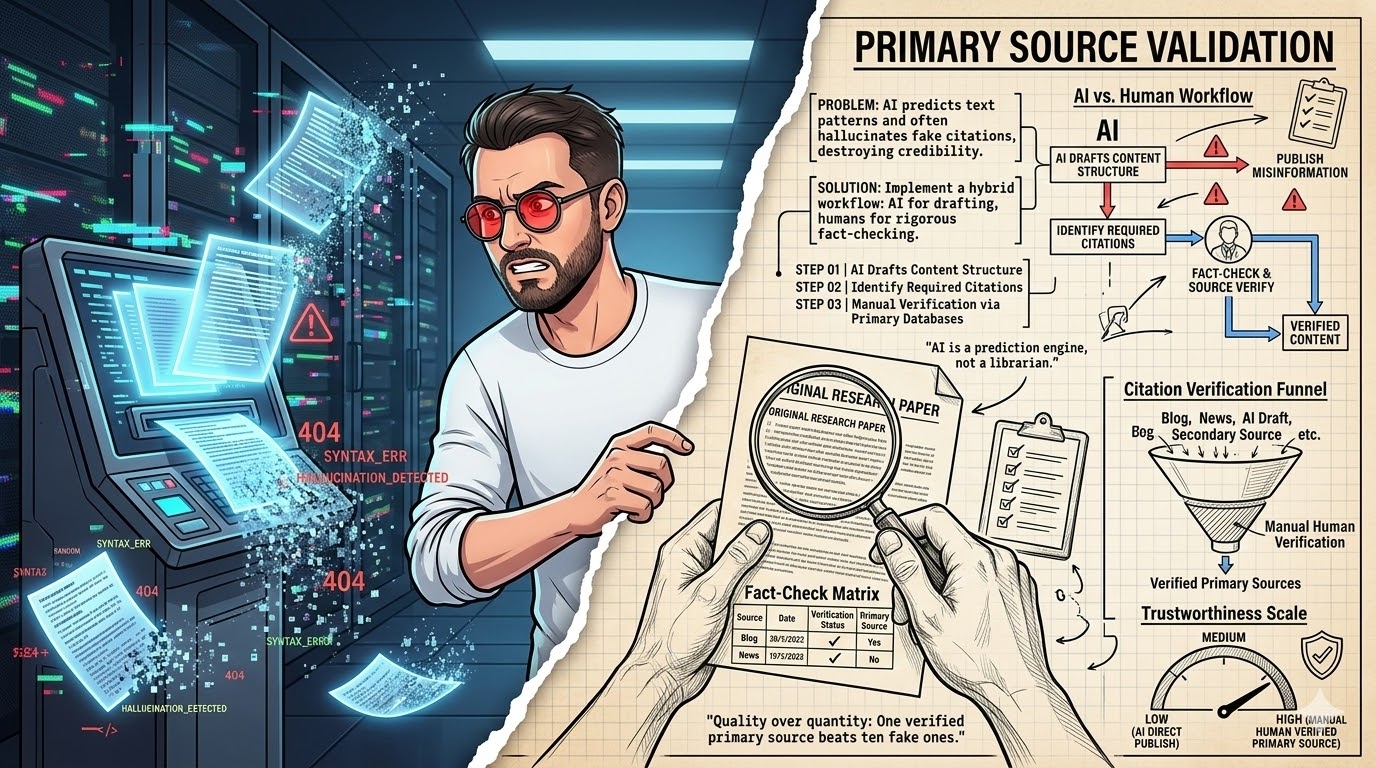
Use AI for research and first drafts. Do not publish AI-only content. Human oversight prevents factual errors and builds trust with your audience.
- AI offers unmatched speed for data collection and initial content generation.
- AI struggles with nuance, real-world context, and factual accuracy in comparisons.
- A hybrid approach, combining AI with human expertise, yields the best results.
If you plan to publish AI content without significant human review, stop reading now.
AI-Only Content vs. AI-Assisted Content
| Criterion | AI-Only Content | AI-Assisted Content |
|---|---|---|
| Accuracy | High error risk | High accuracy |
| Nuance | Generic, superficial | Deep, context-rich |
| Scalability | Very fast, low quality | Fast, high quality |
The Promise vs. The Pain: Why AI-Only Fails for "Alternatives"
I once saw an AI-generated "alternative to" article recommend a CRM tool that had been acquired and shut down months prior. That’s a quick way to lose trust. Your content fails when it presents outdated or fabricated information as fact, because readers will immediately spot the inaccuracies and dismiss your authority. I remember a client who thought they could just hit ‘generate’ and publish. They ended up with a piece that listed features for a product that didn’t even exist anymore. (Not fun, that.) The client was furious. They had trusted us to deliver quality content, and instead, we handed them a piece that was actively misleading. It took us nearly a week of dedicated work to not only fix the article but also to reassure their sales team. That’s a huge hidden cost.
The promise of AI is tempting. Imagine churning out dozens of comparison articles in a day. The reality, however, is often different. Without a human in the loop, AI frequently misses critical details. It pulls data from various sources, but doesn’t always understand context or recency. This leads to glaring errors that can damage your brand. Outdated data is a killer. It makes your content look unprofessional and unreliable. Readers searching for alternatives are already in a decision-making phase. They need accurate, current information. Generic or incorrect details will send them straight to a competitor.
Defining "Alternative To" Articles: What We’re Actually Building
Okay, quick detour. Before we dive deeper, let’s clarify what we mean by "Alternative To" articles. These aren’t just feature lists. They’re decision-making guides. Your article falls flat if it doesn’t address the user’s underlying pain points and specific needs, because a generic comparison helps no one. People aren’t just looking for a different tool. They’re looking for a solution to a specific problem their current tool isn’t solving. Or maybe they’re looking for a cheaper option, better support, or a different feature set. They’re trying to avoid another bad investment. This means your article needs to speak to their fears and hopes. It needs to be a trusted advisor, not just a data dump.
Alternative To Article: A comprehensive comparison guide helping users choose a different SaaS product based on specific needs, budget, and feature sets.
The goal is to provide enough detail for a reader to make an informed choice. This means understanding the nuances of each product. It means highlighting pros and cons that truly matter to a buyer. They solve a real problem. A good "alternative to" article anticipates questions. It addresses common frustrations. It guides the reader through a complex decision process. This level of depth and empathy is hard for AI alone to achieve. It requires understanding the human element of software adoption.
The AI’s Superpower: Data Sourcing & First Draft Speed
Mal ehrlich, who wants to spend all day scraping websites? AI can pull hundreds of data points in minutes. Something that would take a human researcher days. You miss out on massive efficiency gains if you don’t leverage AI for initial data collection, because manual research is slow and prone to human error. AI tools excel at gathering raw information. They can quickly summarize product pages, review sites, and pricing structures. This is where AI truly shines. It handles the tedious, repetitive tasks.
Pros of AI in "Alternative To" Content
- Rapid data collection from multiple sources, saving countless hours.
- Overcome writer’s block by generating initial outlines and draft paragraphs.
- Maintain a consistent tone and structure across many articles efficiently.
Cons of AI in "Alternative To" Content
- Factual inaccuracies and hallucinations can lead to misleading information.
- Lack of nuance means AI misses subtle but critical product differences.
- Generic output fails to connect with specific user pain points effectively.
Think of AI as your super-fast research assistant. It can give you a solid starting point. This foundation includes features, pricing tiers, integrations, and basic use cases. Imagine needing to compare 10 different project management tools. Manually, you’d visit 10 websites, dig through pricing pages, and read dozens of reviews. AI can scrape this data in minutes. It can then organize it into a structured format, like a table or bullet points. This saves you days of grunt work. Speed is the main game changer. This allows your human writers to focus on the higher-value tasks. They can then refine, verify, and add the crucial human touch. AI SEO automation with Postlabs can significantly accelerate this initial phase. It streamlines the content creation process, making it much more efficient.
The "Alternative To" Trap: AI’s Struggle with Nuance & Specificity
This part sucks. An AI might compare two tools based on their pricing pages. But it could easily miss that one has a hidden "enterprise-only" feature. This feature might be crucial for a specific use case. Your comparison becomes useless when AI overlooks critical, subtle differences that matter most to a buyer, because it lacks real-world operational context. AI doesn’t "use" software. It processes text. It doesn’t understand the frustration of a clunky UI or the joy of seamless integration. These are human experiences. A tool might claim ‘unlimited users,’ but then throttle performance at 500. Or its ‘AI integration’ might just be a basic chatbot. These are details AI often misses because it doesn’t understand the *implications* of the text.
Warning: Over-reliance on AI for feature comparison
AI often hallucinates features or misinterprets pricing tiers. This leads to incorrect comparisons and damages your credibility with readers.
I’ve seen AI confidently state a tool offers a specific integration, only for a quick manual check to reveal it was deprecated years ago. Or it might list a feature as standard when it’s only available on the most expensive plan. AI lacks real-world context. This is where the "alternative to" article trap lies. Without human oversight, these articles become generic and misleading. They fail to provide the deep, actionable insights readers truly need. This is why a human editor is non-negotiable. It’s the difference between a helpful guide and a piece of content that actively misleads.
Human Expertise: The Secret Sauce for Trust & Authority
I once spent an hour interviewing a product manager. I needed to understand a niche feature that no AI could ever grasp from public documentation. That insight made the article. Your content will lack credibility if it doesn’t include genuine insights from someone who has actually used the tools, because readers can sense generic advice. Human writers bring experience. They understand user pain points. They can articulate the "why" behind a feature, not just its existence. (Been there.) This human touch builds trust. Readers want to feel like they’re getting advice from someone who truly understands their problem. They want to avoid making a bad purchase decision.
"Authenticity and deep understanding are the bedrock of trust in product reviews."
— General Consensus, Content Marketing Experts
An AI can’t convey empathy or share a personal anecdote about a tool’s quirks. I’ve spent years in the SaaS space. I know which companies have great support, even if their pricing page doesn’t scream it. I know which ‘free trials’ are actually just glorified demos. This kind of institutional knowledge is invaluable. Human experience is irreplaceable. It adds a layer of authority and relatability that AI simply cannot replicate. This is where your brand’s unique voice comes through. It’s what differentiates your content from the endless sea of generic information. It transforms a simple comparison into a valuable, trusted resource.
Fact-Checking Fails: How AI Invents Features & Pricing
Weird enough: That happens often. I’ve seen AI invent an entire pricing tier for a SaaS product. It even came complete with fake features. This was just to fill a gap in a comparison table. Your entire article loses all integrity if you don’t rigorously fact-check every AI-generated claim, because even one major error destroys reader trust. AI models are trained on vast datasets. However, they don’t always distinguish between fact and plausible fiction. They are designed to generate coherent text, not necessarily truthful text.
Myth
AI always pulls correct data from reliable sources for comparisons.
Reality
AI can confidently fabricate details, especially for less common tools or specific feature sets. Always verify every claim, including pricing, features, integrations, and company status.
This "hallucination" problem is real. It’s not just about outdated information. It’s about AI making things up entirely. One time, an AI article claimed a popular CRM had a built-in video conferencing tool. It didn’t. This wasn’t just a small mistake; it was a fundamental misrepresentation of the product’s core offering. A reader might have based a purchase on that false claim. Imagine a reader making a purchase decision based on a feature your article claimed existed, only to find it doesn’t. That’s a quick path to a lost customer and a damaged reputation. Verify every single detail. This means checking pricing pages, feature lists, and even trying out free trials if possible. For a complete AI guide on how to integrate AI into your SEO workflow effectively, check out this resource from Postlabs. It covers crucial steps for maintaining accuracy.
Crafting the Comparison: Beyond Feature Lists
Not just specs, right? Instead of just "Feature X: Yes/No," structure comparisons around "Who is this for?" and "What problem does it solve best?" Your comparison will be shallow if it only lists features without explaining their practical implications for different user personas, because features alone don’t tell the whole story. A truly useful comparison goes deeper. It considers the target audience for each tool. It explores the specific use cases where one tool excels over another. This requires a human understanding of market segments and user needs. For a startup founder, ease of use and a low entry price are paramount. For an enterprise, robust security and complex integrations are key. Your comparison needs to segment these needs clearly.
Think about the "hidden gotchas." These are the things you only learn after using a tool for a while. Maybe it’s a steep learning curve, poor customer support, or unexpected integration issues. AI can’t easily uncover these. A human can. Focus on user outcomes. Explain how each feature translates into a benefit or a drawback for a specific type of user. This makes your content far more valuable and actionable. It moves beyond a simple data dump to become a trusted advisor. It helps readers visualize how a tool fits into their daily workflow.
Scaling Your Workflow: AI as Your Research Assistant
Anyway. Using AI, I can now draft 3-4 "alternative to" articles in the time it used to take me to research one. This frees up my time for the critical human editing. You’ll struggle to scale your content production if you don’t integrate AI into the early stages of your workflow, because manual processes are a bottleneck. AI isn’t here to replace you. It’s here to augment your capabilities. It handles the initial heavy lifting. This includes gathering competitive intelligence and structuring the first draft. Before AI, researching one detailed ‘alternative to’ article could take me 10-15 hours. Now, with AI handling the initial data pull and first draft, I can cut that down to 3-5 hours of human input per article. That’s a 70% time saving.
This means you can produce more content, faster. You can cover more "alternative to" keywords. This expands your organic reach significantly. Your human team can then focus on adding value. They can refine the AI output. They can inject unique insights and ensure factual accuracy. AI handles the grunt work. This hybrid model is the most effective way to scale high-quality content in 2026. Learn more about leveraging Postlabs for efficient content scaling. It provides tools to make this workflow seamless, allowing you to manage multiple content projects simultaneously.
The Future is Hybrid: AI + Human for Winning Content
So. The best "alternative to" articles I’ve seen in 2026 combine AI’s speed for data gathering with a human’s critical eye for nuance and validation. You’ll fall behind competitors if you treat AI as a full replacement for human writers, because a purely automated approach lacks the depth and trust readers demand. The future of content creation is not AI versus human. It’s AI with human. It’s a partnership where each brings its unique strengths to the table. AI provides the raw material and efficiency. Humans provide the intelligence, empathy, and quality control. This collaborative approach ensures your content is both scalable and trustworthy. It allows you to dominate competitive niches. It positions you as a reliable source of information.
In a crowded market, content quality is a differentiator. Companies that master this hybrid approach will outcompete those relying solely on automation or slow manual processes. It’s about building a content engine that’s both fast and reliable. This strategy not only boosts your SEO but also builds a loyal audience. They will return to your site because they trust your recommendations. It’s about collaboration, not replacement. Embrace this hybrid model. It’s the only sustainable path to producing effective "alternative to" articles that truly serve your audience and drive business results.
AI-Assisted Content Audit (2026)
| Project/Item | Cost/Input | Result/Time | ROI/Verdict |
|---|---|---|---|
| AI-Only Draft | $5 | 2 hours | Negative |
| AI + Human Edit | $50 | 8 hours | Positive |
| Manual Research | $150 | 20 hours | Neutral |
What I Would Do in 7 Days to Launch "Alternative To" Content with AI
- Day 1-2: Research & Keyword Mapping. Identify 5-10 high-intent "[Product] alternative" keywords. Use AI to quickly gather initial data on competitors, including features, pricing, and common use cases.
- Day 3-4: AI First Drafts. Generate initial drafts for your chosen articles using AI. Focus on structuring the content, outlining basic features, and presenting initial pricing information. Do not expect perfection.
- Day 5-6: Human Review & Deep Dive. Fact-check every AI-generated claim rigorously. Add human insights, nuanced comparisons, and personal anecdotes from using the tools. Refine the tone, ensuring it’s authoritative yet relatable.
- Day 7: Optimize & Publish. Add internal links to relevant content. Craft compelling meta descriptions and titles. Integrate high-quality images or comparison charts. Schedule for publication and monitor performance.
Your "Alternative To" Article Checklist
- Did I fact-check all AI-generated features and pricing against current official sources?
- Does the article address specific user pain points, not just a generic list of features?
- Have I included unique human insights or experiences with the tools being compared?
- Is the tone authoritative yet relatable, avoiding corporate jargon or overly formal language?
- Are there clear calls to action or next steps for the reader, guiding their decision?
- Is the content free from generic, repetitive AI phrasing, ensuring a fresh perspective?
- Have I considered different user personas and tailored the comparison to their needs?
Frequently Asked Questions
Can AI write a full "Alternative To" article without any human input?
Technically, yes, AI can generate a full article. However, it will likely contain factual errors, lack nuance, and fail to build trust with readers. Human review and editing are essential for quality and accuracy.
What are the biggest risks of using AI for these types of articles?
The primary risks are factual inaccuracies (hallucinations), outdated information, and a lack of genuine insight into user experience. These issues can severely damage your brand’s credibility and mislead your audience.
How much time can AI save me on "Alternative To" content?
AI can significantly reduce the time spent on initial research and drafting, potentially cutting the overall content creation time by 50-70%. This frees up human editors for higher-value tasks like fact-checking and adding unique insights.