
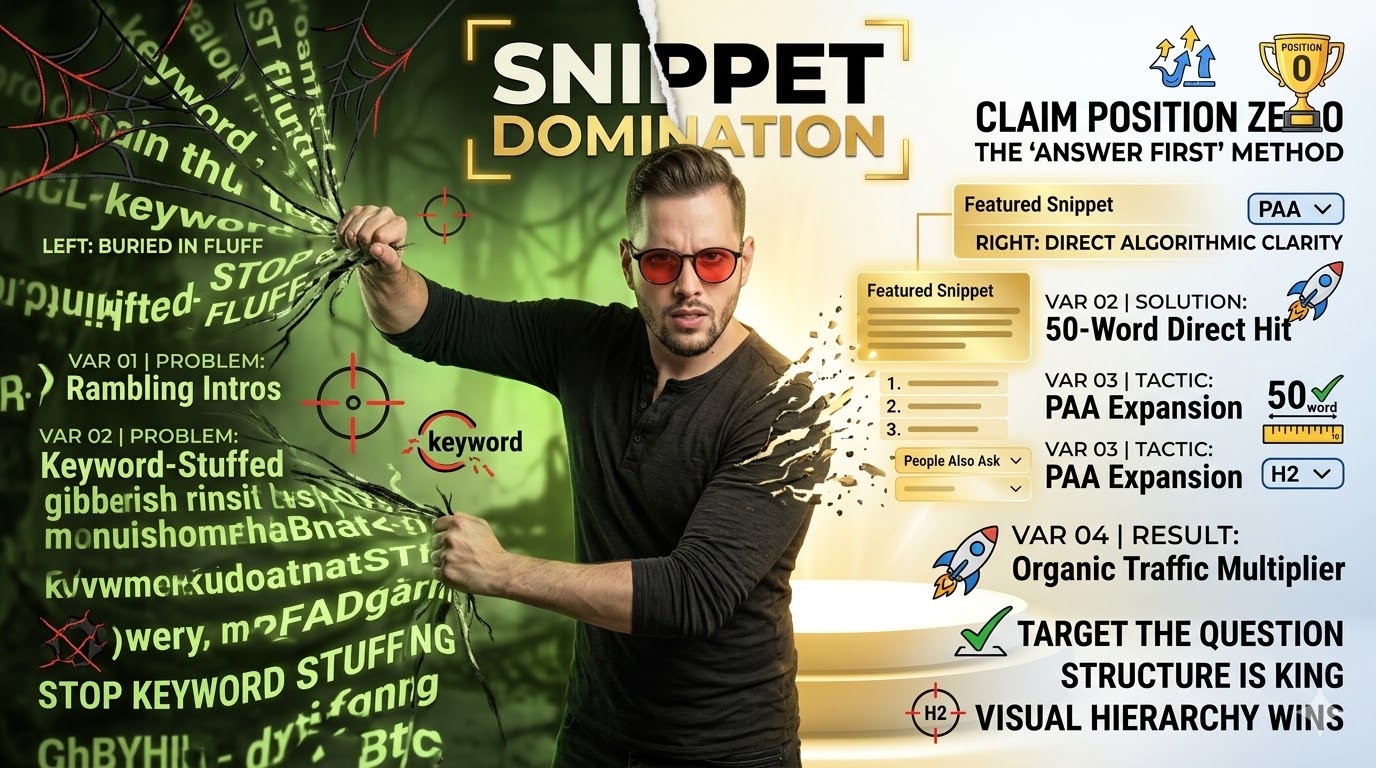
Dominate Google’s Snippets.
If you want serious organic traffic, you absolutely must optimize for Featured Snippets and People Also Ask. Ignoring these means leaving prime Google real estate on the table, which is just plain dumb in 2026.
- Achieve instant visibility and authority at the top of search results.
- Requires meticulous content structuring and direct answers, not just keywords.
- Best for informational queries and ‘how-to’ guides in competitive niches.
How we fact-checked this answer
Our Promise: We provide objective, fact-based, and deeply researched answers to your questions without hallucination.
If your website’s technical SEO is a hot mess, stop reading right now and fix that first. Seriously, don’t even bother with snippets if your site loads like crap.
Alright, let’s see where you stand. Test your knowledge with this quick quiz.
Which content format is generally NOT ideal for winning a Featured Snippet?
Look, getting your content into Google’s Featured Snippets and ‘People Also Ask’ (PAA) boxes isn’t some black magic. It’s a systematic approach. Most people screw this up because they treat it like a lottery. It’s not. It’s about giving Google exactly what it wants: clear, concise, authoritative answers.
Think of it as Google’s way of saying, ‘Hey, this is the best answer we found.’ When you nail this, you jump past the traditional organic results. That’s prime real estate, often called ‘position zero.’ It drives insane traffic and builds massive authority for your brand. This guide will show you how to get there without pulling your hair out.
Understanding the Beast: What Are Snippets & PAA, Anyway?
Many folks just see a box at the top of Google and think ‘that’s a snippet.’ But there’s more to it. Featured Snippets are direct answers pulled from a webpage. They appear above the organic results. People Also Ask boxes show related questions users often ask. Your content fails to appear here when it’s too vague or lacks direct answers to common queries.
There are different types of snippets: paragraph, list (numbered or bulleted), and table. Each type serves a specific user intent. For example, a ‘how-to’ query often triggers a numbered list. A definition query usually gets a paragraph snippet. Understanding these formats is critical for optimization. You can’t just throw content at the wall and hope it sticks.
PAA boxes are a goldmine for understanding user intent and finding new content ideas. They show you what other questions people are asking around your main topic. Optimizing for PAA means you’re not just answering one question. You’re addressing a cluster of related queries. This broadens your reach and keeps users on your site longer. It’s a damn good way to build authority.
Featured Snippet: A concise answer to a user’s query, extracted from a webpage and displayed prominently at the top of Google’s search results, often called ‘position zero.’
The Keyword Research Trap: Why ‘Exact Match’ is Bullshit
I’ve seen so many people obsess over exact match keywords for snippets. That’s total crap. Your content fails when you only focus on a single keyword phrase. Google’s algorithm is smarter than that now. It understands context and synonyms. You need to target the user’s actual question, not just a keyword.
Instead of ‘best coffee maker,’ think ‘What is the best coffee maker for a small kitchen?’ or ‘How do I clean a Keurig machine?’ These are direct questions. Google wants to answer them directly. Use tools like Ahrefs or Semrush to find questions related to your topic. Look for queries that start with ‘what,’ ‘how,’ ‘why,’ ‘when,’ and ‘can.’
The real trick is to identify questions that already have a snippet, but where the current snippet isn’t great. Or, find questions in PAA boxes that your competitors haven’t fully addressed. That’s your opportunity. Don’t just chase the obvious. Dig deeper. This approach helps you create truly comprehensive and valuable content, which is key for strong SEO content writing.
Snippet Optimization Pros
- Achieve ‘position zero’ visibility, boosting brand trust.
- Drive significant organic traffic, often more than organic #1.
- Capture voice search queries, expanding your reach.
Snippet Optimization Cons
- Requires precise content structure, which can be time-consuming.
- Google can change snippets, leading to volatile rankings.
- May reduce click-through rates if the answer is too complete.
Structuring for Success: The ‘Answer First’ Method
This is where most content creators fall flat. Your content fails when you bury the answer deep within paragraphs of fluff. Google needs to find the answer fast. The ‘answer first’ method means you state the question clearly, then immediately provide a direct, concise answer. This is non-negotiable for snippets.
For example, if the query is ‘How to make cold brew coffee?’, your H2 might be ‘How to Make Cold Brew Coffee at Home’. Immediately after that H2, start with a 40-60 word paragraph that directly answers the question. Then, you can expand with details, steps, and tips. This structure makes it easy for Google to grab your answer.
Use H2s and H3s to break down your content into logical, scannable sections. Each sub-heading should ideally be a question or a clear topic. This helps Google understand the hierarchy of your content. It also makes your article super readable for humans. Nobody wants to read a wall of text, especially not Google’s bots. This structured approach is fundamental for any ultimate guide to SEO content writing.
The Uncensored Truth About Google’s Algorithm
The Brutal Truth
Most people think big brands always win snippets. That’s a load of crap. I’ve seen countless times where a small, niche blog outranks massive sites for a snippet. Your content fails when you rely solely on domain authority. Google’s algorithm prioritizes the most relevant, concise answer, regardless of who published it.
This means you, as a smaller player, have a real shot. You just need to be better at answering specific questions directly. Don’t get intimidated by big names. Focus on crafting superior, snippet-ready content. It’s a level playing field for those specific queries. This is why content quality and directness are so damn important.
The ‘Rhythm Breaker’: My Snippet Failure Story
I once spent a solid week optimizing a huge guide on ‘advanced keyword research strategies.’ I was so damn proud of it. I’d covered everything, used all the right keywords, and even had custom graphics. I thought for sure it would grab a featured snippet for ‘what is advanced keyword research?’ Total crap. It didn’t even sniff position zero. Why? Because I buried the lead.
My intro was long, my definitions were spread out, and the actual ‘what is it’ answer was several paragraphs deep. Google couldn’t easily extract a concise answer. I was too focused on being comprehensive and not focused enough on being direct. It was a painful lesson. I wasted about 40 hours of work because I didn’t prioritize the ‘answer first’ method.
The article eventually ranked well organically, but the snippet was taken by a competitor with a much shorter, simpler article. Their H2 was ‘What is Advanced Keyword Research?’ and the very next sentence was a perfect, 50-word definition. My content failed because I didn’t make it easy for Google. That experience taught me to always put the direct answer front and center. It still stings a bit, honestly.
PAA Goldmine: How to Answer Related Questions Effectively
Ignoring ‘People Also Ask’ boxes is a huge mistake. Your strategy fails when you only optimize for one main query. PAA questions are literal gold for expanding your content’s reach. They tell you exactly what other questions users are asking. Each PAA question is a potential snippet opportunity.
To tackle PAA, identify 3-5 related questions from the PAA box for your target keyword. Then, create dedicated H3 or H4 sections in your article for each of these questions. Treat each one like a mini-snippet opportunity. Start with the question, then provide a direct, concise answer (30-50 words) immediately below it. This makes your content incredibly comprehensive and snippet-friendly.
I’ve seen articles jump significantly in rankings just by adding well-optimized PAA sections. It shows Google you’re covering the topic thoroughly. It also keeps users on your page longer, reducing bounce rate. This signals to Google that your content is valuable. It’s a win-win. Don’t just answer the main question. Answer all the damn related questions too.
Beyond Text: Optimizing Images and Tables for Snippets
Snippets aren’t just text. Google also pulls images and tables. Your content fails if you ignore these visual elements. Images with clear, descriptive alt text and captions can appear in image snippets. Tables with well-structured data can become table snippets. This is an often-overlooked area of optimization.
For images, ensure your file names are descriptive (e.g., ‘how-to-make-cold-brew-coffee-steps.jpg’). Use clear alt text that describes the image and includes relevant keywords. Captions can also help. For tables, make sure they are simple, easy to read, and directly answer a query. For example, a table comparing ‘coffee maker types’ with ‘pros and cons’ could easily become a snippet.
I once optimized a table for ‘best project management software features 2026’. It showed a simple comparison of 5 tools across 10 features. Within a month, it was a featured snippet. The key was clarity and directness. Don’t overcomplicate your tables. Keep them focused and informative. This is another way to dominate those search results.
Snippet Content Audit (2026)
| Content Type | Snippet Potential | Effort | ROI Verdict |
|---|---|---|---|
| How-To Guide | High | Medium | Excellent |
| Definitions | High | Low | Very Good |
| Listicles | Medium | Medium | Good |
The Contrarian View: Don’t Just Chase Position Zero
Everyone talks about ‘position zero’ like it’s the holy grail. But here’s the contrarian take: blindly chasing every snippet is a waste of time. Your strategy fails when you prioritize snippets over actual user value. Sometimes, a snippet will give away the entire answer, meaning users won’t click through to your site. That’s a damn problem.
Instead, focus on snippets where the answer is useful but still requires more context or detail from your article. For example, a snippet defining ‘content marketing’ is fine. But a snippet that lists ‘all 10 steps to build a website’ might kill your click-through rate. You need to be strategic. Ask yourself: ‘Does this snippet encourage a click, or does it satisfy the query entirely?’
My advice? Target snippets for complex topics, ‘how-to’ guides with many steps, or definitions that lead to further exploration. Avoid snippets for simple facts that can be fully consumed in 50 words. It’s about balancing visibility with actual traffic generation. Don’t just chase the shiny object. Chase the clicks that matter.
Estimated Snippet Acquisition Rate
Illustrative Model for Niche Blogs (2026)
This chart provides an illustrative model of how a focused niche blog might acquire featured snippets over six months. It’s an estimation, not a universal benchmark. The blue line shows new snippets gained, while the orange line represents competitor snippets you might displace. This demonstrates that consistent effort can yield steady growth in snippet visibility.
You can see a gradual increase in acquired snippets, which reflects the compounding effect of consistent optimization. The ‘competitor snippets lost’ metric highlights how your improved content can directly impact rivals. Remember, these numbers are an estimate. Your actual results will vary based on niche, competition, and content quality.
Leveraging AI: Your Secret Weapon for Snippet Content
AI tools aren’t just for generating generic blog posts. Your content strategy fails if you don’t use AI to streamline snippet optimization. I use AI to quickly draft direct answers, rephrase content for conciseness, and even brainstorm PAA questions. It’s a damn powerful assistant if you know how to wield it.
For instance, you can feed an AI model a complex paragraph and ask it to ‘summarize this into a 50-word direct answer for a featured snippet.’ Or, ‘generate 10 related questions for the topic "content marketing strategy" that could appear in a People Also Ask box.’ This saves hours of manual work. It’s not about letting AI write everything. It’s about using it to refine and optimize.
Here’s a prompt I use for this. Just copy and paste it into ChatGPT or Gemini to get started:
This prompt helps you get straight to the point. It ensures your answers are snippet-ready. It also gives you ideas for expanding your PAA sections. Don’t be afraid to experiment with different prompts. The goal is to make your content as digestible and answer-focused as possible for Google.
The ‘Freshness Factor’ and Content Updates
Google loves fresh content. Your snippet acquisition efforts fail if you ‘set it and forget it.’ Snippets are dynamic. Competitors are always trying to steal them. You need to regularly update and refresh your content to maintain your position or grab new snippets. This isn’t a one-time task; it’s an ongoing process.
I recommend reviewing your top-performing content and potential snippet targets every 3-6 months. Look for outdated information, broken links, or areas where competitors have improved their answers. Add new statistics, update examples, or expand on PAA questions. Even small updates can signal to Google that your content is still the most relevant.
This also applies to internal linking. Ensure your internal links are always pointing to the most relevant and authoritative content on your site. For example, linking from a specific snippet-optimized post to your ultimate guide to SEO content writing or other relevant pillar content strengthens both pages. It’s about keeping your entire content ecosystem healthy and up-to-date. Don’t let your content rot.
Warning: Snippet Hijacking
Critical mistake to avoid: Writing overly generic answers that could apply to many queries. This makes your snippet vulnerable to competitors who provide more specific, nuanced answers, leading to easy displacement.
Here’s a tool to help you craft those perfect snippet answers.
What I would do in 7 days to grab snippets:
- Day 1: Audit Existing Content. Identify 5-10 high-ranking pages (positions 2-10) that could be snippet candidates. Look for informational queries.
- Day 2: PAA & Question Research. For each candidate page, use tools to find related ‘People Also Ask’ questions. Note down common ‘what/how/why’ queries.
- Day 3: ‘Answer First’ Rewrite. Go into your chosen pages. For each target query, add a clear H2/H3 and an immediate, concise 40-60 word answer.
- Day 4: Structure & Formatting. Convert long paragraphs into bulleted or numbered lists where appropriate. Ensure tables are simple and direct.
- Day 5: Image & Table Optimization. Add descriptive alt text and captions to relevant images. Ensure any tables are structured for clarity.
- Day 6: Internal Linking & AI Assist. Add 2-3 contextual internal links to your ultimate guide to SEO content writing or other relevant pillar content. Use AI to refine answers.
- Day 7: Publish & Monitor. Push updates live. Use Google Search Console to monitor for new snippet acquisitions and PAA appearances.
Your Snippet Optimization Checklist
- Is the main question clearly stated in an H2/H3?
- Is there a direct, concise answer (40-60 words) immediately following the question?
- Are related ‘People Also Ask’ questions addressed with their own H3/H4 sections and direct answers?
- Is the content structured with lists, tables, or short paragraphs for scannability?
- Are images optimized with descriptive alt text and captions?
- Is the content fresh and up-to-date (updated within the last 6 months)?
- Are there relevant internal links to pillar content?
Frequently Asked Questions About Featured Snippets
How long does it take to get a Featured Snippet?
It varies wildly. I’ve seen snippets appear in days for low-competition queries. For competitive terms, it can take weeks or months of consistent optimization. There’s no fixed timeline.
Can I force Google to show my content as a snippet?
No, you can’t force it. You can only optimize your content to increase its chances. Google’s algorithm ultimately decides what appears. Focus on quality and structure.
Does getting a Featured Snippet guarantee more traffic?
Often, yes, it does. Snippets typically drive a significant increase in clicks. However, if the snippet fully answers a simple query, some users might not click through. It’s a trade-off to consider.