
Translate Style Guides for AI: Do It.
Yes, you must translate your style guide. Ignoring this step wastes AI potential and creates inconsistent content. You will get off-brand output.
- Ensures brand voice and factual accuracy across all AI-generated content.
- Requires initial manual effort and ongoing prompt engineering refinement.
- Ideal for automating blog posts, social media updates, and email newsletters with consistent tone.
If your content needs are minimal and human writers handle everything, stop reading.
Why Your AI Needs a Style Guide (It’s Not Just for Humans)
I once saw a client’s AI-generated content go completely off the rails. It used a formal, stiff tone for a brand that was all about casual, friendly interactions. The problem wasn’t the AI’s capability. It was the lack of clear instructions. Your AI output goes off-brand when you skip this crucial translation step.
Think of your style guide as the AI’s core personality file. Without it, the AI is just guessing. It pulls from its vast training data, which includes everything from academic papers to internet memes. That’s why you get generic, bland, or even wildly inappropriate content. You need to give it guardrails.
Style Guide as System Prompt: A structured set of instructions, derived from an existing brand style guide, designed to inform an AI model’s tone, voice, format, and factual constraints for content generation.
This isn’t just about sounding good. It’s about efficiency. When your AI consistently produces content that aligns with your brand, you spend less time editing. This frees up your team for higher-level tasks. It’s a fundamental part of effective AI SEO automation.
The Trap of "Just Tell the AI to Be [Adjective]"
Honestly, I’ve wasted countless hours with prompts like "be professional" or "write in a friendly tone." The AI tries its best, but the results are always vague and bland. Generic prompts fail because they lack measurable, actionable instructions. This approach is a common pitfall.
The AI doesn’t understand "friendly" the way a human does. It needs examples. It needs specific words to use or avoid. For instance, instead of "friendly," tell it: "Use contractions. Address the reader as ‘you.’ Avoid jargon. Use short sentences." That’s actionable.
Pros of AI Style Guides
- Ensures consistent brand voice across all content, reducing manual edits.
- Accelerates content creation cycles, boosting publishing frequency.
- Minimizes factual errors and off-brand messaging, protecting reputation.
Cons of AI Style Guides
- Requires significant upfront effort to translate human rules into AI instructions.
- Needs continuous testing and refinement to maintain optimal performance.
- Can limit creative freedom if rules are too rigid, requiring careful balance.
This isn’t about stifling creativity. It’s about directing it. Think of it like giving a chef a recipe instead of just saying "make something tasty." A good recipe still allows for skill and nuance. But it ensures the core dish is consistent. Your content will lack impact if you rely on vague adjectives.
Deconstructing Your Style Guide: From Rules to Variables
A 50-page PDF style guide isn’t an AI prompt. It’s a reference document. The trap is thinking you can just paste it in. You lose control if you don’t break down those human-readable rules into discrete, machine-interpretable instructions. This is where many people stumble.
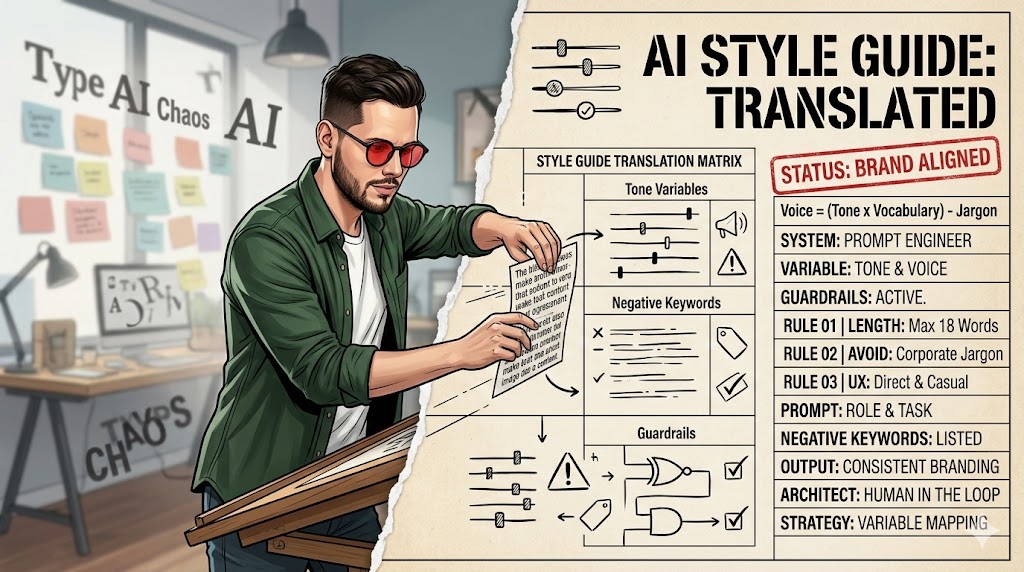
I start by categorizing everything. What are the rules for tone? What about sentence length? Are there specific words we always use (brand terms) or never use (competitor names)? Each of these becomes a variable in your AI’s system prompt. For example:
- Tone: Conversational, slightly informal, helpful.
- Audience: Small business owners, marketing managers.
- Sentence Length: Average 10-14 words. Max 18 words.
- Formatting: Use H2s for main sections, H3s for sub-sections. Use bullet points for lists.
Warning: Overwhelm is Real
Don’t try to translate everything at once. Starting with too many complex rules will lead to prompt overload and confusing AI output. Prioritize the 3-5 most critical brand elements first.
This breakdown makes the style guide actionable. It turns abstract concepts into concrete commands. It’s the difference between hoping for good content and engineering it. Your AI will struggle to follow instructions if they aren’t broken down clearly.
Mapping Tone and Voice: Beyond "Friendly"
I remember a specific campaign where the AI kept using corporate jargon like "synergistic opportunities" despite my "friendly" instruction. It was a mess. Your content sounds robotic when you don’t define tone with specific examples and constraints. This is a common frustration.
Instead of just an adjective, give the AI a persona. "You are a seasoned, relatable blogger and operator. You speak directly to the reader. You use short paragraphs. You add occasional dry humor. You avoid corporate buzzwords." This paints a much clearer picture.
Then, provide examples. "Good: ‘This part sucks, honestly.’ Bad: ‘It is imperative to note the inherent difficulties.’" The AI learns from these contrasts. It starts to understand the nuances of your desired voice. This is a critical step for quality output.
This level of detail makes a huge difference. It moves the AI from generic text generation to brand-aligned content creation. You won’t get the desired voice if you don’t provide concrete examples and clear boundaries.
The "No-Go" List: What AI MUST Avoid (And How to Enforce It)
I had an AI suggest "disruptive innovation" in a blog post for a very traditional industry. It was a facepalm moment. AI will hallucinate or use banned phrases if you don’t explicitly forbid them. This is a non-negotiable part of prompt engineering.
Every brand has its forbidden words or concepts. These might be competitor names, outdated industry terms, or even specific marketing clichés. Create a clear "Negative Keyword List" for your AI. Instruct it to actively avoid these terms. This is just as important as telling it what to include.
Myth
"AI is smart enough to know what not to say."
Reality
AI models are trained on vast datasets and will often include common phrases or concepts unless explicitly instructed to avoid them. You must define negative constraints.
Beyond specific words, think about concepts. Does your brand avoid making hype promises? Tell the AI: "Do not use phrases like ‘guaranteed success,’ ‘easy money,’ or ‘overnight results.’ Focus on realistic benefits and effort required." Your content will quickly lose credibility if you don’t enforce these negative constraints.
Structuring Your AI System Prompt for Consistency
Your AI gets confused if the instructions aren’t organized logically. I’ve seen prompts that are just a wall of text, and the AI misses half the rules. A structured system prompt is key to consistent output. It’s like giving the AI a clear roadmap.
I’ve found a simple "Role, Task, Constraints, Format" structure works best. It’s easy for me to write, and the AI seems to process it better. Here’s a basic breakdown:
- Role: "You are a senior content strategist for [Your Company]."
- Task: "Write a blog post about [Topic]."
- Constraints: "Adhere to the brand voice (casual, helpful, direct). Avoid jargon. Max 18 words per sentence. Include a call to action for our complete AI guide."
- Format: "Use H2s for main sections, H3s for sub-sections. Use bullet points for lists. Output in HTML."
This clear hierarchy helps the AI prioritize and apply rules effectively. It reduces the chances of it ignoring a crucial instruction buried in a long paragraph. Your AI will struggle to deliver consistent results if your prompts lack a logical structure.
Testing and Iteration: The Only Way to Fine-Tune Your AI
You’ll never get perfect output on the first try. I usually run 5-10 test prompts for each new instruction set. Then I compare the AI’s output against my style guide. This iterative process is the only way to fine-tune your AI’s performance. It’s a non-stop cycle of refinement.
Look for specific deviations. Did it use a banned word? Was the sentence length too long? Did it miss a key formatting rule? Each deviation is a data point. Use it to refine your prompt. Add more specific instructions, clarify ambiguities, or provide more examples.
"The quality of your AI output is directly proportional to the clarity and specificity of your prompts. It’s not magic; it’s engineering."
— General Consensus, AI Content Strategy
This isn’t a one-and-done task. As your brand evolves, so should your AI style guide. New products, new campaigns, new target audiences – all require adjustments to your core instructions. Your AI will never reach its full potential if you don’t commit to continuous testing and iteration.
AI Prompt Refinement Audit (2026)
| Project/Item | Cost/Input | Result/Time | ROI/Verdict |
|---|---|---|---|
| Initial Prompt | 2 hrs | 60% align | Low |
| Refinement 1 | 1 hr | 85% align | Medium |
| Refinement 2 | 0.5 hr | 95% align | High |
Keeping it Fresh: Updating Your AI Instructions in 2026
Your content will feel dated if you don’t update your AI instructions regularly. The digital landscape changes fast. New trends emerge. Your brand voice might subtly shift. I review my core prompts every quarter, sometimes more often if there’s a major campaign.
This isn’t just about adding new rules. It’s also about pruning old ones. Are there instructions that are no longer relevant? Are there terms the AI now understands better, making explicit rules redundant? Streamlining your prompts can sometimes improve performance.
Think of it as software maintenance for your content engine. You wouldn’t run outdated software, right? The same applies to your AI prompts. Your content will lose its edge if you don’t keep your AI instructions current.
Scaling Your AI Content: Team Training and Tooling
Your team will struggle if they don’t understand the AI’s boundaries and capabilities. I make it a point to train new hires on our AI prompt library. This ensures everyone knows how to interact with the AI effectively. It prevents costly mistakes and inconsistent output.
Provide clear guidelines on when to use AI, what types of content it’s best for, and how to review its output. Emphasize that AI is a tool, not a replacement for human oversight. Teach them how to spot off-brand content or factual inaccuracies. This is crucial for maintaining quality.
Consider tools that help manage your prompts. Platforms like Postlabs can store and organize your system prompts. They allow for version control and easy sharing across teams. This prevents prompt drift and ensures everyone uses the approved instructions. Scaling content without proper tooling is a nightmare.
The Future is Prompt Engineering: Your New Skillset
You’ll be left behind if you don’t embrace prompt engineering as a core skill. This isn’t just for tech gurus. It’s for every content creator, marketer, and business owner. Understanding how to communicate effectively with AI is becoming as vital as understanding SEO or copywriting.
I spend at least 30 minutes a week just experimenting with new prompt structures. I try different ways of phrasing instructions. I test new constraints. This continuous learning is essential. The AI models are evolving rapidly, and so should your skills.
This isn’t just about getting better content. It’s about unlocking new efficiencies. It’s about creating scalable income streams for your business. The ability to translate complex human concepts into clear AI instructions is a superpower in 2026. Don’t underestimate its value.
What I would do in 7 days:
- Day 1: Audit Your Style Guide. Identify 3-5 core brand elements (tone, audience, key terms).
- Day 2: Draft Initial System Prompt. Translate those elements into clear "Role, Task, Constraints" instructions.
- Day 3: Create a "No-Go" List. List 5-10 words or concepts your AI must avoid.
- Day 4: Run Test Prompts. Generate 5-10 pieces of content using your new prompt.
- Day 5: Review and Refine. Compare AI output to your style guide. Adjust prompt based on deviations.
- Day 6: Add Examples. Incorporate 2-3 "good" and "bad" examples for tone/voice.
- Day 7: Document and Share. Save your refined prompt and share it with your team.
AI Style Guide Translation Checklist
- Have you defined the AI’s persona and role clearly?
- Are all instructions concrete and measurable, avoiding vague adjectives?
- Is there a specific list of words/phrases the AI must avoid?
- Is the prompt structured logically (e.g., Role, Task, Constraints, Format)?
- Have you provided examples for desired tone and voice?
- Are you regularly testing and iterating on your prompts?
- Is your team trained on how to use and review AI-generated content?
- Are you using tools to manage and version control your prompts?
Frequently Asked Questions
How long does it take to translate a style guide for AI?
Initial translation can take 4-8 hours for a comprehensive guide. Ongoing refinement is continuous, but typically requires 1-2 hours per week for optimal results.
Can I use a generic style guide for all AI content?
No, a generic guide will lead to generic output. Each AI prompt should be tailored to specific content types and brand nuances to ensure high-quality, on-brand results.
What’s the biggest mistake when creating AI style guides?
The biggest mistake is being too vague or expecting the AI to "just know." You must provide extremely specific, actionable instructions and examples for every desired outcome.