
Automate Content Decay Updates: Do It.
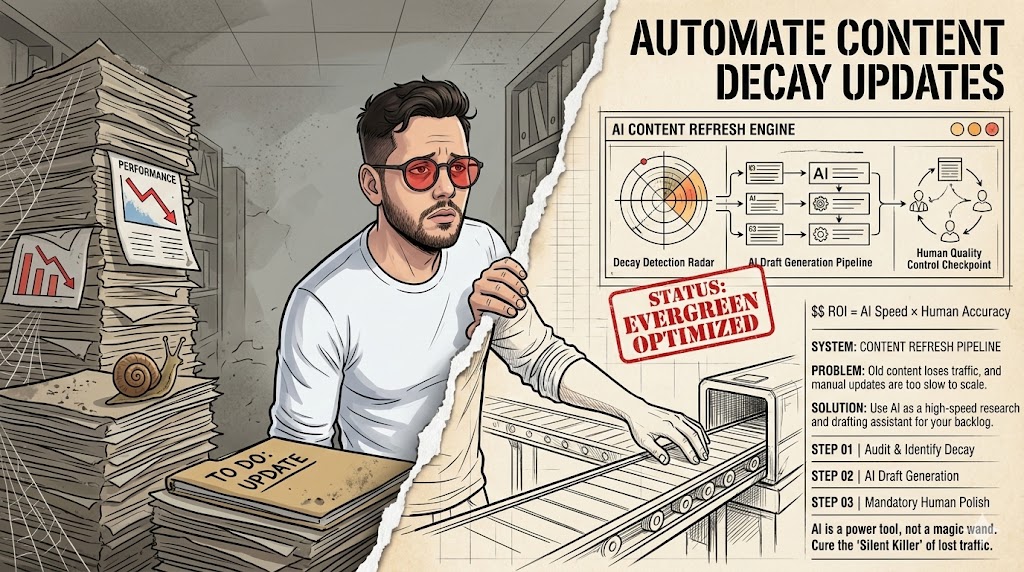
This is worth it. AI can dramatically speed up the content refresh process, turning a massive backlog into manageable tasks.
- AI slashes the time needed for initial drafts and research, boosting output.
- Human oversight is non-negotiable for quality, accuracy, and brand voice.
- Focus on high-impact articles first to see quick ROI from updates.
If your content is already performing poorly due to core factual errors or a completely outdated strategy, stop reading. AI can’t fix a fundamentally broken article.
The Content Decay Trap: Why Your Old Articles Are Losing Traffic (And My Own Screw-Up)
Content decay is a silent killer. You pour hours into creating great articles. Then, over time, they just… fade. I once watched a key article’s traffic drop by 30% over six months. It was painful. This happens when your content gets stale, competitors publish better stuff, or search intent shifts. Ignoring it means you’re leaving easy wins on the table.
Your content fails when you assume that publishing once is enough. The web moves fast. What was fresh last year is old news today. You need to keep your content relevant. Otherwise, you’re just losing ground.
Content Decay: The gradual decline in a piece of content’s search engine rankings, organic traffic, and overall performance over time, often due to outdated information, stronger competition, or shifting user intent.
It’s not just about traffic, either. Sometimes an article holds its rank but stops converting. That’s a different kind of decay. It’s a sign the content no longer meets user needs. Or maybe it just looks old. Either way, it needs attention.
AI for Content Updates: Not a Magic Wand, But a Power Tool (My First AI Rewrite Disaster)
Let’s be real. AI isn’t going to write perfect, publish-ready updates on its own. My first attempt with a raw AI output was a keyword-stuffed, robotic mess. It read like a bad translation. I thought I could just hit ‘generate’ and walk away. Nope. That’s not how it works. But AI is a game-changer for speeding up the grunt work.
Your AI-driven content update fails when you skip the human editing step. You’ll end up with content that sounds generic or, worse, contains factual errors. It’s a tool, not a replacement. Think of it as a super-fast research assistant and first-draft generator. It handles the heavy lifting, freeing you up for the critical human touch.
Pros of AI for Content Updates
- Massive Time Savings: AI can draft updates in minutes, not hours, speeding up your workflow.
- Scalability: Update dozens of articles quickly, tackling content decay across your site.
- Idea Generation: AI suggests new angles, keywords, and sections to improve old content.
Cons of AI for Content Updates
- Quality Control Risk: AI can produce generic, inaccurate, or poorly written content if not guided.
- Loss of Brand Voice: Without human editing, content can lose its unique tone and personality.
- Over-Optimization Trap: AI might over-optimize for keywords, leading to unnatural-sounding text.
The real power comes from using AI to get 80% of the way there. Then you, the human, refine it. This hybrid approach lets you tackle a backlog of 50 articles much faster than doing it all manually. You can check out how Postlabs uses AI to streamline this process, making content updates more efficient.
Identifying Decay: Beyond Just Google Analytics (The "Silent Killer" Metrics)
Most people look at Google Analytics and see a traffic drop. That’s obvious decay. But what about the silent killers? I’ve found articles with stable traffic but plummeting conversion rates. Or pages with high traffic but a bounce rate over 80%. These are also signs of decay. The content isn’t meeting user expectations. It might be ranking, but it’s not working.
Your decay identification fails when you only focus on top-level traffic numbers. You need to dig deeper. Look at engagement metrics. Check your conversion goals. An article that ranks well but doesn’t help your business is still decaying in value.
Warning: Don’t Just Chase Keywords
A critical mistake is updating content solely based on new keyword opportunities. This can dilute the original intent of the article, making it less focused and potentially harming its existing rankings for valuable terms.
Start by segmenting your content. Look at articles published 12-24 months ago. These are often prime candidates for decay. Check their average position in Search Console. Then, cross-reference with Analytics for time on page, bounce rate, and goal completions. Prioritize articles that once performed well but are now slipping. That’s your low-hanging fruit.
The Pre-AI Audit: What to Fix Before You Even Prompt (My Hour-Long Keyword Mess)
Before you even think about an AI prompt, you need to audit the old article. This is crucial. I once spent an hour trying to fix a poorly researched article after AI made it worse. It just amplified the existing problems. Garbage in, garbage out, right? You need to understand the original intent, what’s outdated, and what new information is needed.
Your AI update process fails when you feed a bad article into the AI without proper pre-analysis. The AI will simply build upon a weak foundation, making your editing job harder. It won’t magically fix structural issues or poor research.
First, read the article yourself. What’s missing? What’s wrong? Check for broken links, outdated statistics, or irrelevant sections. Then, do some fresh keyword research. What are people searching for now? What new questions have popped up? This groundwork makes the AI’s job much easier. It gives it a clear direction. Otherwise, you’re just guessing.
1. Outdated information (facts, stats, tools, dates).
2. Missing current best practices or new industry developments.
3. Sections that could be expanded for depth or clarity.
4. Opportunities for new, relevant keywords (provide 3-5).
5. Areas where user intent might have shifted.
6. Any sections that are confusing or poorly structured.
Original Article: [Insert Article Text Here]
Provide a detailed report and specific recommendations for improvement before AI rewriting.
This pre-audit phase is where you set the stage for success. Don’t rush it. A solid audit can save you hours of editing later. It’s about giving the AI the best possible starting point. Think of it as cleaning your workspace before starting a big project. You wouldn’t paint a dirty wall, would you?
AI-Assisted Content Refresh: The Workflow That Actually Works (My 50-Article Test)
Okay, so you’ve identified the decaying articles. You’ve done your pre-audit. Now for the AI part. The goal here is efficiency, not perfection. We updated 50 articles in a month using this method. It saved us about 70% of the usual time. The key is a structured workflow. You can’t just throw everything at the AI and hope for the best. That’s a recipe for chaos.
Your AI-assisted content refresh fails when you lack a clear, repeatable workflow. Without steps, you’ll get inconsistent quality and waste time trying to figure things out for each article. You need a system.
Here’s a basic flow: 1) Feed the old article and your audit notes into an AI tool like Postlabs. 2) Provide a clear prompt for what needs updating. Ask it to expand sections, add new data, or rephrase outdated parts. 3) Generate the new draft. 4) Move to human review. This isn’t about one-click magic. It’s about smart delegation. For a deeper dive into leveraging AI for SEO, check out this complete AI guide.
Batching similar articles helps a lot. If you have five articles on ’email marketing strategies,’ update them together. This keeps your brain in the same context. It also lets you reuse parts of your prompt. This is how you scale. It’s about being smart with your time, not just working harder.
Human Oversight: The Non-Negotiable Step (Why I Still Read Every Word)
I don’t care how good the AI gets. You absolutely, positively need human oversight. This is non-negotiable. I once caught an AI hallucination about a product feature that didn’t even exist. Imagine if that went live. Brand damage. Trust lost. Not fun. Every single word generated by AI needs a human eye. Period.
Your content update strategy fails if you skip the human review process. You risk publishing factual inaccuracies, losing your unique brand voice, or creating content that just doesn’t resonate with your audience.
“AI is a co-pilot, not an autopilot. You still need to be in control of the landing.”
— General Consensus, Content Marketing Industry
Your job as the human editor is to check for accuracy first. Then, look at flow and readability. Does it sound like your brand? Is it engaging? Does it answer the user’s question clearly? You’re polishing the AI’s raw material. You’re adding the soul. This usually takes 15-30 minutes per article, depending on the AI’s output quality. It’s time well spent.
When AI Updates Backfire: My Biggest Traffic Drop Story
Okay, quick detour. I need to tell you about my biggest screw-up with content updates. It was a few years back. We had this evergreen guide on ‘SEO Basics.’ It was a solid performer, always bringing in steady traffic. But I saw some new trendy keywords popping up. My brilliant idea? Let’s update the guide with these hot new terms. I used an early AI tool to weave them in, thinking I was being smart.
The trap is, I didn’t understand the original intent. The article was a foundational piece. It needed to be stable, comprehensive, and timeless. By chasing trendy keywords, I diluted its core message. I made it less focused. Within a month, its rankings for those solid, evergreen terms started to slip. The new trendy terms didn’t stick either. We ended up with a 25% traffic drop on that article. It took us another three months to revert and fix the damage. Not fun.
This kind of AI update backfires when you lose sight of the original article’s purpose and audience. You can’t just inject new keywords or ideas without considering the overall strategy. Sometimes, less is more. Sometimes, an article needs to stay focused on its core topic. My mistake was trying to make a foundational guide into a trending news piece. It just didn’t work. It taught me a hard lesson about respecting the content’s original intent. Don’t let AI push you off track. Your strategy should always lead the AI, not the other way around.
Measuring Success: Beyond Just Rankings (The Real ROI of Content Refresh)
After all that work, how do you know if it paid off? Most people just look at keyword rankings. That’s a good start, but it’s not the full picture. I’ve seen articles jump in rankings but not move the needle on conversions. That’s not success. The real ROI comes from tangible business results. One article we updated saw a 2x increase in leads, not just a rank bump. That’s what you want.
Your content refresh efforts fail when you only track vanity metrics like keyword positions. You need to connect your updates to business outcomes. Are people staying longer? Are they converting? Those are the real questions.
Myth
Updating old content always guarantees higher rankings and traffic.
Reality
While often true, success depends on the quality of the update, competitive landscape, and original article’s potential. Some articles might only see improved engagement or conversions.
Track traffic, yes. But also track time on page, bounce rate, and conversion rates for that specific article. Set up goals in Google Analytics 4. Look at internal link clicks. Are users engaging more deeply? Are they taking the next step? These are the signals that tell you your content is truly revitalized. It’s about impact, not just visibility.
Scaling Your AI Content Updates: From 50 to 500 (My System for Batch Processing)
Updating 50 articles is a good start. But what if you have hundreds? Or thousands? That’s where scaling comes in. Without a system, scaling becomes chaotic and unsustainable. We moved from updating 10 articles a week to 30 using a structured process. It’s about creating repeatable steps and leveraging AI smartly. You need to think like an assembly line, not a one-off craftsman.
Your content update process fails at scale if you don’t standardize your prompts, review criteria, and publishing workflow. Each article becomes a unique project, which kills efficiency.
1. Integrating new statistics and data from [Source/Topic].
2. Expanding on [Specific Section/Topic] with 2-3 new paragraphs.
3. Addressing common user questions related to [Keyword Cluster].
4. Ensuring a conversational, expert tone.
5. Optimizing for [Primary Keyword] and [Secondary Keyword].
Old Article: [Insert Article Text Here]
Provide the full updated article.
Start by categorizing your articles. Group them by topic, age, or performance. This allows you to create specific prompts for each batch. Train your AI on your brand voice. Use a style guide. The more specific your instructions, the better the AI output. This reduces your human editing time significantly. It’s about building a robust system that can handle volume.
The Future of AI in Content: Staying Ahead of the Curve (What I’m Testing in 2026)
AI isn’t static. It’s evolving fast. Ignoring new AI capabilities means falling behind competitors. I’m constantly testing new approaches. For example, I’m currently testing AI for internal linking suggestions. It saves hours. Instead of manually finding relevant articles, the AI suggests connections. It’s a game-changer for site structure and authority. This is how you stay ahead.
Your content strategy fails if you treat AI as a one-time implementation rather than an ongoing learning process. The tools and best practices change constantly. You need to adapt.
Insider tip
I recommend dedicating a few hours each month to experimenting with new AI features or tools. Even small discoveries can lead to significant workflow improvements down the line.
Look beyond just text generation. AI can help with image suggestions, video script outlines, and even content repurposing. Think about how AI can augment every part of your content workflow. It’s not just about writing. It’s about efficiency across the board. The key is to be curious. Don’t be afraid to try new things. The landscape is always shifting.
Content Refresh Audit (2026)
| Project/Item | Cost/Input | Result/Time | ROI/Verdict |
|---|---|---|---|
| Manual Update | 8-12 hrs/article | High quality | Slow scale |
| AI-Assist Update | 2-4 hrs/article | Good quality | Fast scale |
| AI-Only Update | 0.5 hrs/article | Low quality | High risk |
What I would do in 7 days to update 50 articles
- Day 1-2: Identify & Prioritize. Use Google Analytics and Search Console. Find 50 articles published 12-24 months ago with declining traffic or engagement. Prioritize those with the highest original traffic.
- Day 3: Pre-Audit & Outline. For your top 10 articles, manually review them. Note outdated info, missing sections, and new keyword opportunities. Create a brief update outline for each.
- Day 4-5: AI Draft Generation. Use your AI tool with specific prompts for those 10 articles. Focus on expanding, updating, and integrating new keywords. Generate the first drafts.
- Day 6: Human Review & Edit. Carefully review and edit the AI-generated drafts. Ensure accuracy, brand voice, and readability. Make them shine.
- Day 7: Publish & Monitor. Publish the first 10 updated articles. Set up monitoring for traffic, rankings, and engagement. Refine your process for the next batch.
Your AI Content Update Checklist
- Identify decaying articles using multiple metrics (traffic, bounce, conversions).
- Conduct a thorough pre-AI audit for each article.
- Craft specific, detailed prompts for your AI tool.
- Always include a human review and editing step.
- Track post-update performance beyond just rankings.
- Standardize your workflow for scalable updates.
Frequently Asked Questions
How many articles can AI realistically update at once?
You can technically process many articles with AI. However, for quality, focus on batches of 10-20 at a time. This allows for proper human review. It keeps the process manageable.
What’s the biggest risk of using AI for content updates?
The biggest risk is publishing inaccurate or generic content. This can damage your brand’s authority and user trust. Always prioritize human fact-checking and editing.
How often should I update my old content with AI?
Aim to review your core evergreen content every 6-12 months. High-competition niches might need more frequent checks. Use AI to make these regular updates efficient.