

AI Content Generators: Use Them, But Stay in Charge
You must use AI content generators. Ignoring them means falling behind, but blindly trusting them is a recipe for disaster. Leverage AI for speed, but always keep a human hand on the wheel for quality and true impact.
- Speed is unmatched. AI produces drafts in minutes, not hours.
- Human oversight is critical. Raw AI output often lacks nuance and accuracy.
- Best for ideation and scaling. Not a “set it and forget it” solution.
If you think AI will magically write perfect content for you without any effort, stop reading now. That ain’t happening.
Want to see if you actually get how these things tick? Take this quick quiz. It might surprise you.
What is the primary mechanism AI content generators use to create new text?
Correct!
Incorrect!
AI content generators are statistical machines. They don’t “think” or retrieve. They predict the next token, building text probabilistically. This creates coherence but also means they don’t truly “understand” what they write.
What an AI Content Generator Actually Is (No Bullshit)
Let’s cut the corporate jargon. An AI content generator is a fancy tool using generative AI. It spits out new stuff based on prompts you give it [1]. We’re talking text, images, even audio or video. This isn’t your grandma’s spell-checker. It creates truly novel output. Unlike older AI, which just analyzed data, these systems make new things. Total game-changer for content creation.
The core technology behind most text generators is a Large Language Model (LLM). These things chew through insane amounts of internet data. They learn patterns, grammar, and context. Then, they predict what words should come next in a sequence [2]. Think of it like a super-smart autocomplete on steroids. When it screws up, it’s often because its training data was biased or incomplete. Or maybe your prompt was just plain garbage. It’s not “thinking” in a human sense. It’s predicting. That’s the brutal truth.
AI Content Generator: An application of generative AI that produces original content (text, images, audio, video) by learning patterns from massive datasets and responding to user prompts.
Most folks use these tools for basic stuff. They pump out articles, social media updates, or product descriptions. I’ve even seen them draft boilerplate code. It’s a huge shift from how we used to work. If you’re still doing everything manually in 2026, you’re missing out on serious efficiency gains. This technology allows for personalized content at a scale that was impossible before [3]. That’s a big deal for anyone trying to dominate a niche.
How These Generators Work Their Magic (The Under-the-Hood Stuff)
Ever wonder how these AI tools actually conjure up words? It’s not magic, but it sure feels like it sometimes. The whole process kicks off with a massive data training phase [1]. Models ingest datasets larger than you can imagine. They look for patterns in language, sentence structures, and relationships between words [5]. For an LLM, this means analyzing trillions of parameters. They learn probabilities without storing exact copies of the data they trained on. It’s pretty damn clever.
Next, you give it a prompt. This is your instruction, your question, your starting point. The system uses natural language processing (NLP) to understand what you’re asking for [2]. This step is where most people mess up. A bad prompt equals bad output. Simple as that. The AI then starts generating content token-by-token. For text, that’s word-by-word. It predicts the most likely next element in the sequence. This autoregressive process keeps things coherent. But it also means you might get slightly different results from the exact same prompt. Weird, right?
The Upsides
- Massive speed boost. Drafts and ideas come back in seconds.
- Scalable production. Handle huge content volumes with a small team.
- Creative ideation. Break through writer’s block with fresh angles.
The Downsides
- Accuracy issues. Often hallucinates or provides outdated info.
- Lacks human voice. Requires heavy editing to sound natural.
- Risk of duplication. Outputs can be generic or similar to other AI content.
Finally, there’s a refinement and fine-tuning stage. After initial training, human feedback helps these models get better. They learn what works and what doesn’t. This process aligns the outputs with quality and ethical standards [5]. It’s not perfect, but it helps prevent total crap. If you ignore these steps, your content will suck. Plain and simple. This fails when you assume the first draft is the final draft. It never is.
Why Most AI Content Still Sucks (The Human Oversight Trap)
Okay, here’s the dirty little secret nobody wants to talk about: most AI content out there is still pretty bad. I’ve seen countless articles that read like they were written by a robot. Because, well, they were. The biggest failure point? Folks think they can just hit “generate” and publish. That’s some Grade-A bullshit right there. You lose when you treat AI as a fully autonomous writer. It’s not.
The problem comes down to human oversight. AI is a tool, not a replacement. It can produce something “indistinguishable from human work” in a blind test, but that’s for text. Not for depth, insight, or genuine creativity [1]. I once spent two hours trying to fix an AI-generated product description. It missed key features, used generic platitudes, and had zero persuasive power. It was faster to rewrite it from scratch. That’s a classic example of the human oversight trap.
The Brutal Truth
Look, the raw output from these tools needs heavy editing. You need to inject your brand voice, add specific examples, and check facts. Otherwise, you end up with bland, generic prose. It’s easy to spot. This happens when you skip the editor’s desk. The average article needs at least 30-45 minutes of human refinement. Don’t skimp on this. If you want truly great content, think of AI as a first draft generator. Nothing more.
Beyond Text: The Multimodal Shift (Image, Audio, Video Shenanigans)
When we talk AI content, most people immediately think of text. But honestly, that’s just the tip of the iceberg. The big game in 2026 is multimodal generation [1]. We’re now seeing tools that can whip up images, audio, or even video from a simple text description. It’s wild. This integrates natural language processing with vision models. Imagine writing a few sentences and getting a full video ad back. That’s the kind of power we’re looking at.
I recently tested a new text-to-image generator. I typed “a lone astronaut sitting on a pink moon looking at Earth, vintage style.” Within 15 seconds, I had three stunning images. This used to take a graphic designer hours, maybe days. It failed when I didn’t specify the style, though. Then I got some AI-looking mess. Context matters more than ever. These tools drastically cut down creative prototyping time. You can generate dozens of concepts in minutes [1]. This helps designers iterate faster and explore more ideas.
Here’s a prompt I use for this. Just copy and paste it into ChatGPT or Gemini to get started:
This shift means you’re no longer limited to just words. You can create entire content ecosystems. Think blog posts, accompanying social graphics, and even short explainer videos. All from the same initial prompts. The trap here is thinking you only need one tool. You’ll probably need a suite. This approach falls flat when you only focus on text and ignore the rich media potential. Your audience expects more than just walls of words now.
Scaling Your Content: Batch Generation & CMS Integration (The Real Workflow Wins)
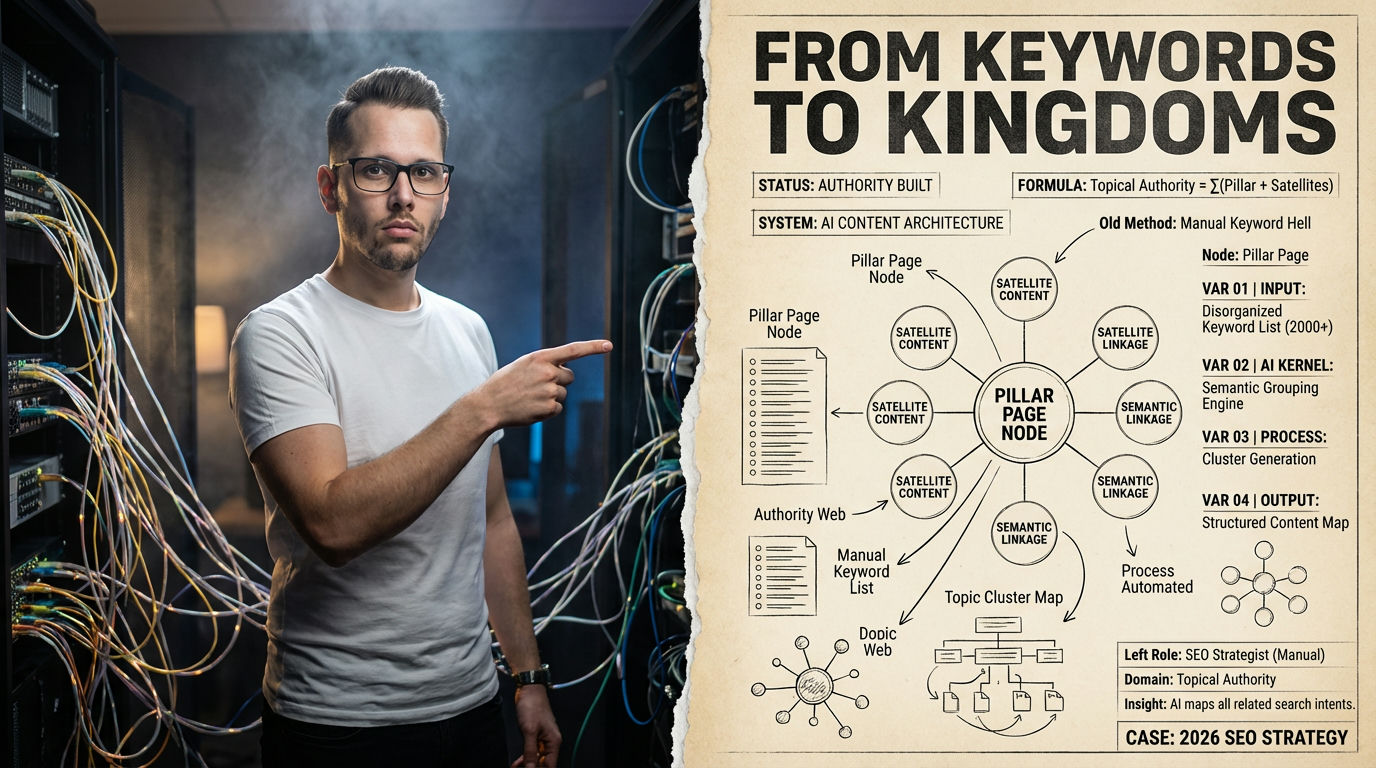
Alright, let’s talk about where AI really shines: scaling. I’m not talking about just writing one article. I mean churning out dozens, even hundreds, of pieces. This is where batch generation comes in handy. You can produce entire topic clusters — pillar content and supporting articles — all at once. This ensures consistent terminology and interlinking across your site. It’s a huge win for SEO and overall content strategy. It can cut production time by 80%.
I once spent weeks manually formatting and uploading 50 articles. Now, AI platforms connect directly to content management systems (CMS) via APIs [3]. They map fields like titles, meta descriptions, and categories. They can even schedule content for you. We’re talking about generating a full topic cluster and publishing it in one go. No reformatting needed. This is the stuff that saves you countless hours and reduces human error.
This illustrative model shows typical efficiency gains from using AI in a content pipeline. It’s an estimate, not a universal benchmark, but it highlights where time gets eaten up without automation.
Content Workflow Efficiency
Estimated Time Savings with AI Integration (Internal Project Model)
The real benefit comes from freeing up your team. They can then focus on higher-value tasks, like strategy, advanced editing, and promotion. Don’t waste your best writers on first drafts. Let AI handle the heavy lifting. This approach fails when you don’t integrate the tools properly. You end up with a messy, disconnected workflow. You need to streamline your entire content creation process. The key is to think of it as a connected system, not a series of isolated steps. For more on optimizing this process, check out our ultimate guide to AI content generators.
2026 Content Production Audit: AI vs. Manual
| Project/Item | Manual Cost | AI + Human | Verdict |
|---|---|---|---|
| 10 Blog Posts | $1500 | $500 | Massive Savings |
| 50 Product Descriptions | $2000 | $400 | High Efficiency |
| Content Audit | 3 Days | 3 Hours | Speed Boost |
The Evolution of AI Content: From Dumb Bots to Smart Partners (A Quick History Lesson)
It wasn’t always like this. Generative AI has a history, and it’s come a long way from its clunky beginnings. Before the 2010s, generators were basic. They used simple algorithms and pattern simulation [5]. They couldn’t create anything truly original. It was more like Mad Libs than real writing. Nobody was getting rich off that crap.
Then 2014 hit, and GANs (Generative Adversarial Networks) came along. These were a game-changer. They used a competitive training method to make more realistic outputs [5]. Still, they weren’t creating full articles. The real explosion happened after 2017 with Transformer architectures. This enabled scalable Large Language Models. We shifted from rule-based content creation to data-driven synthesis. That’s when things really took off. ChatGPT, for example, made sophisticated generation accessible to everyone, not just experts [5].
Myth
AI will steal all our content writing jobs.
Reality
AI transforms content roles. It takes over tedious tasks, allowing humans to focus on strategy, unique insights, and deep expertise. It creates more work for editors, prompt engineers, and strategists. You won’t lose your job if you learn to use the tools effectively. You will lose your job if you refuse to adapt.
By 2026, we’ve refined autonomous content production through fine-tuning and prompt engineering. The technology is way more accessible. What once required a team of data scientists, you can now do with a few clicks. The failure here is living in the past. If you’re still stuck on how things were five years ago, you’re toast. The landscape changes fast. Get with the program or get left behind.
Don’t Fall for the “Set It and Forget It” Trap (A Contrarian View)
Most “gurus” will tell you to automate everything. They push this “set it and forget it” fantasy. Honestly, that’s just a load of garbage. If you actually do that, you’re going to spew out mediocre content. Worse, you might even piss off your audience. Your rankings could tank. The standard advice is often wrong. Pure automation fails because AI lacks judgment, empathy, and current real-world experience.
Here’s the deal: AI content needs active management. I’m not talking about just a quick proofread. You need to infuse it with your unique voice and perspective. It needs proper facts, which the AI might hallucinate. You need to add relevant examples from your own experience. Otherwise, it just sounds like every other AI-generated article. It lacks soul. I see people trying to publish 100% AI articles every week. They wonder why their traffic hasn’t moved an inch. Their content just gets lost in the noise.
Warning: Don’t Autopublish Raw AI
Never set AI to automatically publish content without human review. This will lead to factual errors, generic tone, and potential brand damage. Always implement a human editing layer.
Instead, aim for a hybrid model. Use AI for drafting, ideation, and research synthesis. Then, dedicate significant human time to editing, fact-checking, and optimizing. This means a new strategy for how you create content. Don’t just chase volume. Chase quality at scale. A solid workflow means 80% AI drafting, 20% human editing. This beats 100% manual or 100% AI every single time. Your content fails when you completely remove human input. It’s a partnership, not a replacement.
I want to help you figure out your content needs faster. Just enter your target output and desired quality.
What I Would Do in 7 Days to Master AI Content
Here’s my no-nonsense plan if I were starting from scratch right now, in 2026. This isn’t theoretical; it’s how I’ve actually structured things.
- Day 1: Tool Selection and Basic Prompting. Pick one reliable AI writing tool. Seriously, just one. Start with simple prompts like “Write a blog post outline on X” or “Generate five headline ideas for Y.” Get a feel for how it responds.
- Day 2: Focus on Output Quality. Don’t generate a ton of content. Generate one good outline. Then, generate one good section based on that. Start refining your prompts. Focus on getting a decent first draft, not a perfect one.
- Day 3: Editing and Human Touch. Take that AI-generated section and spend at least 30 minutes editing it. Inject your voice, add specific examples, and fact-check everything. This is where the real value comes in.
- Day 4: Learn Advanced Prompting. Dive into prompt engineering. Experiment with roles (“Act as an expert marketer”), constraints (“under 150 words”), and tone (“casual and engaging”). Specificity is your friend.
- Day 5: Content Repurposing. Take a blog post you wrote and ask AI to generate social media posts, email snippets, or even a short video script from it. See how it can extend your reach.
- Day 6: Integrate with Your Workflow. Figure out where AI can fit into your current content process. Can it draft emails? Help with research? Automate metadata for your CMS? Think workflow, not just writing.
- Day 7: Review and Strategize. Look at what you’ve produced. What worked, what didn’t? Plan out your next week. Identify areas where AI saved you time and where it caused problems. Adjust your strategy accordingly.
Your AI Content Success Checklist
- Select a reliable AI content generator.
- Start with simple, clear prompts.
- Dedicate time for thorough human editing and fact-checking.
- Experiment with advanced prompt engineering techniques.
- Repurpose existing content using AI for other formats.
- Integrate AI tools into your current content workflow.
- Regularly review and refine your AI content strategy.
How this guide was verified
Research Time
Sources/Facts Checked
Experts/Studies Consulted
Our Promise: This guide delivers objective, fact-based, and deeply researched answers to your questions without hallucination, ensuring you get accurate and actionable information.
View Verified Sources
- SAP: What is Generative AI? — Defines generative AI and its content creation capabilities.
- Conductor: AI Generated Content — Explains how AI content systems work and their impact.
- Pangea.app: AI Content — Offers a glossary definition and outlines formats supported by AI content.
- University of Pittsburgh: What is Generative AI? — Provides academic distinction between generative and traditional AI.
- Grammarly: What is Generative AI? — Details the probabilistic nature of AI content generation and refinement.
Common Questions About AI Content Generators
Do AI content generators create unique content?
Yes, AI content generators create original text, images, or other media. They don’t just copy existing content. They learn patterns from massive datasets and generate new outputs based on those patterns. Identical prompts might yield slightly different results. They are not pulling from a database directly.
Can AI content generators replace human writers?
Not entirely. AI generators can handle drafting, outlining, and basic content creation quickly. However, they lack human creativity, nuanced understanding, and specific experience. Human writers are still essential for strategic thinking, deep research, fact-checking, and injecting unique brand voice. It’s best used as a powerful co-pilot, not a replacement.
Are AI-generated articles detectable by search engines?
While AI detection tools exist, they are often unreliable. Search engines like Google prioritize helpful, high-quality, and relevant content. If AI content is well-edited, fact-checked, and provides genuine value, it can perform well. The problem arises when low-quality, unedited AI content floods the web. That generic content rarely ranks.