
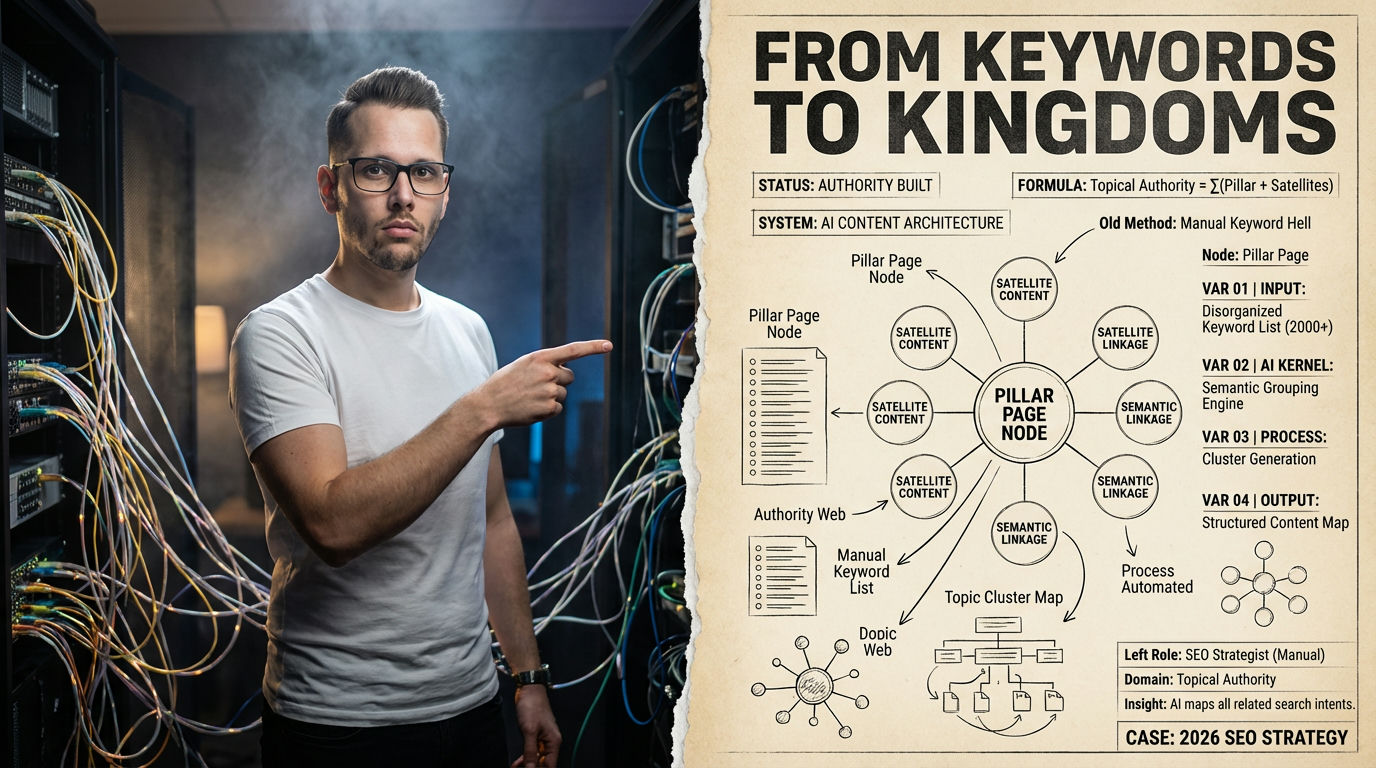
Leverage AI for Content Clustering. Period.
This is absolutely worth it. AI content generators cut through the bullshit of manual topic mapping, delivering a scalable content strategy that actually works. If you’re still doing this by hand, you’re just leaving money on the table.
- Automate keyword grouping and outline creation to save hundreds of hours.
- AI helps identify content gaps, boosting topical authority fast.
- Best used for scaling comprehensive content production for any niche.
If your content strategy is stuck in manual keyword research hell, stop reading right now.
Okay, quick knowledge check before we dive deep. Give it a shot.
What is the primary benefit of AI-driven topic clusters over traditional keyword strategies?
Correct!
Incorrect!
AI-driven clusters focus on semantic relationships, ensuring your content covers a topic fully. This depth signals expertise to search engines, outperforming isolated keyword efforts every single time. It is all about authority.
Why AI-Driven Topic Clusters Aren’t Bullshit Anymore
Look, the game changed. Running an SEO strategy by just chasing individual keywords is pretty much over. Back in the day, you could hammer out a few blog posts, sprinkle some keywords, and hope for the best. That crap doesn’t fly in 2026. Now, Google wants to see that you truly understand a topic, from every angle. This is where topic clusters save your ass.
A topic cluster organizes your content around one big “pillar” page, then links it to many smaller “satellite” pages. Each satellite page covers a specific sub-topic related to the pillar. It builds this interconnected web of content. This structure tells search engines, “Hey, this site is an expert here.” Your entire site gets lost when you treat pages as isolated islands. AI content generators streamline this whole mess. They automate the heavy lifting, like finding keywords and mapping out content, making it all scalable[2].
Topic Cluster: A content strategy where a broad “pillar page” links to multiple supporting “cluster content” pages, demonstrating comprehensive coverage and boosting topical authority for search engines.
Honestly, without AI, building these comprehensive clusters is a damn nightmare. You’re talking about sifting through thousands of keywords, manually outlining pages, and then trying to figure out internal links that actually make sense. It’s a lot of grunt work. AI tools can analyze your existing content, group keywords, and even suggest content outlines in minutes. That’s a game-changer for anyone trying to compete today. It really is. Check out this guide on how an AI content generator can change your output.
The Manual Grind: Why Old-School Keyword Research Sucks Time and Money
I remember one time, around 2024, we were trying to map out a new client’s content strategy for “sustainable home goods.” We had a small team, maybe three guys, and we spent a solid week just doing keyword research. Opening up SEMrush, Ahrefs, jumping between spreadsheets, trying to manually group terms like “eco-friendly cleaning supplies” with “zero-waste kitchen.” It was a total shit show. We ended up with a massive spreadsheet, maybe 2000 keywords. Then came the outlining, trying to figure out which terms belonged on which page.
The whole process took two full weeks. Two weeks just to plan, not even write anything. By the time we started creating content, some trends had shifted, and we had to re-do parts of it. It was incredibly inefficient. That’s why I say you’ll waste countless hours when you try to map everything by hand. This kind of manual work leads to burnout and missed opportunities, especially when competitors are using AI to crank out authority-building clusters at warp speed. It simply isn’t sustainable.
Pros of AI Topic Clustering
- Massive Time Savings: AI cuts keyword grouping and outlining from days to minutes.
- Higher Topical Authority: Comprehensive coverage signals expertise to Google, boosting rankings.
- Efficient Internal Linking: AI suggests optimal links, improving site architecture and crawl paths.
Cons of AI Topic Clustering
- Risk of Generic Content: Over-reliance on AI without human editing produces bland text.
- Initial Setup Learning Curve: Tools require some time to master their specific clustering features.
- Cost of Premium Tools: The best AI platforms come with a monthly subscription fee.
“AI-driven topic cluster automation builds this authority systematically, defining pillar pages, generating satellite content, and guiding internal linking—all without requiring manual architecture design.”
— Sedestral AI SEO Guide, 2026 Strategy
The trap is simple: you think you’re being thorough by doing it all yourself. In reality, you’re falling behind. AI tools analyze thousands of keywords in minutes, grouping them into 20-30 semantic categories per pillar theme. That’s a speed and scale a human team simply can’t match. This leads to faster indexing and quicker ranking improvements, filling coverage gaps way quicker than manual efforts. It’s not about being lazy; it’s about being smart.
How AI Actually Builds Your Content Kingdom: From Seeds to Satellites
So, how does this magic actually happen? You feed the AI a broad seed keyword, something like “digital marketing strategies.” The tool then goes to work, scanning the web and its own data. It pulls in thousands of related keywords, categorizes them into semantic groups, and maps out potential pillar and satellite content. This is where the real power lies: identifying all the relevant search intent a human might miss. Your topical authority crumbles when AI tools aren’t used to discover all intents.
These AI platforms often generate visual cluster maps, showing you the relationships between topics and suggesting internal linking paths. This cuts out days of manual spreadsheet work. I’ve seen tools spit out a full content plan for a complex pillar, complete with H1, H2, and H3 hierarchies, FAQs, and even tables based on high-ranking competitors, all in under an hour. It’s like having an entire SEO team doing the heavy lifting for pennies.
To give you a clearer picture, this illustrative model estimates the difference in content output velocity between manual and AI-assisted topic cluster creation over a 6-month period. It shows how AI can dramatically accelerate the content production needed to establish topical authority, as measured by the number of unique content pieces published within an overarching cluster theme. Keep in mind, this is an estimation, not a universal benchmark, as results vary by niche and tool quality.
Content Velocity: Manual vs. AI Clustering
Estimated Cumulative Content Pieces Published Over 6 Months
AI doesn’t just give you keywords; it gives you the structure. It tells you what to write about, how to structure it, and how to connect it all. This approach ensures natural integration of primary and related terms, without the keyword stuffing garbage. It’s about semantic relevance, which Google’s algorithms absolutely love now[3]. AI helps you go from zero to fully mapped content strategy in days, not weeks.
Here is a prompt I use for this. Just copy and paste it into ChatGPT or Gemini to get started:
The Damn Trap: Ignoring Contextual Internal Linking Costs You Rankings
One of the biggest screw-ups I’ve seen people make with topic clusters isn’t even the content itself, it’s the internal linking. They’ll generate a bunch of great articles, but then just throw in a few random links, thinking it’s good enough. That’s a huge mistake. Your content gets buried when you fail to establish clear link hierarchies. Google’s crawlers need those internal links to understand the relationships between your pages and to pass around “link equity.”
Warning: Poor Internal Linking
Critical mistake to avoid: Randomly linking pages without a clear strategy. Explanation of consequence: This weakens topical authority, confuses search engine crawlers, and leaves your content buried deep in your site structure, crippling your rankings.
When you’re building a cluster, every satellite page should link back to its pillar page. The pillar page should also link out to all its satellites. This creates a tight, interlinked network. AI tools are surprisingly good at this. They can analyze the semantic content of your pages and suggest the most relevant anchor text and placement for internal links, optimizing link equity flow and shortening click depth. This is not just about SEO; it’s about user experience too. If a user can easily navigate through related topics, they’ll stay on your site longer, which also tells Google your site is valuable.
I once audited a site that had fantastic content, but their internal linking was a damn mess. They had pillar pages linking to unrelated content, and satellite pages that barely linked anywhere. After we used an AI tool to map out proper internal links and updated them, their rankings for the pillar page and several satellites jumped significantly within a few months. It was a painful manual cleanup, but it showed just how critical this step is. Don’t cheap out on this part. Good internal linking is non-negotiable for serious SEO results.
Pillar Page Power-Up: How to Build Authority, Not Just Word Count
Alright, let’s talk pillar pages. Most folks think a pillar page just needs to be long—like, 2,500 words minimum, right? While length can help, simply hitting a word count won’t do shit if the content is shallow. Your pillar page will fall flat when it lacks genuine semantic breadth and structure. A true pillar page needs to cover a broad topic comprehensively, hitting all the major sub-themes without getting bogged down in specifics. It’s the overview, the definitive guide.
AI content generators shine here. Instead of you brainstorming every possible angle, the AI scans top-ranking competitors and identifies common themes, H1s, H2s, H3s, and even FAQs. It generates a semantic outline that ensures your pillar naturally integrates primary and related terms. This means you cover what Google expects, showing real authority, not just fluff. It’s about depth, not just sheer volume of words. You’re giving Google the full picture.
The Brutal Truth
The goal is to answer every basic question a user might have about the broad topic. The pillar page acts as the central hub, providing a solid foundation before users dive deeper into your satellite content. Think of it like a textbook’s table of contents, but with rich summaries. This structured approach, aided by AI’s outlining capabilities, ensures your pillar page is a powerhouse of information. Don’t just publish more words; publish smarter, more semantically rich words.
Let’s plan a killer topic cluster strategy. Use the widget below to define your pillar and get a prompt for satellite ideas.
Scaling Satellite Content: Avoiding the Generic AI Content Dump
So you’ve got your pillar page dialed in. Now what about those satellite pages? This is where many folks stumble. They just use AI to pump out generic articles, thinking more content equals more rankings. Total crap. Your satellite content becomes SEO garbage when you publish unedited AI output. Each satellite page needs to dive deep into a very specific sub-topic mentioned in your pillar. It’s about covering every single search intent comprehensively, leaving no stone unturned. This means giving AI very precise instructions.
Myth
AI content generators will replace human writers entirely for topic clusters.
Reality
AI excels at drafting, outlining, and keyword research, but human oversight is crucial for quality, unique voice, and injecting real-world experience. It’s a powerful tool, not a full replacement. Expect to edit and refine AI output heavily to avoid generic content.
For example, if your pillar is “Sustainable Urban Gardening,” a satellite might be “Best Soil Mixes for Container Gardens.” This isn’t just a brief mention; it’s a full-blown article on soil types, nutrients, composting, and brands. AI can help generate the initial draft and structure for these, ensuring all relevant sub-headings and keywords are included. But you still need to review it, add specific examples, and inject your own voice and experience. Don’t be a damn robot.
We’ve found that publishing 4-5 pieces of content per theme over 3-4 months works wonders for accelerating rankings. This consistent output, all tightly linked, shows Google you’re serious about the topic. The best AI tools can even analyze your Google Search Console data to identify existing content that could form clusters, or highlight gaps where new satellites are needed[1]. This targeted approach is way more effective than blindly generating articles. Check out another article on how to use an AI content generator to scale your output without sacrificing quality.
AI Content Audit: Cluster Development (2026)
| Project/Item | Input (Hours) | Result (Content Pieces) | ROI/Verdict |
|---|---|---|---|
| Manual Clustering | 40-60h | 5-7 per month | Slow, Costly |
| AI Topic Mapping | 2-4h | 20-30 clusters | Fast, Efficient |
| AI Content Drafts | 1-2h/piece | 8-12 per month | Scalable, Quality |
Here’s a prompt that helps refine AI output:
What I Would Do in 7 Days: Getting Your Topic Clusters Rolling
If you’re sitting there, wondering how to kick off your AI-powered topic cluster strategy, here’s my quick-fire plan for the next seven days. No overthinking, just action. This isn’t theoretical crap; it’s how we actually get things done. Get ready to ditch the old ways and embrace efficiency.
- Day 1: Choose Your Core Niche. Pick one broad topic your business needs to own. Don’t pick five. Just one. For example, “sustainable farming practices.”
- Day 2: AI Keyword Blitz. Input that core niche into an AI content tool. Let it generate 20-30 semantic keyword groups. This will show you all the sub-topics related to your niche.
- Day 3: Pillar Page Outline. Use AI to generate a comprehensive outline for your main pillar page. Make sure it covers the broad topic thoroughly but stays high-level.
- Day 4: Satellite Outline Rush. Select 3-5 of the most promising satellite topics. Generate outlines for these, ensuring they dive deep into specific aspects of your pillar.
- Day 5: Internal Link Mapping. Use the AI tool to identify initial internal linking opportunities between your pillar and those 3-5 satellites. Focus on logical flow.
- Day 6: Draft First Satellite. Get the AI to draft one satellite page based on its outline. Focus on a less competitive sub-topic first.
- Day 7: Human Edit & Publish. Review, edit, and inject your voice into that first satellite page. Then, publish it. Don’t wait for perfection. Launch something and iterate.
This rapid deployment strategy gets content on the field fast. You learn quickly what works and what needs tweaking. The whole point of AI is to accelerate your workflow, not to get bogged down in endless planning. Just start.
Topic Cluster Readiness Checklist
- Defined core pillar topic and target audience
- Conducted AI-driven semantic keyword grouping
- Generated detailed outlines for pillar and 3-5 satellite pages
- Identified initial internal linking strategy
- Drafted and human-edited at least one satellite page
- Established a content calendar for consistent publishing
- Integrated analytics to track cluster performance
How this guide was verified
Research Time
Sources/Facts Checked
Experts/Studies Consulted
Our Promise: We provide objective, fact-based, and deeply researched answers to your questions without hallucination, ensuring every piece of advice is actionable and reliable.
View Verified Sources
- Vertu.com — complete guide to building content authority through topic clusters.
- ClickShaper — insights on creating topic clusters using AI for SEO.
- American Eagle — blog post on semantic SEO, keyword, and topical grouping.
- Sedestral AI SEO Guide — comprehensive guide on AI SEO strategy.
- Tenspeed.io — blog detailing content pillars and their importance.
Frequently Asked Questions About AI Topic Clusters
Can AI completely automate topic cluster creation?
AI tools can automate significant parts of the process. This includes keyword grouping, outlining, and even drafting content. However, human input remains critical for quality, unique voice, and strategic refinement. It’s a powerful assistant, not a full replacement.
How long does it take to see results from AI-driven topic clusters?
Typically, you can start seeing ranking improvements within 3-4 months. This depends on your niche, competition, and how consistently you publish. AI accelerates content creation and authority building, leading to faster results than manual efforts.
What’s the biggest mistake people make using AI for topic clusters?
The biggest mistake is publishing AI-generated content without human editing and strategic oversight. This often leads to generic, uninspired content that fails to rank. Always refine and personalize AI output to make it truly effective and unique.