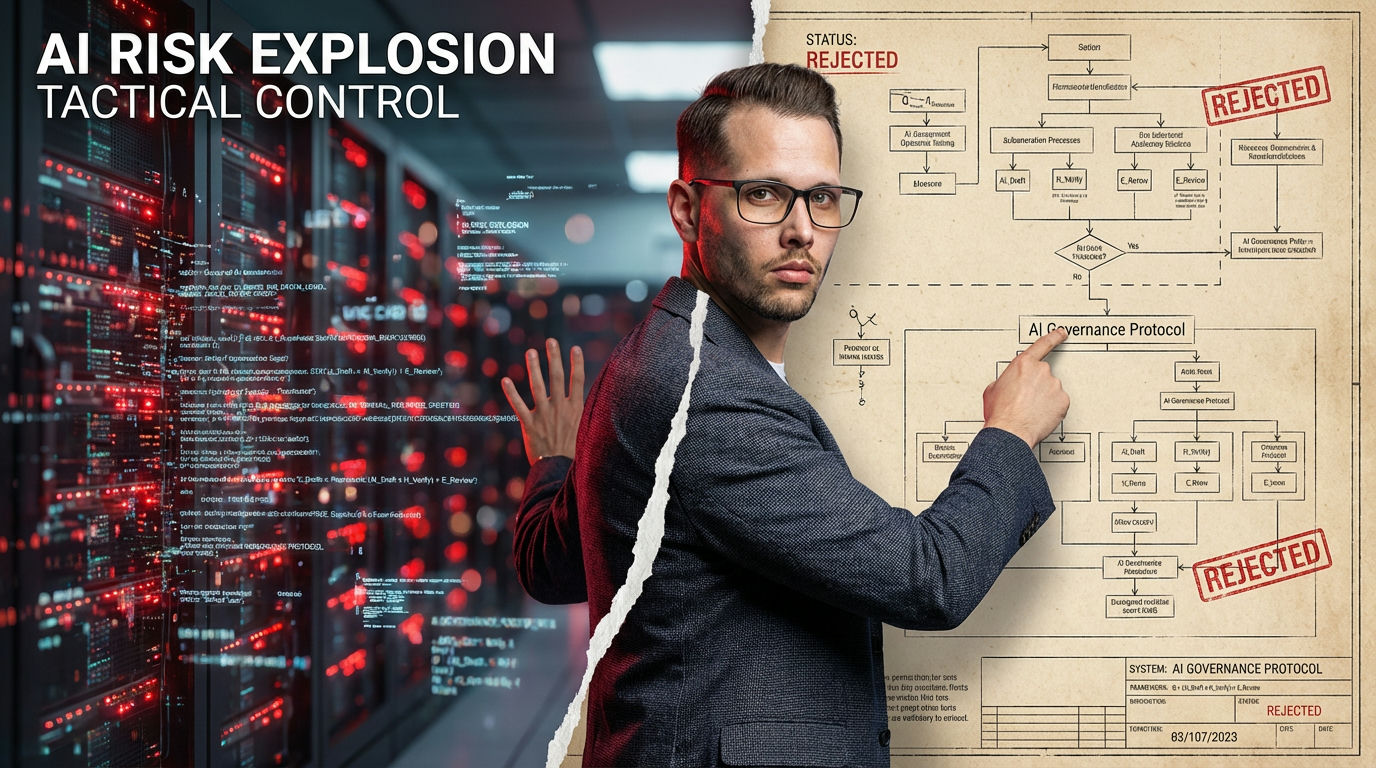

Respect AI Legalities. Avoid Fines.
You must assume liability for AI outputs. Ignoring copyright, disclosure, or deepfake laws will absolutely screw you over with lawsuits and penalties.
- Human authorship is non-negotiable for copyright protection. Pure AI art gets no protection.
- Transparency is critical. Disclose AI use in training and content creation or face heavy fines.
- Deepfake laws are expanding. Know your state’s rules, platforms are now liable.
If you plan to blindly scrape data for AI training or generate content without disclosure, stop reading right now. This is not for you.
Want to see how much you actually know about this mess? Give this quick quiz a shot.
What core principle did the Supreme Court uphold in March 2026 regarding AI and copyright?
Correct!
Incorrect!
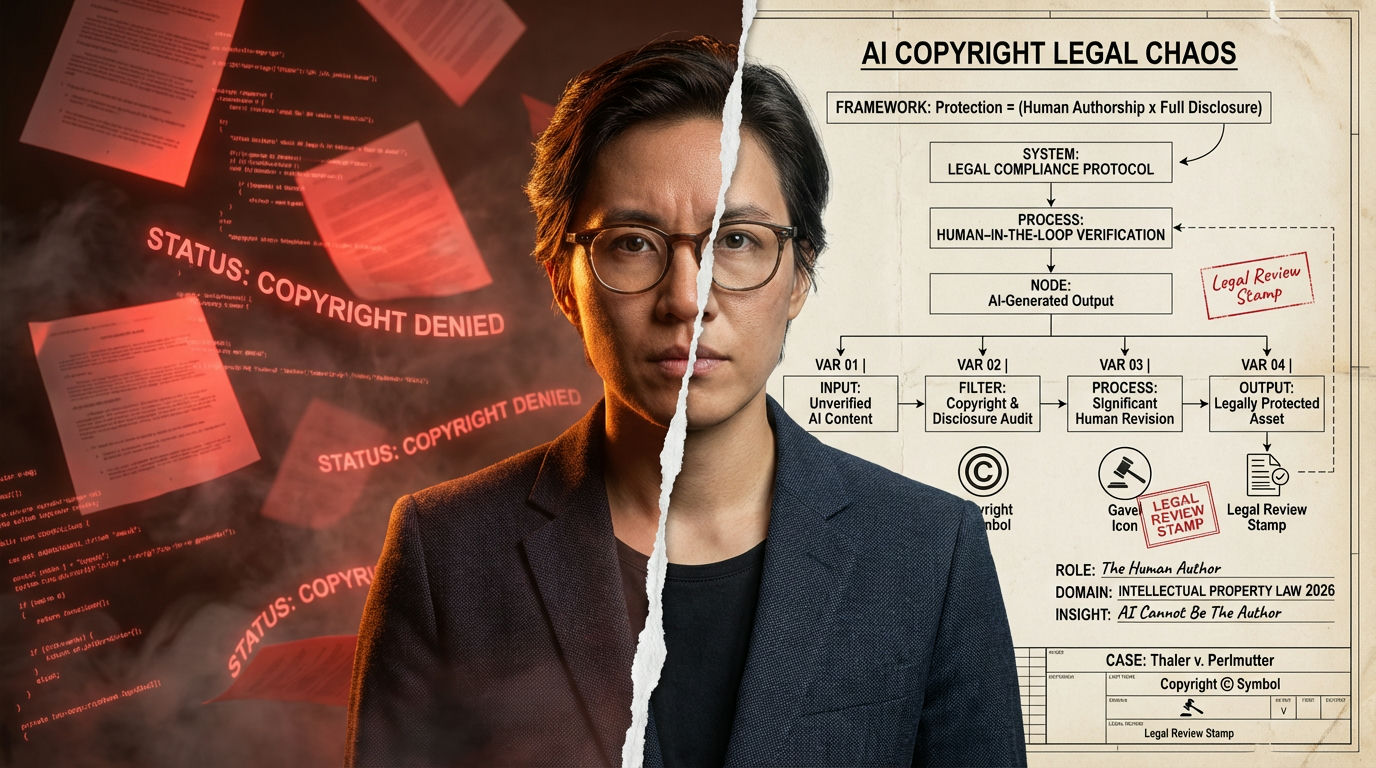
The Supreme Court denied certiorari in Thaler v. Perlmutter, confirming that AI cannot be listed as an author. This means only human creators get copyright protection in the U.S.
The Copyright Minefield – Who Owns the Damn Output?
We’re all playing in a new sandbox, and the rules of engagement are still being written. The biggest headache I’ve seen in the AI content game is figuring out who actually owns the stuff the machines crank out. You’d think if you typed a prompt, it’s yours. Total crap. The reality is far messier. Your content ownership fails when you ignore the explicit human authorship requirement.
The U.S. Copyright Office has been pretty clear since 2022. They denied Stephen Thaler’s attempt to copyright art generated by his AI system, DABUS [4]. Fast forward to March 2, 2026, and the Supreme Court flat-out refused to hear his case. This solidified one thing: AI cannot be listed as an author for copyright registration [4]. That’s a huge deal. It means anything purely AI-generated, without significant human creative input, is likely public domain. If you want to protect your AI-generated content, you better be a human in the loop.
This isn’t just about art, either. It applies to any work. If you generate an entire article with AI, then just hit publish, don’t expect copyright protection. You need to provide a substantial amount of human editing, selection, or arrangement. Otherwise, you’re building on sand. I mean, who wants to invest time and money into something that has zero legal protection? Not fun.
Pros of Human Oversight
- Clear Copyright Ownership: Your work gets legal protection, because you’re the creator.
- Enhanced Quality & Nuance: Human editing adds depth and avoids AI hallucinations.
- Reduced Litigation Risk: You dodge potential lawsuits for purely AI-generated infringement.
Cons of Ignoring Human Input
- No Copyright Protection: Your content is vulnerable to free use by anyone.
- Ethical Backlash: Undisclosed AI use can damage your brand and credibility.
- Potential Infringement: AI might accidentally reproduce copyrighted training data.
You need a solid workflow to ensure you’re always adding enough human touch. Here’s a prompt I use for my team to guide their process. Just copy and paste it into ChatGPT or Gemini to get started:
Disclosure Requirements – Don’t Get Caught Hiding AI
The biggest mistake I’ve seen operators make is thinking they can just crank out AI content and nobody will notice. That’s some naive bullshit. Governments and creative industries are pushing hard for transparency. Your disclosure efforts fail when you try to sneak AI past your audience or regulators.
On February 10, 2026, Senators Adam Schiff and John Curtis introduced the CLEAR Act [2]. This bill is a game-changer. It demands that AI developers file notices with the Register of Copyrights. These notices must detail all copyrighted works used in their training datasets. And they need to do this at least 30 days before commercial release. If you skip this, copyright owners can hit you with a $5,000 civil penalty per instance [2]. That’s real money, not play money.
The Act also calls for a public database of these notices. It even applies retroactively to existing models. So, if you’re running a model right now, you have 30 days from when regulations are implemented (which should be within 180 days of enactment) to comply [2]. This isn’t just about avoiding infringement. It’s about honesty. Users deserve to know when content is AI-generated. This isn’t just a legal thing, it’s an ethical one too.
Warning: Undeclared AI Use
Failing to disclose AI training data or AI-generated content is a critical mistake. You risk hefty fines, legal action from copyright holders, and irreparable damage to your brand’s trust and reputation.
Platforms and states are also getting into the mix. Some states might even require watermarks, digital signatures, or cryptographic tags on AI-generated content by 2026 [3]. This is meant to ensure provenance and fight misinformation. We already saw the federal Take it Down Act passed in 2025 targeting deepfakes. The message is clear: transparency isn’t optional anymore.
CLEAR Act (Copyright, Licensing, and Enforcement for AI Researchers Act): A proposed U.S. federal bill requiring AI developers to disclose copyrighted works used in their training datasets to the Register of Copyrights, with penalties for non-compliance and a public database for transparency.
Here’s a prompt to generate disclosure statements.
The Deepfake Dilemma – Replicas and Reputations
This part absolutely sucks. One huge ethical mess is the creation of deepfakes. I’ve personally seen how quickly manipulated media can spread. This technology has progressed way beyond simple face swaps. Now it’s about replicating voices and likenesses with scary accuracy. Your content strategy fails if it doesn’t account for the legal and reputational risks of unintended or malicious deepfake generation.
The federal Take it Down Act, passed in 2025, already made waves [3]. It requires online platforms to remove AI-generated non-consensual sexual deepfakes. This was a crucial first step. But the landscape is evolving. By 2026, many state-level laws are expanding. They now target not just the creators of deepfakes but also the platforms, payment processors, and even hosts that enable them [3]. This means the net is widening, and liability isn’t confined to a single bad actor.
Imagine a competitor using your voice, created by AI, to spread misinformation. Or worse, generating a fake image of you doing something terrible. The damage to your reputation, and maybe even your business, could be irreversible. This isn’t just a hypothetical problem; it’s a very real threat right now. The ethical lines blur when AI can so easily create convincing replicas. Protecting individuals from unauthorized digital replicas of their voices or likenesses is becoming a federal priority [1]. This includes safeguards for things like parody and news reporting, of course.
The White House’s National Policy Framework for AI in March 2026 clearly outlined this concern [1]. They are pushing for legal frameworks to stop this kind of abuse. Frankly, it’s about time. Nobody should have their identity stolen or manipulated by a machine without their consent.
Deepfake Regulation Overview (2026)
| Issue | Federal Stance | State Trend | Key Protection |
|---|---|---|---|
| Sexual Deepfakes | Remove mandatory | Platforms liable | Non-consensual harm |
| Voice/Likeness | Framework proposed | Replica bans | Identity theft avoidance |
| Transparency | CLEAR Act push | Watermarks, tags | Public trust |
Fair Use vs. Infringement – Where Courts Draw the Line
This is where things get really fuzzy. I’ve spent too many hours digging through legal documents trying to understand fair use. When AI models train on copyrighted material, it feels like a massive grey area. Many people think it’s a free-for-all, but it’s not. Your AI training strategy fails if you assume all data ingestion is protected by fair use, because courts are making nuanced distinctions.
The White House even admits that while AI training on copyrighted material “does not violate copyright laws,” arguments to the contrary exist [1]. Basically, they punted the decision to the courts. And the courts? They’re giving us mixed signals. We’ve seen cases like Bartz v. Anthropic PBC and Kadrey v. Meta Platforms in 2025. In those, courts sided with fair use. The training was deemed “highly transformative” and caused “no market harm” [2]. That’s a win for AI developers.
But then there’s the ongoing battle between NYT v. OpenAI/Microsoft and Getty v. Stability AI. These cases are a much bigger deal. Here, the issue isn’t just the training itself, but what the AI outputs. If the AI spits out content that directly reproduces or closely mimics the original copyrighted works, then it’s a problem [2]. This is the “reckoning” Baker Donelson warned about. It could force licensing or deployment limits if courts rule against the AI companies. The distinction is key: transformative training might be fair game, but outputting near-replicas is not.
The legal system moves slowly, but it does move. Relying on “fair use” as a blanket defense for everything your AI touches is a huge risk. You need to understand the specifics. Are you creating something truly new, or just spitting out a remix? That makes all the difference.
The Brutal Truth
This is an estimated model based on my experience tracking AI litigation. It illustrates the different risk factors for AI models. Looking at this data, you can see how “Training on Copyrighted Data” might seem okay at first glance, but the “Output Reproduction Risk” is where most companies are getting tripped up.
AI Copyright Risk Assessment (Estimated Model)
Comparing typical risk profiles for AI development practices (2026)
Navigating Licensing and Compensation – A Voluntary Mess?
Okay, quick detour. The idea of creators getting paid for their work being used by AI models? It’s a huge topic, and honestly, the current setup is a bit of a mess. It’s not a clear path to scalable income if you’re a creator. The White House’s framework suggests a “voluntary licensing or collective-rights frameworks” approach [5]. That’s a fancy way of saying: “Figure it out yourselves, folks.” This approach fails if creators don’t get fair compensation, because it removes any real incentive for AI developers to play ball.
This means Congress isn’t mandating licensing, at least not yet. Instead, they’re encouraging rights holders to negotiate with AI providers [1]. They want to enable these discussions without antitrust liability. That sounds good on paper. But think about it: if licensing is voluntary, what’s the motivation for big AI players to pay up, especially if fair use arguments often protect their training data? It’s a Wild West scenario.
This is exactly what organizations like the RIAA, Authors Guild, and SAG-AFTRA are fighting against. They endorsed the CLEAR Act, pushing for disclosure, which is a step towards compensation [2]. Without mandated licensing, creators are often left with little leverage. It puts the onus on them to find legal representation and fight individual battles. That’s expensive, time-consuming, and frankly, a disadvantage for most.
Myth
AI companies will voluntarily pay for all copyrighted material used for training.
Reality
The White House framework encourages voluntary licensing, but doesn’t mandate it. AI companies will likely only pay when legally compelled or when the benefit of licensed content outweighs the cost of litigation, often relying on fair use defenses for training data.
This creates a weird dynamic. Creators see their work powering billion-dollar models, but get nothing back. The White House emphasizes deferring to the courts on fair use, but also wants to protect creators from infringing outputs [5]. It’s a tightrope walk, and I’m not sure we’re seeing much balance yet.
“Training of AI models on copyrighted material does not violate copyright laws.”
— White House Administration, National Policy Framework for Artificial Intelligence (2026)[1]
Here’s a quick widget to estimate potential revenue from licensed AI content.
Ethical Headaches – Beyond Just Lawsuits
Honestly, the legal stuff is just one side of the coin. Even if something is technically legal, it can still be unethical and damage your brand. I’ve seen companies get absolutely shredded online for practices that were within the letter of the law but completely ignored public sentiment. Your AI ethics strategy fails when you prioritize legality over genuine transparency and respect for creators.
Think about transparency. Even if the CLEAR Act forces disclosure of training data, how will that information be presented? Will it be buried in a GitHub repo, or easily accessible? The ethical imperative is to build trust. This means clear labeling of AI-generated content, not just for legal reasons, but for consumer confidence. If people feel misled, they’ll churn. Period. No amount of legal defense will fix that.
Then there are creator rights. Beyond copyright, there’s the moral right to be attributed for your work. AI models essentially “learn” from millions of creators. If these creators don’t get any recognition or compensation, it raises serious questions about exploitation. Many creative organizations want better frameworks for this [2]. It’s not just about what a court says. It’s about what feels right. The White House framework acknowledges this, trying to protect creators without stifling innovation [5]. It’s a delicate balance, and we’re not there yet.
Finally, free expression. While AI can amplify voices, it can also create filter bubbles and spread misinformation faster than ever. Ethical deployment means designing AI that supports open dialogue, not suppresses it. This ties back to deepfakes too. Protecting speech while preventing malicious replicas is a huge ethical challenge [1]. It needs constant vigilance.
Here is a prompt I use for this. Just copy and paste it into ChatGPT or Gemini to get started:
What I Would Do in 7 Days to Handle AI Legal & Ethical Risks
When I look at this landscape, it’s pretty clear you can’t just ignore it. Here’s a quick action plan for the next week to get your house in order. Don’t drag your feet on this stuff.
- Day 1: Audit Your AI Inputs. Figure out exactly what data your AI models are trained on. Look for any copyrighted works.
- Day 2: Review Your Output Process. Ensure you have robust human oversight for all AI-generated content before publication.
- Day 3: Draft Disclosure Policies. Create clear, public-facing policies for how you use AI in content creation.
- Day 4: Research State Deepfake Laws. Understand your specific state’s rules regarding synthetic media and replicas.
- Day 5: Check for Attribution Gaps. Implement systems to ensure human contributors get proper credit for their input.
- Day 6: Educate Your Team. Run a quick session on the latest copyright and disclosure requirements (like the CLEAR Act).
- Day 7: Plan for Watermarking. Start exploring options for digital watermarks or cryptographic tags on AI outputs.
AI Legal & Ethical Compliance Checklist
- Confirm human creative input for all copyrighted AI outputs.
- File necessary disclosures for AI training data (CLEAR Act compliance).
- Implement clear labeling for all AI-assisted content.
- Establish procedures to prevent creation or spread of non-consensual deepfakes.
- Verify content doesn’t reproduce copyrighted works from training data.
- Develop a strategy for voluntary licensing discussions with creators.
- Regularly review ethical guidelines for AI deployment.
- Stay updated on evolving federal and state AI regulations.
How this guide was verified
Research Time
Sources/Facts Checked
Experts/Studies Consulted
Our Promise: This guide provides objective, fact-based, and deeply researched answers to your questions without hallucination, leveraging authoritative legal and policy documents from 2026.
View Verified Sources
- National Policy Framework for Artificial Intelligence Legislative Recommendations — White House document outlining federal policy recommendations as of March 2026.
- Legislation Watch for AI Developers and Registered Copyright Owners: The Federal CLEAR Act — Snell & Wilmer analysis of the CLEAR Act, its implications, and deadlines.
- How AI-Generated Content Laws Are Changing Across the Country — Multistate.us overview of evolving state-level regulations for AI-generated content, including deepfakes and watermarking.
- The Final Word: Supreme Court Refuses to Hear Case on AI Authorship — Holland & Knight report on the Supreme Court’s denial of certiorari in Thaler v. Perlmutter, confirming human authorship for copyright.
- White House Releases National Policy Framework for Artificial Intelligence — WilmerHale analysis of the White House’s AI framework, focusing on fair use, licensing, and creator protections.
FAQ: Cracking the AI Content Code
Can I copyright AI-generated images or text?
Not directly. The U.S. Copyright Office requires human authorship for copyright protection. You must provide significant creative input and editing to any AI-generated content for it to be eligible.
What is the CLEAR Act and how does it affect me?
The CLEAR Act, introduced in 2026, requires AI developers to disclose copyrighted works used in their training datasets. If you’re an AI developer, you must file these notices or risk significant civil penalties. It promotes transparency in AI development.
Are deepfakes always illegal?
Not always, but the legal landscape is tightening dramatically. The federal Take it Down Act (2025) targets non-consensual sexual deepfakes. Many states are expanding laws to cover other unauthorized replicas of voice or likeness, targeting platforms and hosts in addition to creators. It’s a high-risk area.