
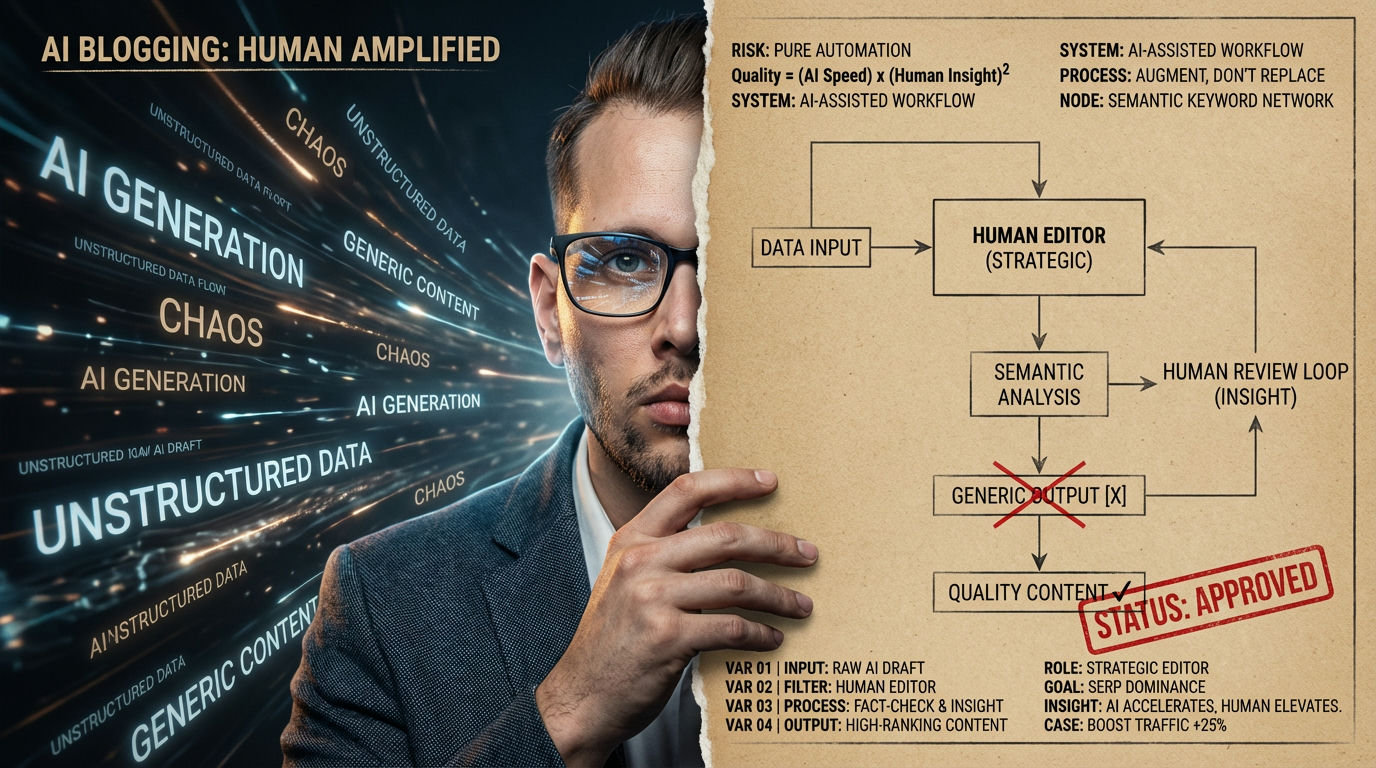
Leverage AI, Don’t Automate
If you leverage AI for speed and data, you win. If you automate your entire process, you lose. Pure AI-generated content is often bland and fails to resonate with a human audience.
- AI significantly boosts content creation speed and volume.
- Over-reliance on AI without human input leads to generic, low-ranking content.
- Use AI for research, ideas, and first drafts; always add unique human insights.
If your goal is to publish unedited AI drivel, stop reading. That strategy is total crap and will not work long-term.
Think you know everything about using AI for blogging? Take this quick quiz to test your knowledge.
What percentage of organic traffic does Gartner predict will come from AI chatbots by 2026, forcing bloggers to adapt?
Correct!
Incorrect!
Gartner predicts that 25% of organic traffic will derive from AI chatbots by 2026[3]. This means bloggers need to optimize for question-based queries and direct answers, not just traditional keywords. It’s a fundamental shift in how people find information.
AI-Assisted vs. Fully Automated Blogging
| Criterion | AI-Assisted | Fully Automated |
|---|---|---|
| Use Case | Content acceleration, idea generation | Quantity-focused, hands-off scaling |
| Strengths | Speed, semantic depth, human touch | High volume, low labor cost |
| Limitations | Requires significant human editing | Generic, poor quality, low engagement |
AI & Keyword Research: Stop Chasing Bullshit Queries
I once spent damn near a whole afternoon manually digging for long-tail keywords. It was tedious, slow, and half the time, the terms were pure garbage. This fails when you rely solely on manual, gut-feeling research in 2026; you miss massive opportunities for semantic coverage.
AI tools can instantly identify vast networks of related terms. They don’t just spit out keywords; they help find the deeper intent behind them. This is how you get 78% more semantic keywords than human-written pieces[4]. It’s not about stuffing keywords anymore. It’s about covering every angle a user might search from.
Use this prompt in your AI tool. It gives you a starting point that’s way more comprehensive than just brainstorming alone. The point is to cover more ground, faster. You want to understand what people are actually asking, not just what words they are typing. This helps you build a solid foundation for your content strategy.
How this guide was verified
Research Time
Sources/Facts Checked
Experts/Studies Consulted
Our Promise: This guide delivers objective, fact-based, and deeply researched answers to your questions without hallucination.
View Verified Sources
- Backlinko – Blogging Statistics: The Latest Trends & Data (2026) — provides current data on AI adoption and usage in blogging.
- The Digital Elevator – AI Statistics (2026) — offers statistics on efficiency and volume increases from AI writing tools.
- Eesel.ai – 2026 Predictions for Blog Writing with AI — outlines future trends like Answer Engine Optimization and human-centric content.
- BlogRecode – Why AI-Generated Blogs Might Outrank You — discusses AI’s impact on keyword coverage and ranking potential.
- KeoMarketing – Marketing Analytics & Attribution Guide — confirms B2B reliance on AI for blog production.
Structuring Content with AI: Don’t Build a Shitty Outline
I used to spend 30-45 minutes crafting a detailed outline. Then I’d get halfway through drafting and realize the flow was off, or I missed a crucial point. It was a damn waste of time. Your outline process fails if it’s too rigid and doesn’t adapt to new information or AI insights.
AI can generate initial outlines in minutes. More than that, you can have a conversation with the AI to refine it. Ask it to “make it punchier” or “add a section on X.” This iterative process is a game-changer. About 54% of bloggers use AI for outlines and 58% for headlines, streamlining these crucial early steps[1].
This prompt isn’t just about speed. It ensures your outline is built on a foundation of popular queries and related topics. That means your content is more likely to rank and satisfy search intent. Don’t be afraid to experiment with different angles using AI before settling on a final structure.
Pros of AI in Blogging
Cons of AI in Blogging
- Risk of Generic Content: Outputs can be bland without human refinement.
- Accuracy Issues: AI sometimes hallucinates, needing fact-checking.
- Lacks Human Touch: Personal anecdotes and unique insights are missing.
Drafting with AI: The Trap of Generic Crap
I’ve seen so many folks try to just dump an AI output onto their blog. Seriously, it’s total crap. The resulting article reads like a textbook and gets zero engagement. Your drafting process fails when you skip the human editing and personalization phase, making your content forgettable.
AI tools like Jasper AI can generate substantial first drafts quickly. This is where AI truly shines for scaling. Organizations using these tools report 59% faster content creation and 77% higher output volume[2]. But this only works if you understand that the AI’s draft is just that: a draft. It’s a starting point, not the finish line.
Think of the AI as a super-fast intern who writes all the basic stuff. Then you, the expert, come in and add the real value. This means injecting your unique voice, specific examples, and lived experience. If you need a comprehensive resource on getting the most out of these tools, check out this excellent AI content generator ultimate guide. It covers everything from basic prompts to advanced workflows. You might even find some hidden gems for your own process.
The Brutal Truth
This approach transforms content creation. Instead of spending hours on initial writing, you spend that time on making the content better. That’s how you get efficient without sacrificing quality.
Optimizing AI Content for SEO: Don’t Let it Sink
I once had an AI article about “best camping gear” that sounded great but just wouldn’t rank. It was well-written, but it lacked the specific semantic depth Google craves. The piece just sank like a stone. Your content’s SEO fails when it’s not explicitly optimized beyond surface-level keyword inclusion.
AI tools can help you cover 78% more semantic keywords than manual writing efforts. This isn’t about keyword stuffing; it’s about context. Tools like Surfer AI build articles using SERP data to include relevant headings and terms that top-ranking pages use. This is crucial for optimizing your AI-generated draft.
With 25% of organic traffic predicted to come from AI chatbots by 2026, you also need to think about Answer Engine Optimization (AEO)[3]. This means writing direct answers to common questions. Don’t just target keywords. Target the questions people are asking. This ensures your AI-assisted content is ready for the evolving search landscape.
Here’s an estimated model based on my experience showing the SEO performance impact:
Estimated SEO Performance Gains by AI Integration (2026)
Illustrative model of content ranking changes based on AI assistance levels
This chart illustrates how different levels of AI integration might affect your SEO performance. “Avg. Keyword Coverage” shows how many relevant terms your content hits, while “Avg. Ranking Position” indicates where your articles appear in search results (lower is better). As you can see, basic AI assistance improves coverage and rankings over no AI at all. However, a fully AI-generated article that is left unedited might cover many keywords but still rank poorly due to lack of quality and context. The sweet spot is a full AI workflow with human editing. This blend provides extensive keyword coverage and strong ranking potential. Remember, this is an estimated model based on observed trends, not a universal benchmark.
Warning: Over-Optimization Risks
Don’t let AI stuff keywords. While AI can find more semantic keywords, blindly adding them without natural integration can lead to Google penalties. Always review for readability and natural language.
Injecting Human Experience: Why Pure AI Blogs Are Garbage
I remember a marketing agency client in 2025 who swore by 100% AI-generated blogs. They churned out 50 articles a month. Their traffic? Flatlined. Conversions? Zero. It was a damn expensive lesson. Your content strategy is garbage if it lacks the genuine human experience that Google’s “people-first” content updates prioritize.
Eesel.ai analysts hit the nail on the head: “Generative AI is everywhere… but it can’t live your life. It can’t test a product [or] feel the frustration”[3]. This means AI can write about a topic, but it can’t share a story about how you actually fixed a botched WordPress update at 3 AM. That’s the stuff people connect with.
Originality is king now, especially with the web flooding with generic AI content. Your job isn’t to just publish what the machine says. It’s to add the details, the specific advice, the personality. This is your differentiating factor. If you don’t do this, your blog becomes just another voice in the crowd, and nobody needs that noise.
Myth
AI will replace human bloggers entirely.
Reality
AI is a powerful tool for augmentation, not total replacement. 95% of bloggers use AI at least sometimes, but human oversight is crucial for authenticity, unique insights, and avoiding generic content. Humans provide the experience AI cannot replicate.[1]
This means your role shifts from content generator to content curator and enhancer. You take the AI’s speed and apply your human brain to make it impactful. Otherwise, you’re just contributing to the content glut nobody cares about.
Publishing & Beyond: Avoid Content Graveyards
I’ve been there. You hit publish, then forget about it. That’s how content graveyards are born. A post sitting there, unpromoted, unrefreshed, doing absolutely nothing for your business. Publishing fails when you treat it as the finish line, instead of the start of your content’s journey.
AI can assist even at this final stage. Tools like All in One SEO (AIOSEO) have AI assistants directly in the WordPress editor. This helps with meta descriptions, alt text, and internal linking suggestions. No more copy-pasting into different tools. It streamlines the whole damn workflow.
But remember: AI cannot promote your content. That’s still on you. You need a distribution strategy, whether that’s social media, email newsletters, or linking from other posts. Once your content is live, monitor its performance. Use tools to see what’s working and what’s not. Then, refine or refresh it. This iterative process is what keeps your content alive and ranking.
Here’s a simple tool to help you craft compelling headlines or social media snippets. Just enter a topic and a key emotion.
Answer Engine Optimization (AEO): The process of creating content specifically designed to directly answer questions and be consumed by AI chatbots and voice assistants, often appearing in “AI Overviews” or featured snippets.
AI Blogging Workflow Performance Audit (2026)
| Project/Item | Cost/Input | Result/Time | ROI/Verdict |
|---|---|---|---|
| Keyword Research (AI) | $200/mo tool | 1 hr/post | High Value |
| Drafting (AI + Edit) | $100/mo tool + human | 3 hrs/post | Excellent |
| Full Automation (No Edit) | $50/mo tool | 0.5 hr/post | Negative ROI |
“AI-generated articles covered 78% more semantic keywords than my human-written pieces.”
— A Clearscope tester, BlogRecode analysis
What I would do in 7 days to integrate AI into blogging:
- Day 1: Choose Your Core Tools: Pick one AI writing assistant (like ChatGPT or Jasper) and one SEO tool (like Surfer SEO). Don’t overcomplicate it.
- Day 2: Master Keyword Research with AI: Use your chosen AI to generate semantic keyword clusters for your next 3-5 blog ideas. Focus on question-based queries.
- Day 3: Practice AI Outlining: Feed your keywords into the AI and generate outlines. Experiment with different prompts to get varied structures.
- Day 4: Draft Your First AI-Assisted Article: Let the AI write a first draft based on one of your outlines. Set a timer for 1 hour.
- Day 5: Edit and Inject Human Voice: Spend 2-3 hours heavily editing that AI draft. Add personal stories, specific examples, and your unique opinions. This is critical.
- Day 6: Optimize for SEO with AI Tools: Use your SEO tool to ensure the human-edited draft covers all semantic keywords and is structured for search engines.
- Day 7: Publish & Plan Promotion: Publish your article and create a quick social media promotion plan. Analyze its performance over the next week.
Your AI Blogging Launch Checklist
- Select primary AI writing and SEO tools.
- Generate semantic keyword clusters for new topics.
- Create initial blog outlines using AI prompts.
- Draft content with AI, focusing on speed.
- Infuse human insights and personal experience into drafts.
- Fact-check all AI-generated information.
- Optimize content with SEO tools for target keywords and AEO.
- Review for readability, tone, and brand voice.
- Publish content and plan for active promotion.
- Monitor performance and plan content refreshes.
Frequently Asked Questions
Can AI write entire blog posts that rank well?
While AI can generate full articles, they rarely rank well without substantial human editing and optimization. Google prioritizes “people-first” content, meaning unique insights and lived experience are crucial.
What is the biggest mistake when using AI for blogging?
The biggest mistake is treating AI as a full automation solution. Simply publishing raw AI output leads to generic, low-quality content that fails to engage readers or rank in search engines. You need to add your human touch.
How fast can AI tools speed up content creation?
AI writing tools can significantly boost efficiency. Businesses report 59% faster content creation and 77% higher output volume when using these tools, particularly for idea generation, outlines, and first drafts.[2]