

Embrace AI SEO Tools Now. Don’t Wait.
This is worth it. The right AI SEO tech stack in 2026 isn’t optional; it’s how you stay competitive and scale your content efforts.
- AI tools drastically cut content creation and optimization time.
- Over-reliance on AI without human oversight leads to generic, low-ranking content.
- Integrate AI for research, drafting, and technical audits to gain efficiency.
If you’re expecting AI to magically fix a broken SEO strategy, stop reading now. This guide is for operators ready to amplify existing efforts, not replace them.
My First AI SEO Flop: Why Generic Content Tanks
I remember trying to automate an entire blog post series back in 2024. I thought, “Just feed the AI a keyword, and boom, content!” The trap is, I ended up with 20 articles that sounded exactly the same. They were technically correct but utterly bland. My traffic barely budged. This fails when you treat AI as a content factory without a human editor. You get volume, but zero impact.
The real power of AI in SEO isn’t about replacing writers. It’s about making your existing team faster and smarter. Think of it as a super-powered assistant. It handles the grunt work. This frees up your experts for strategy and refinement. We’re talking about a significant shift in workflow, not just a new tool. It’s about building a scalable income stream, not chasing quick wins.
You need to understand the nuances of using AI for SEO. It’s not just about hitting a button. It involves careful prompt engineering and strategic integration. For a deeper dive into these concepts, you might find this comprehensive guide on leveraging AI for SEO incredibly useful. It covers many of the underlying principles.
AI SEO Stack: A collection of artificial intelligence-powered tools integrated to streamline and enhance various search engine optimization tasks, from keyword research to content creation and technical audits.
The Core Principle: AI as an Amplifier, Not a Replacement
Many folks get this wrong. They see AI as a silver bullet. I once saw a client try to generate 500 product descriptions in an hour. The result? A mess of repetitive, keyword-stuffed text. It was a disaster. Your AI SEO efforts will fail if you expect the tools to do all the thinking for you. They are designed to amplify human intelligence, not replace it.
Think of AI as a powerful lens. It helps you see data patterns faster. It drafts content at lightning speed. But you, the operator, still need to aim that lens. You still need to refine the output. This means human oversight is non-negotiable. We use AI to accelerate our research. We use it to create first drafts. Then, our human experts step in. They add the unique voice, the nuanced insights, and the strategic polish. This hybrid approach delivers superior results.
Pros of an AI SEO Stack
- Massive Time Savings: Automate repetitive tasks, freeing up your team for high-value work.
- Enhanced Content Quality: AI assists in research and optimization, leading to more relevant and comprehensive content.
- Scalable Content Production: Generate more content ideas and drafts without proportional increases in manual labor.
Cons of an AI SEO Stack
- Risk of Generic Output: Without proper human guidance, AI can produce bland, unoriginal content.
- Steep Learning Curve: Mastering prompt engineering and tool integration takes time and practice.
- Data Privacy Concerns: Sharing sensitive data with third-party AI tools can pose security risks.
My Top 7 AI SEO Tools for 2026: The Ultimate Tech Stack
Okay, now for the good stuff. After years of testing, breaking things, and finding what actually works, here are the tools I rely on. This isn’t just a list; it’s the core of a system. You need to pick tools that play well together. Your whole strategy falls apart if your tools don’t integrate or serve a clear purpose.
My Essential AI SEO Tools for 2026
Context label: Building an efficient AI SEO workflow requires specific tools for specific jobs. These seven cover the critical bases.
- Surfer SEO – Content Optimization & Keyword Research. Helps analyze top-ranking content and identify missing keywords.
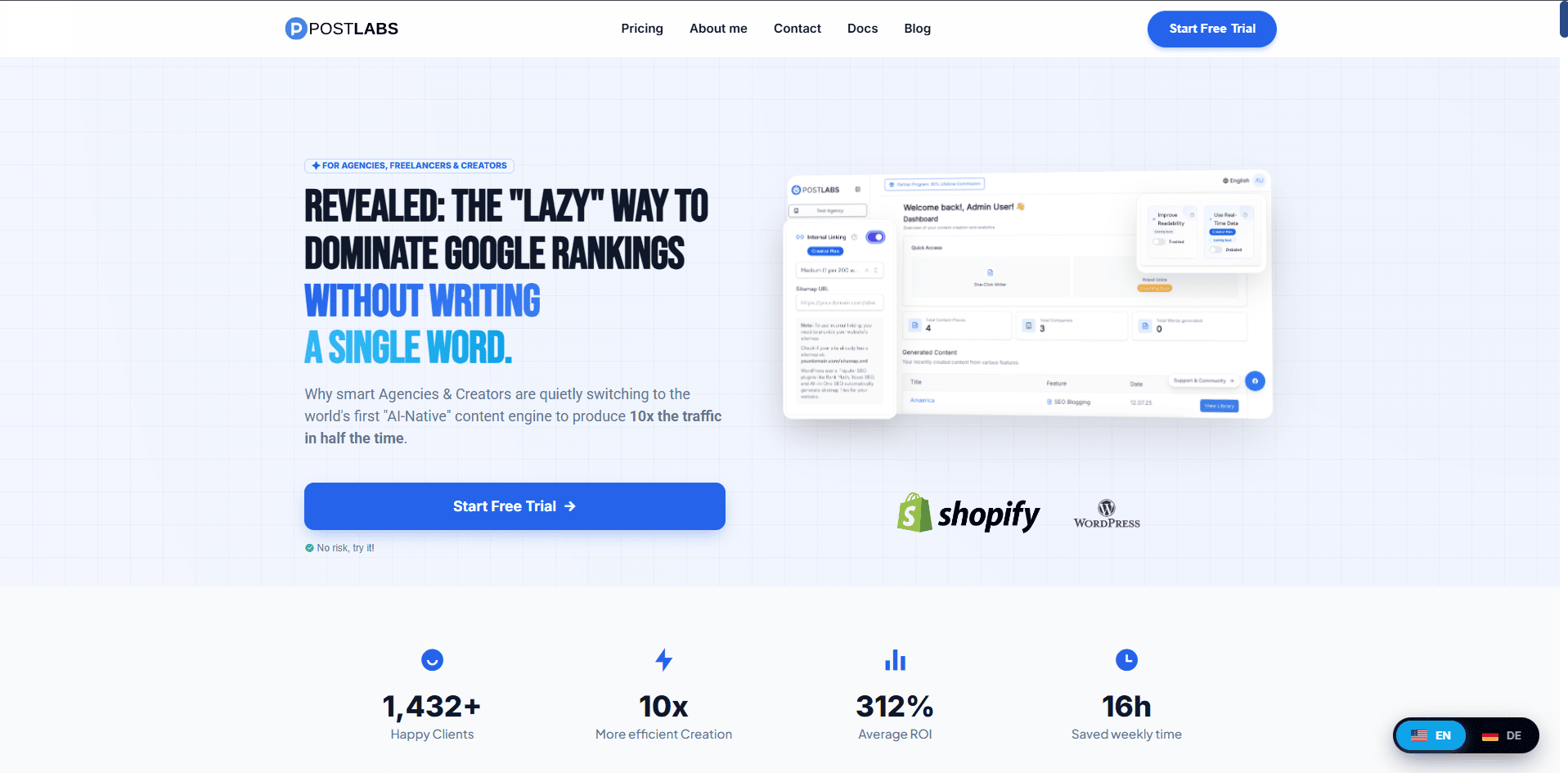
- Postlabs – Automated SEO Content & Blogging. My go-to for scaling content. It connects directly to WordPress to create optimized drafts in bulk, saving hours of manual work.
- Sitebulb – Technical SEO Audits. Integrates AI for deeper insights into crawlability and indexability issues.
- Hunter.io (with AI assist) – Link Building Outreach. Finds contact info and helps personalize outreach emails at scale.
- Looker Studio (with AI insights) – Performance Reporting. Visualizes data and uses AI to spot trends and anomalies in performance.
- Frase.io – Semantic Content Briefs. Creates detailed content briefs based on competitor analysis and entity extraction.
- Semrush (AI features) – Competitor Analysis & Keyword Tracking. Offers AI-powered insights into competitor strategies and keyword gaps.
Decision help label: Choose tools that fill specific gaps in your workflow. Don’t just stack them because they’re popular; ensure they solve a real problem for you.
The Content Generation Trap: When AI Makes You Lazy
I once coached a small agency that bought into the “AI writes everything” hype. They fired half their writing team. Then, they tried to pump out 100 articles a month using only AI. The quality plummeted. Their clients left. This strategy fails when you let AI dictate the entire content creation process without human intervention. You end up with soulless, unengaging text.
My approach with tools like Postlabs is different. We use it for bulk drafting and structural foundation. For example, I’ll use it to generate 10 topical drafts directly into WordPress. Then, a human writer takes over. They inject personality, add unique examples, and ensure factual accuracy. This isn’t about letting AI write your entire blog. It’s about getting from zero to 80% much faster. The final 20% is where the real value lies. That’s where human creativity shines.
Warning: Content Quality Over Quantity
The critical mistake is prioritizing AI-generated content volume over human-edited quality. This leads to a decline in search rankings and user engagement because search engines prioritize helpful, authoritative content.
Technical SEO: Catching Crawl Errors Before They Bite
I learned this the hard way. Back in 2025, I launched a new site. I thought my technical SEO was solid. A month later, I noticed odd indexing issues. Turns out, a critical part of my site was blocked by a rogue robots.txt entry. My traffic suffered for weeks. This fails when you rely on manual checks for complex technical issues. AI-powered tools can spot these problems much faster.
Tools like Sitebulb, with its AI integrations, are game-changers here. They crawl your site. They flag issues like broken links, slow pages, or indexing problems. The AI component then helps prioritize these fixes. It identifies which issues have the biggest impact on your rankings. This means you spend less time hunting for problems. You spend more time solving the ones that matter. It’s about proactive maintenance, not reactive firefighting.
Link Building: Scaling Outreach Without Spamming
Honestly, link building used to be a grind. I spent countless hours finding contacts and writing personalized emails. It was slow. It was painful. My efforts often felt like shouting into the void. This approach fails when your outreach isn’t personalized or scalable. You just become another spammer in an inbox.
Now, tools like Hunter.io, combined with AI, change the game. Hunter helps find verified email addresses. Then, I use an AI assistant to draft personalized outreach emails. I provide context about the target site. The AI generates a unique, relevant message. This isn’t about sending generic templates. It’s about personalizing at scale. It boosts response rates significantly. It makes the whole process less soul-crushing. It’s still hard work, but it’s smarter work.
Performance Tracking: Beyond Basic Analytics
Just looking at raw traffic numbers is a rookie mistake. I once managed a campaign that showed great traffic growth. But when I dug deeper, the conversions were terrible. We were attracting the wrong audience. This fails when you only track vanity metrics. You need deeper insights to make informed decisions.
Looker Studio, with its AI capabilities, helps us avoid this. It pulls data from various sources. It visualizes trends. The AI then highlights anomalies or unexpected patterns. For instance, it might flag a sudden drop in engagement for a specific content cluster. Or it might identify a new, high-performing keyword. This means we get actionable insights, not just data dumps. It helps us pivot strategies quickly. It ensures our efforts are always aligned with business goals.
Semantic Analysis: Moving Beyond Keywords
The old days of keyword stuffing are long gone. I remember trying to rank for “best coffee maker” by just repeating that phrase. It never worked. Google got smarter. This strategy fails when you ignore the broader context and semantic relationships of your topic. You’ll never truly satisfy user intent.
Tools like Frase.io are essential for modern SEO. They analyze top-ranking content. They identify related entities and concepts. This helps us build truly comprehensive content briefs. It ensures our articles cover the topic in depth. It moves beyond simple keyword matching. It helps us understand what Google considers relevant for a given query. This means higher topical authority. It means better rankings. It’s about answering the whole question, not just the obvious one.
Myth
“More keywords equal better rankings.”
Reality
Focus on semantic relevance and comprehensive topic coverage. Google rewards content that fully addresses user intent, not just keyword density.
AI-Powered Competitor Analysis: Uncovering Hidden Opportunities
I once spent days manually sifting through competitor websites. I was looking for their top pages, their keyword strategies, their link profiles. It was tedious. It was inefficient. I often missed crucial details. This fails when your competitor analysis is manual and superficial. You’ll always be a step behind.
Semrush, with its growing AI features, has changed this for me. It quickly identifies competitor strengths and weaknesses. It spots keyword gaps we can exploit. It even analyzes their content strategies. The AI helps surface patterns and opportunities that a human might miss. For instance, it can highlight a sudden increase in a competitor’s ranking for a specific topic. This allows us to react faster. It helps us refine our own strategy. It’s like having an extra pair of eyes, but much faster.
The Human Element: Why Your Brain Still Matters Most
Here’s the real talk: AI is a tool. It’s not a guru. I’ve seen too many people blindly trust AI output. They publish whatever it spits out. Their content becomes predictable. It lacks soul. This fails when you forget that true creativity, empathy, and strategic thinking still come from humans. The best AI tools are useless without a smart operator.
You need to be the conductor of this AI orchestra. You set the vision. You guide the prompts. You refine the output. This means developing your own critical thinking skills even more. Understand your audience deeply. Know your niche inside out. Use AI to execute faster, but never let it dictate your core strategy. The unique insights, the unexpected angles, the real-world examples – those are still your job. That’s where you build true authority and trust.
“AI will not replace humans, but humans who use AI will replace humans who don’t.”
— General Consensus, Tech Industry Observation
AI SEO Tool Stack Review (2026)
| Tool Category | Typical Cost/Month | Avg. Time Saved | ROI/Verdict |
|---|---|---|---|
| Content Optimization | $99 – $299 | 20-30 hours | High |
| Content Generation | $59 – $199 | 15-25 hours | Medium |
| Technical Audits | $79 – $249 | 10-15 hours | High |
What I Would Do in 7 Days (Your Quick Start Plan)
- Day 1: Audit Your Current Stack. See what tools you already have. Identify gaps.
- Day 2: Pick Your Core Content Tool. Choose one AI writer and one content optimizer (e.g., Postlabs + Surfer).
- Day 3: Master Prompt Engineering. Spend 2-3 hours learning how to write effective prompts.
- Day 4: Generate 5 Content Outlines. Use your chosen tools to create detailed briefs.
- Day 5: Draft 2 Articles. Let AI do the heavy lifting for the first draft.
- Day 6: Human Edit & Optimize. Refine the AI drafts, add your unique voice, and optimize for SEO.
- Day 7: Plan for Technical & Outreach. Research a technical audit tool and a link-building assistant.
Your AI SEO Readiness Checklist
- Have you defined your content strategy before using AI?
- Are you actively training your AI models with specific examples?
- Do you have a human editor reviewing all AI-generated content?
- Are you tracking AI-assisted content performance separately?
- Is your technical SEO foundation solid before scaling content?
Frequently Asked Questions About AI SEO Tools
What is the biggest mistake people make with AI SEO?
The biggest mistake is treating AI as a “set it and forget it” solution. It requires constant human oversight, refinement, and strategic guidance to produce high-quality, impactful results.
Can AI replace my SEO team entirely?
No, AI cannot replace a skilled SEO team. It can automate repetitive tasks and provide data insights, but human strategists, content creators, and technical experts are still essential for nuanced decision-making and creative problem-solving.
How quickly can I see results from using AI SEO tools?
Results vary, but you can see efficiency gains in content creation almost immediately. Ranking improvements typically take 3-6 months, depending on your niche, competition, and the quality of your human-AI collaboration.