

Choose AI for Scalable Content.
Use Postlabs AI. Don’t rely solely on freelance writers for volume content. AI offers unmatched speed and cost efficiency for scaling your content operations quickly.
- AI drastically cuts cost-per-article, often by 70% or more.
- Human oversight is still crucial for fact-checking and brand voice.
- AI excels for high-volume, data-driven content production.
If your content strategy demands highly specialized, unique thought leadership daily, stop reading. AI is not a magic bullet for every single scenario.
Postlabs AI vs. Freelance Writers: A Cost-Benefit Showdown
| Criterion | Postlabs AI | Freelance Writers |
|---|---|---|
| Cost per Article | Significantly lower | Higher, varies widely |
| Speed & Scale | Instant, unlimited output | Slower, limited by human capacity |
| Consistency | High, predictable quality | Variable, depends on writer |
The Real Cost of "Cheap" Freelancers: My Content Burnout Story
I once thought I was smart. I hired a team of five "affordable" freelance writers. Each charged about $50 for a 1000-word article. On paper, it looked like a steal. My plan was to churn out 50 articles a month. What a dream, right?
The trap is that the upfront cost is never the full cost. I spent hours onboarding, explaining our brand voice, and detailing keyword briefs. Then came the editing. Oh, the editing. Every article needed significant rewrites. Some were just plain unusable. My "cheap" articles ended up costing me more in time than I saved in cash. This content strategy fails when you underestimate the hidden labor involved.
I was spending 20-30 hours a week just managing writers. That’s a full-time job. My actual cost-per-article, factoring in my time at a reasonable hourly rate, shot up to $150-$200. It was not fun. I was burned out, and our content pipeline was constantly jammed. We barely hit 20 articles a month.
This experience taught me a hard lesson. Freelancers are great for specific tasks. But for scalable, consistent content production, the traditional model often breaks down. The time sink for managing multiple writers, ensuring quality, and chasing deadlines becomes a massive bottleneck. It’s a classic case of saving pennies to spend dollars.
Warning: The "Hidden Cost" Trap
Never assume a low per-word rate equals low total cost. Your time spent on briefing, editing, and managing freelancers is a real expense. Ignoring it will lead to budget overruns and burnout.
AI’s Unbeatable Speed: My 3-Hour Article Workflow
Speed is where AI truly shines. I used to allocate a full day, sometimes two, for a single 1500-word article. That included research, outlining, writing, and editing. It was a grind. Now, with Postlabs, I can often go from idea to publish-ready draft in about three hours. This workflow fails when you skip the critical human review steps.
Here’s how it works: I feed Postlabs a detailed brief. This includes target keywords, audience, and desired tone. Within minutes, I have a solid first draft. I then spend an hour refining, fact-checking, and injecting my unique voice. Another hour goes to internal linking and formatting. The final 30 minutes are for a quick proofread. This speed dramatically lowers your cost-per-article.
Think about it. If a freelancer charges $100 and takes 5 hours (including your management time), that’s $20/hour. If Postlabs costs you $10 in subscription fees per article and takes you 2 hours, that’s $5/hour plus your time. The difference is stark. We’re talking about producing 5-10 articles in the time it used to take for one. That’s a game-changer for content velocity.
The key is to leverage AI for the heavy lifting. It handles the initial research and structure. This frees you up for the higher-value tasks. You can focus on strategic input and quality control. This means more content, faster, without sacrificing quality. It’s a powerful shift in how we approach content creation.
Pros of AI Content Creation
- Massive Cost Savings: Reduce per-article expenses by 70% or more, freeing up budget.
- Unmatched Scalability: Produce hundreds of articles monthly without hiring more staff.
- Consistent Quality: Maintain a uniform brand voice and style across all content.
Cons of AI Content Creation
- Requires Human Oversight: AI needs careful editing and fact-checking to avoid errors.
- Lacks Deep Expertise: Struggles with highly niche, original thought leadership without strong human input.
- Potential for Generic Output: Can produce bland content if prompts are not specific enough.
Quality Control: Why AI is More Consistent Than You Think
Many people assume AI content is inherently lower quality. They believe human writers always deliver superior results. Honestly, I’ve found the opposite to be true for routine content. The trap is believing human variability equals higher quality. This approach fails when you prioritize subjective "flair" over consistent, data-driven performance.
Freelancers, even good ones, have off days. Their quality can fluctuate based on mood, workload, or personal life. One article might be brilliant, the next might be rushed. This inconsistency creates a massive headache for editors. You spend valuable time correcting tone, style, and factual errors. AI, when properly prompted, delivers consistent output every single time.
With Postlabs, I can define my brand voice, target audience, and content guidelines once. The AI then adheres to those parameters across all articles. This means less editing time spent on stylistic corrections. It ensures a uniform experience for readers. This predictability is a huge benefit for maintaining brand integrity and SEO performance.
Of course, AI still needs human review. It’s not perfect. But the starting point is far more consistent. You’re editing for nuance and accuracy, not for fundamental style or structure. This consistency frees up your team to focus on strategic content development. They can spend less time fixing basic errors. It’s about optimizing human effort where it matters most.
Cost-per-article: The total expense incurred to produce one piece of content, including writer fees, editing time, research, and overhead.
Scaling Content: The Freelancer Bottleneck
Trying to scale content with freelancers often hits a wall. I remember needing 100 articles for a new product launch. My existing freelance team could barely manage 30 a month. Hiring more meant a huge onboarding effort. It also meant more management headaches. This scaling attempt fails when you cannot quickly and affordably increase your content output.
The bottleneck isn’t just about finding writers. It’s about finding *good* writers who are available and reliable. Then you need to train them. You have to manage their deadlines and ensure quality. This entire process is slow and expensive. It severely limits your ability to respond to market demands quickly. AI offers virtually unlimited scalability on demand.
With Postlabs, I can generate 100 articles in a fraction of the time it would take a large freelance team. The cost scales linearly with usage, not exponentially with management overhead. This means I can launch new content campaigns faster. I can test new niches without massive upfront investment. It’s a powerful tool for rapid expansion.
This ability to scale quickly is a significant competitive advantage. You can dominate search results for new keyword clusters before your competitors even get started. It allows for agile content marketing. You can adapt your strategy based on performance data without being constrained by human capacity. It’s a strategic asset for growth.
The Hidden Fees of Human Editing: My Budget Surprise
When I first budgeted for freelance content, I only factored in the writer’s fee. That was a huge mistake. I quickly learned that editing, proofreading, and formatting added another 50-100% to the actual cost. My budget was blown within weeks. This content budget fails when you only account for writer fees and ignore post-production labor.
A typical 1000-word article from a freelancer might cost $75. But then I’d spend 1-2 hours editing it. If my time is worth $50/hour, that’s another $50-$100. So, the "cheap" article now costs $125-$175. This is a common oversight. The true cost of content includes all labor from ideation to publication.
With AI-generated content, the initial draft is often cleaner. It requires less heavy lifting in the editing phase. I still spend time editing, but it’s more about refining than restructuring. This means my editing time per article is significantly reduced. It might be 30-60 minutes instead of 90-120 minutes. This reduction directly translates to lower overall costs.
This efficiency compounds over time. If you produce 50 articles a month, saving an hour of editing per article is 50 hours. That’s more than a full work week. That saved time can be reinvested into strategy, promotion, or other high-impact tasks. It’s a smarter allocation of resources. It makes your content budget stretch further.
Content Production Cost Audit (2026)
| Project/Item | Cost/Input | Result/Time | ROI/Verdict |
|---|---|---|---|
| Freelance Article | $75 writer + $75 edit | 1 article / 6 hrs | High labor cost |
| Postlabs AI Article | $10 AI + $50 edit | 1 article / 2 hrs | Significant savings |
| Scaling 100 Articles | $15,000 freelance | 100 articles / 600 hrs | Slow, expensive |
Keyword Strategy: AI’s Data Edge
Effective SEO content starts with solid keyword research. Freelancers can do this, but it often adds to their fee. Their research might also be limited by their tool access or experience. I’ve seen many articles miss key long-tail opportunities. This SEO strategy fails when your content isn’t built on comprehensive, data-driven keyword analysis.
AI tools, especially those integrated with platforms like Postlabs, leverage vast datasets. They can identify relevant keywords, analyze competitor content, and suggest optimal article structures. This happens in seconds. It ensures your content is optimized from the ground up. AI provides a data-driven advantage in keyword strategy.
This means your articles are more likely to rank higher and attract organic traffic. You’re not guessing which keywords to target. You’re using insights derived from millions of data points. This precision is hard for even the best human writer to replicate consistently. It’s a powerful way to maximize your content’s ROI.
By integrating AI into your keyword strategy, you ensure every article has a strong SEO foundation. You can quickly identify content gaps and fill them. This proactive approach to SEO is crucial in 2026. It helps you stay ahead of the competition. It’s about working smarter, not just harder.
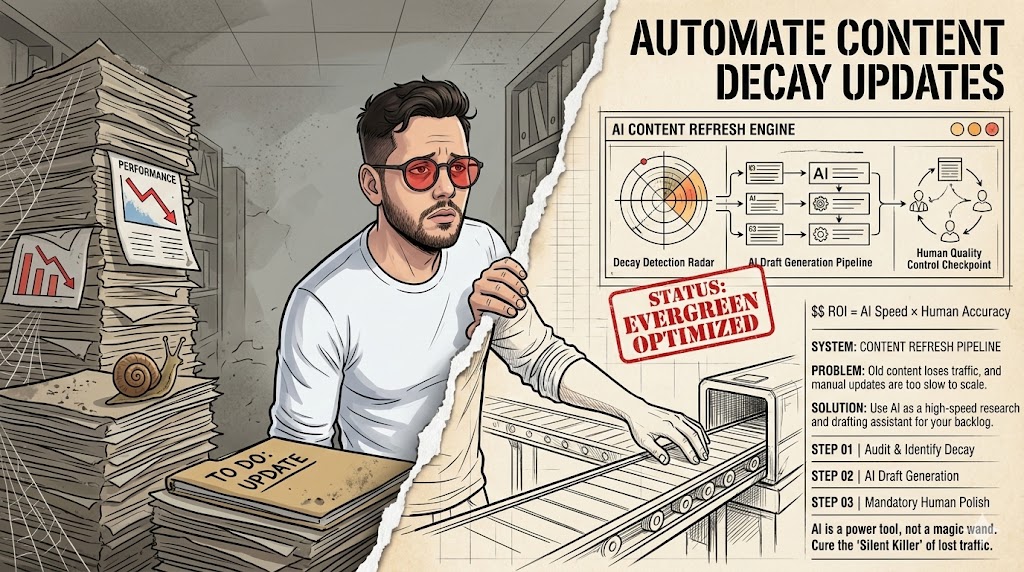
Beyond the Article: AI for Content Updates
Content isn’t a "set it and forget it" game. Old articles need updates. They need refreshing to stay relevant and rank well. This is a tedious, time-consuming task for human writers. I once tried to update 50 old posts with freelancers. It took months and cost a fortune. This content maintenance plan fails when you cannot efficiently refresh your existing content library.
AI can quickly analyze existing content. It can identify outdated information, missing keywords, or areas for expansion. Then, it can generate updated sections or even full rewrites. This process is incredibly fast and cost-effective. AI makes content refreshing a scalable, manageable task.
Imagine updating hundreds of articles in a few weeks. This would be impossible with a traditional freelance model. With AI, it’s a reality. This ensures your entire content library remains fresh and valuable. It helps you maintain your search rankings. It also improves user experience.
This capability extends the life of your content assets. You get more mileage out of every article you’ve ever published. It’s a smart investment in your existing content. It helps you avoid the dreaded "content decay" that plagues many websites. It’s a powerful tool for long-term SEO success.
The "Originality" Myth: What AI Really Delivers
Myth
AI content is never truly original or unique. It just rehashes existing information.
Reality
AI synthesizes information and generates new combinations of ideas and phrasing. While it draws from existing knowledge, its output can be unique in structure and expression, offering a fresh perspective on topics. The "originality" comes from your unique prompts and editing.
Many folks worry that AI content lacks originality. They fear it’s just a copy-paste job. This is a common misconception. The truth is, AI synthesizes information in novel ways. It can combine concepts and phrases to create genuinely unique content. This fear of unoriginality fails when you don’t understand how AI processes and generates text.
Think of it like a highly skilled researcher. The AI consumes vast amounts of data. Then, it generates text based on your specific instructions. It doesn’t just copy. It creates new sentences and paragraphs. The "originality" of the final piece often comes from the unique angle you provide in your prompt. Your input guides the AI to produce distinct content.
I’ve used Postlabs to generate articles on topics with a lot of existing content. By providing a specific angle or a unique set of keywords, the AI produces something fresh. It’s not plagiarized. It’s a new interpretation. This allows you to stand out in crowded niches.
The real power isn’t in the AI’s ability to invent new facts. It’s in its ability to present existing information in a compelling, SEO-friendly, and unique way. Your role as the editor is to ensure factual accuracy and inject your brand’s unique voice. This partnership creates truly valuable content.
Building Your AI-Powered Content Team
Shifting to an AI-first content strategy doesn’t mean firing all your writers. It means restructuring your team. I learned this the hard way. I thought AI would replace everyone. Instead, it changed their roles. This team restructuring fails when you don’t redefine human roles and responsibilities clearly.
Your team members become "AI content managers." They focus on crafting precise prompts. They edit for accuracy, brand voice, and strategic alignment. They handle the final polish and promotion. This is a higher-level, more strategic role. AI elevates human roles, it doesn’t eliminate them.
This approach allows you to produce more content with fewer people. Each team member becomes more productive. They spend less time on repetitive writing tasks. They spend more time on creative strategy and quality control. This leads to a more efficient and engaged team. It’s a win-win.
Consider training your existing writers on AI tools. Show them how to use our complete AI guide. This empowers them with new skills. It makes them more valuable to your organization. It transforms your content operation into a lean, powerful machine. It’s about smart resource allocation.
"The future of content creation isn’t AI replacing humans, but humans leveraging AI to achieve unprecedented scale and efficiency."
— General Consensus, Content Industry Experts
When Freelancers Still Make Sense: The Niche Exception
Despite all the benefits of AI, there are still times when a human freelancer is the better choice. It’s not an either/or situation. It’s about knowing when to deploy each tool. I once tried to use AI for a highly technical, deeply philosophical piece. It was a disaster. This content strategy fails when you force AI into areas requiring profound human insight.
Freelancers excel in areas requiring deep, specialized expertise. Think about niche topics like quantum physics, complex legal analysis, or highly personal storytelling. These areas demand nuanced understanding. They need original thought that AI cannot yet replicate. For true thought leadership, a human expert remains invaluable.
Also, if you need content with a very specific, emotional, or artistic flair, a human touch is often superior. AI can mimic emotions, but it struggles with genuine empathy. For brand storytelling that needs to resonate on a deep human level, freelancers are still the go-to. It’s about matching the tool to the task.
So, the best approach is a hybrid one. Use AI for your foundational, high-volume, data-driven content. Then, bring in expert freelancers for those specific, high-value pieces. This allows you to get the best of both worlds. It optimizes your budget and maximizes your content impact. It’s a balanced strategy for modern content marketing.
What I would do in 7 days to leverage AI for content
- Day 1-2: Audit Existing Content & Identify Gaps. Use tools to find low-performing articles and keyword opportunities.
- Day 3: Master Your AI Prompting. Spend time learning how to write effective prompts for Postlabs.
- Day 4-5: Generate 10 Foundational Articles. Focus on high-volume, low-competition keywords.
- Day 6: Refine & Edit. Human-edit the AI drafts for accuracy, brand voice, and flow.
- Day 7: Publish & Analyze. Get those articles live and start tracking their performance.
Your AI Content Success Checklist
- Define clear content goals and target audience.
- Integrate AI tools like Postlabs into your workflow.
- Develop strong, detailed AI prompts for consistent output.
- Implement a rigorous human editing and fact-checking process.
- Continuously monitor content performance and iterate.
- Train your team on AI content management best practices.
- Reserve expert freelancers for highly specialized content needs.
Frequently Asked Questions
How much can AI reduce my cost-per-article?
In many observations, AI can reduce the cost-per-article by 70% or more. This is due to faster generation times and reduced human labor for initial drafts.
Will AI replace my freelance writers completely?
No, AI is a tool to augment, not fully replace. It handles high-volume, data-driven content. Freelancers remain valuable for niche expertise, deep research, and unique thought leadership.
What are the main risks of using AI for content?
The main risks include factual inaccuracies, generic output if prompts are poor, and potential for a lack of unique human perspective. Human oversight is essential to mitigate these issues.