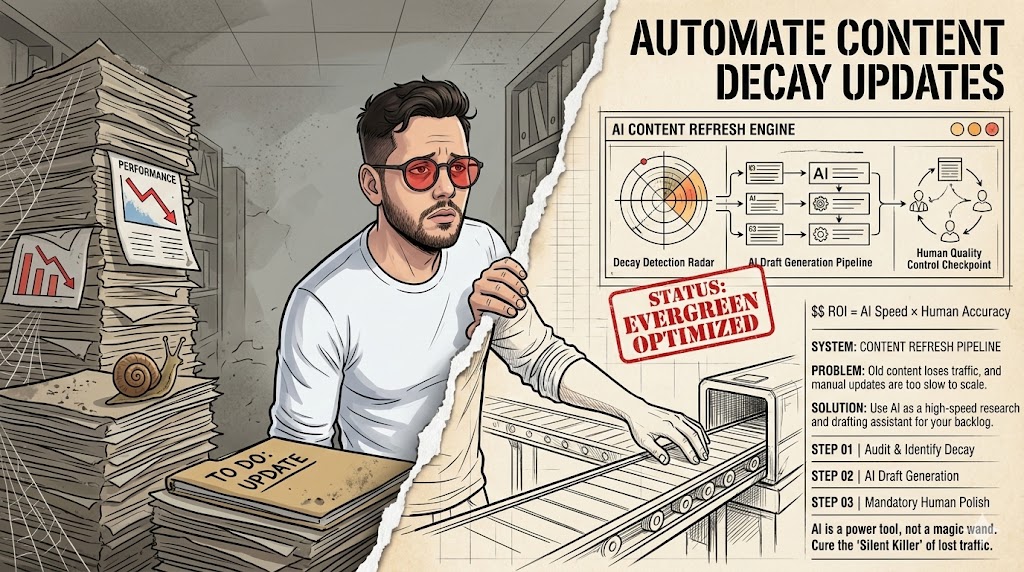


Embrace Human-in-the-Loop. Reject Full Automation.
Human-in-the-Loop (HITL) is non-negotiable for 2026 SEO success. Relying solely on AI for SEO will lead to generic content and missed opportunities. You need human intelligence to guide AI, not just review it.
- HITL ensures content relevance, expertise, and strategic alignment.
- The main limitation is the need for skilled human operators, not just reviewers.
- Best use case: Scaling high-quality, authoritative content with AI as a co-pilot.
If your SEO strategy involves zero human oversight beyond basic proofreading, stop reading. This approach will fail.
The AI Hype Trap: Why "Fully Automated SEO" Fails
I've seen it happen too many times. A client gets excited about "AI SEO" and thinks they can just press a button. They expect AI to handle everything from keyword research to final content publishing. This usually leads to a traffic drop. Your SEO tanks when you trust AI blindly without human oversight.
The promise of fully automated SEO is tempting. It sounds like a dream. However, AI, even in 2026, lacks critical human elements. It cannot truly understand nuanced search intent. It struggles with emotional resonance. It also can't adapt to sudden market shifts without guidance. We need to be smarter.
Myth
AI can handle 100% of your SEO content creation.
Reality
AI is a powerful tool for drafting and scaling. It needs human strategic input and refinement for quality, relevance, and E-E-A-T signals. Without a human, content often falls flat.
Many operators believe AI can simply replace writers and strategists. This is a huge mistake. AI excels at processing data and generating text. It does not excel at understanding human psychology. It also doesn't grasp brand voice or complex strategic goals. You need a human to bridge that gap. Otherwise, your content becomes generic noise.
Defining Human-in-the-Loop: More Than Just a "Reviewer"
Okay, so what exactly is "Human-in-the-Loop" (HITL) in 2026 SEO? It's not just about a quick spell check. It's about deep, meaningful human intervention at every critical stage. Your HITL strategy collapses if you treat humans as mere proofreaders.
Think of it this way: AI is a super-fast, tireless junior assistant. It can draft, research, and analyze. But it needs a senior strategist to direct it. Spending only 15 minutes per article isn't enough. A true HITL model integrates human expertise. This happens from initial strategy to final publication and beyond. It ensures quality and relevance.
Human-in-the-Loop (HITL): A system where human intelligence is actively integrated into the AI workflow. For SEO, this means humans provide strategic direction, refine AI outputs, ensure quality, and make final decisions.
This means humans define the content strategy. They craft detailed prompts. They edit for tone, accuracy, and E-E-A-T. They also analyze performance data. This continuous loop of human guidance and AI execution is crucial. It prevents AI from going off the rails. It also ensures your content truly connects with your audience.
Pros of HITL in SEO
- Ensures content aligns with complex brand voice and strategic goals.
- Adds unique human insights and real-world experience to content.
- Significantly improves E-E-A-T signals, boosting search rankings.
Cons of HITL in SEO
- Requires skilled human operators, which can be a bottleneck.
- Adds time to the content creation process compared to full automation.
- Demands clear workflows and training to be effective and scalable.
Strategic Content Planning: Humans Set the Compass
The first trap I often see is letting AI pick all the topics. AI can identify keyword gaps. It can even suggest content clusters. But it lacks the intuition for market trends. It also misses the understanding of audience pain points. Content misses the mark when AI picks topics without human market insight.
I remember one project where AI suggested dozens of keywords. They were all high volume, low competition. Great, right? Not really. We wasted weeks creating content. It turned out these keywords had zero commercial intent. The audience was searching for definitions, not solutions. A human strategist would have caught this immediately.
Your human team needs to define the target audience. They must identify their core problems. They also need to map out the customer journey. This strategic layer informs all AI content generation. AI then becomes a powerful tool. It helps you execute on a well-defined plan. It doesn't create the plan itself.
This human-led planning ensures every piece of content serves a purpose. It prevents wasted effort. It also guarantees relevance. That's something AI alone cannot achieve. It needs that human touch.
Crafting the AI Prompt: Your Secret Weapon
Once you have your strategy, the next human role is prompt engineering. This is where you translate your strategic vision into clear instructions for the AI. AI output is generic if your prompts are vague or incomplete. I've spent an hour refining a single prompt for a complex guide. It makes all the difference.
A good prompt is like a detailed brief for a human writer. It includes persona, tone, style, and specific instructions. It also outlines desired outcomes. You need to tell the AI exactly what you want. This includes the target audience and the desired call to action. You must also specify the key points to cover. For a complete AI guide, check out the resources at Postlabs.
Without strong prompts, AI will default to average. It will produce bland, uninspired content. This won't stand out in 2026. Your human team needs to master this skill. It's about guiding the AI. You need to shape its output. This ensures it meets your high standards.
Insider tip
I always include negative constraints in my prompts. Tell the AI what *not* to do. For example, "Do not use corporate jargon." Or, "Avoid passive voice." This helps steer the AI away from common pitfalls and keeps the output crisp.
Prompt engineering is an ongoing learning process. You'll refine your prompts based on AI's output. You'll learn what works and what doesn't. This iterative process is inherently human. It requires judgment and experience. It's a skill that pays dividends.
The Human Editor's Edge: Beyond Grammar Checks
This is where many people get HITL wrong. They think "editing" means fixing typos. That's a tiny part of it. Content feels robotic and untrustworthy if human editors only fix typos. I remember a piece AI wrote about "quantum SEO." It was technically correct but totally unreadable. It lacked flow and human empathy.
A human editor brings crucial elements. They inject personality. They ensure brand voice consistency. They also add unique insights. These are things AI simply cannot replicate. They check for factual accuracy. They also ensure the content resonates emotionally. This is especially true for sensitive topics.
Warning: Superficial Editing
A critical mistake is treating AI-generated content like any other draft. AI often hallucinates or presents plausible but incorrect information. Human editors must fact-check thoroughly and add genuine expertise, not just polish grammar.
The human editor's role is to elevate the AI's draft. They transform it from functional to exceptional. This means restructuring sentences for better flow. It means adding anecdotes. It also means strengthening arguments. This human touch makes the content memorable. It also builds trust with your audience. It's the difference between content that ranks and content that converts.
E-E-A-T & Authority: The Human Stamp of Trust
Google's focus on Experience, Expertise, Authoritativeness, and Trustworthiness (E-E-A-T) is stronger than ever. Your content struggles to rank if it lacks genuine expertise and experience. Google's algorithm updates in 2025 really hammered sites without clear author authority. AI can't fake this.
Humans provide the E-E-A-T. An expert in your niche can review AI content. They can add personal anecdotes. They can also include unique data points. This shows real experience. They can also cite credible sources. This builds authority. This human validation makes the content trustworthy. It signals to Google that this isn't just generic AI output.
"Content that demonstrates clear E-E-A-T signals will consistently outperform generic AI-generated text. Google prioritizes real human insight."
— General Consensus, SEO Industry 2026
This is where your team's unique knowledge shines. They can refine AI's explanations. They can simplify complex topics. They can also add practical advice. This comes from years of doing the work. This human layer is irreplaceable. It's what separates top-tier content from the rest. It's about building genuine credibility.
Technical SEO: AI Identifies, Humans Prioritize & Fix
Technical SEO is another area where HITL is essential. AI tools are fantastic at crawling sites. They can identify broken links, crawl errors, and slow pages. They can even suggest fixes. However, technical issues persist if humans don't translate AI reports into actionable tasks. AI doesn't understand your business priorities.
I once had an AI tool flag 200 broken internal links. That's a lot. But a human had to step in. I manually prioritized the top 10 most impactful ones. These were links on high-traffic pages. Or they were links to critical conversion pages. AI can't make those judgment calls. It just sees the problem. It doesn't understand the context.
Your human team reviews AI's technical audits. They prioritize issues based on impact and effort. They then implement the fixes. Sometimes, a suggested AI fix might break something else. A human needs to foresee this. Tools like Postlabs can help identify issues. But human expertise is needed for the final decision and implementation.
This human oversight prevents unintended consequences. It ensures that technical changes support your overall SEO goals. It's about smart execution. It's not just about blindly following a machine's recommendations. That would be a recipe for disaster.
Performance Analysis & Iteration: Closing the Loop
The HITL process doesn't end at publication. It continues with performance analysis. AI can gather vast amounts of data. It can track rankings, traffic, and conversions. But your strategy stagnates if you don't use human insight to interpret AI data. Raw data is just numbers.
We once saw a 10% drop in CTR on an AI-optimized title. The AI thought it was perfect. A human quickly identified it as too clickbaity. It didn't match the content's serious tone. We changed it back. CTR recovered. This shows AI can optimize for metrics. But it often misses the human element of trust and brand perception.
Humans interpret the "why" behind the numbers. They identify patterns. They connect data points to broader market trends. They also make strategic adjustments. This iterative loop of AI data collection and human analysis is powerful. It allows for continuous improvement. It ensures your SEO strategy remains agile and effective.
Scaling HITL: Building Your AI-Powered Team in 2026
So, how do you scale this HITL model? It's not about hiring hundreds of writers. It's about building a lean, efficient team. Scaling becomes impossible if you don't define clear roles and workflows. I tried to manage 10 AI writers myself once; it was a nightmare. Clear processes are key.
Your team needs specific roles. You might have a "Prompt Engineer." This person focuses on crafting effective AI instructions. You'll need "Content Strategists." They define the overall direction. And "Expert Editors." They refine and validate AI output. This division of labor ensures efficiency.
HITL Team Allocation (2026)
| Role | Primary Input | Key Output | Value Add |
|---|---|---|---|
| Strategist | Market Research | Content Briefs | Direction |
| Prompt Engineer | Briefs + AI | AI Drafts | Efficiency |
| Expert Editor | AI Drafts | Final Content | Quality |
Leverage AI SEO automation tools like Postlabs. They streamline the process. They handle repetitive tasks. This frees up your human team. They can then focus on high-value activities. These include strategy, creativity, and quality control. This is how you scale effectively. You combine the best of both worlds.
What I Would Do in 7 Days to Implement HITL
- Day 1-2: Audit Current Content. Identify 5-10 underperforming articles. See where AI could have helped with initial drafts or research.
- Day 3: Define Your AI Persona. Create a detailed persona for your AI assistant. What's its tone? Its knowledge base? Its limitations?
- Day 4: Craft Your First Prompt. Take one underperforming article. Write a detailed prompt for AI to rewrite or expand it. Include E-E-A-T elements.
- Day 5: AI Draft & Human Edit. Generate the AI draft. Spend significant time editing. Focus on brand voice, unique insights, and factual accuracy.
- Day 6: Publish & Monitor. Publish the revised content. Set up tracking for key metrics.
- Day 7: Review & Refine. Analyze initial performance. Adjust your prompt and editing process based on results.
HITL SEO Checklist for 2026
- Define clear human roles for strategy, prompting, and editing.
- Integrate AI tools for drafting and data analysis, not decision-making.
- Prioritize E-E-A-T by adding genuine human expertise to every piece.
- Implement a robust fact-checking process for all AI-generated content.
- Establish an iterative feedback loop between human editors and AI output.
- Regularly update your AI prompts based on performance and new insights.
- Train your team on advanced prompt engineering techniques.
Frequently Asked Questions
Can AI ever fully replace human SEOs?
No, not in 2026 or the foreseeable future. AI lacks strategic intuition, emotional intelligence, and the ability to build genuine E-E-A-T. It is a powerful tool, but it requires human guidance.
What is the biggest risk of ignoring HITL?
The biggest risk is producing generic, low-quality content that fails to rank. It also risks damaging your brand's authority and trust. Google prioritizes human-quality content.
How much time should a human spend on AI-generated content?
It varies, but a good rule of thumb is 30-50% of the time a human would spend writing from scratch. This includes prompt engineering, editing, fact-checking, and adding unique insights.