

AI Won’t Replace SEO: Adapt or Get Left Behind
You must integrate AI into your SEO workflow. Ignoring it means falling behind; mastering it unlocks huge efficiency gains for your business. The future belongs to the “Orchestrator,” not the manual operator.
- AI automates repetitive tasks, freeing up human strategists for higher-level work.
- Human judgment and brand voice remain the only “moat” against AI-generated noise.
- Use AI to build frameworks and analyze data, but keep a human hand on the steering wheel.
If you think AI is a magic button for instant rankings, stop reading now. This isn’t that kind of article. We’re talking about professional-grade strategy, not “get rich quick” shortcuts.
The AI Hype vs. SEO Reality: My First Client Panic Call
I remember a client calling me in early 2026. They were terrified. Headlines screamed about AI writing all content. They thought their entire SEO budget was suddenly useless.
This kind of fear is common. It stems from misunderstanding what AI actually does. Your SEO strategy fails when you treat AI as a replacement for human insight, not a powerful tool. AI is here to augment, not to outright replace.
Honestly, the initial panic around AI was overblown. We’ve seen this before with other tech shifts. The real game changer isn’t AI writing perfect content. It’s AI handling the grunt work.
AI in SEO: The application of artificial intelligence technologies to automate, optimize, and enhance various aspects of search engine optimization, from content generation to data analysis and technical audits.
This means you can focus on strategy. You can spend more time understanding user intent. That’s where the real value lies.
Why AI Won’t “Replace” You (Unless You Let It)
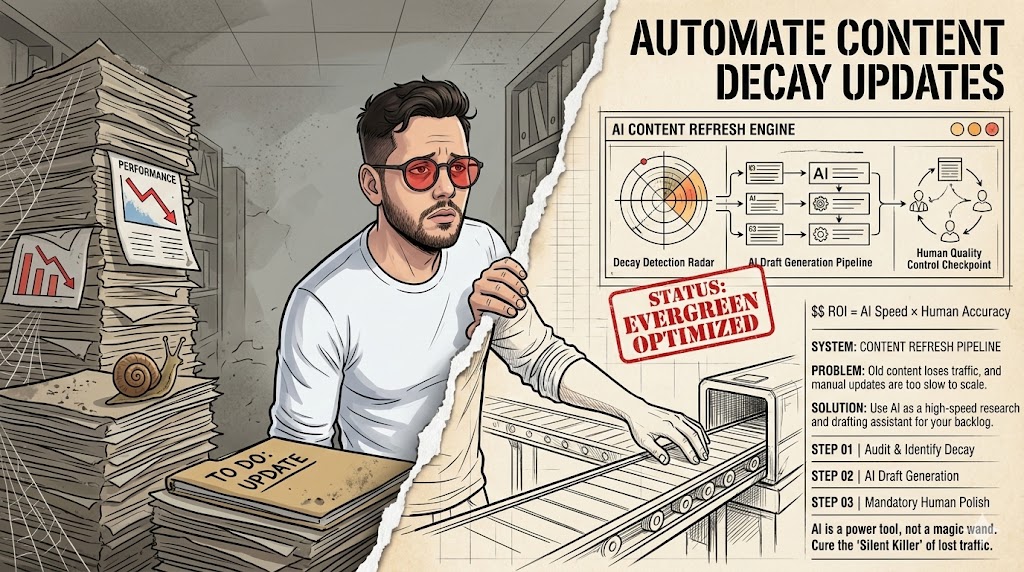
I once spent three full days manually auditing 500 pages. It was a nightmare of spreadsheets and broken links. Today, AI tools can do that same audit in a few hours. That’s a huge shift.
The trap is thinking your job is those manual tasks. It’s not. Your job is to interpret, strategize, and build relationships. You become obsolete if you cling to tasks AI can do faster and better. It’s about evolving your role. If you don’t have a solid tech stack yet to stay ahead, check out my curated list of the best AI SEO tools for 2026.
Think of it like this: a calculator didn’t replace accountants. It just made them more efficient. AI is our new calculator. It handles the repetitive parts. This frees you up for complex problem-solving. That’s where your human brain shines.
Pros of AI in SEO
- Automates tedious tasks, saving hundreds of hours weekly.
- Analyzes vast datasets quickly, revealing hidden patterns.
- Scales content production, allowing for broader topic coverage.
Cons of AI in SEO
- Lacks true creativity and nuanced understanding of human intent.
- Can generate generic or inaccurate content without human oversight.
- Requires significant human expertise to guide and validate its output.
The Real AI Superpower for SEO: Automation, Not Creation
I’ve seen teams cut content brief creation from four hours down to thirty minutes. This isn’t about AI writing the whole article. It’s about AI building the framework. It pulls data, identifies keywords, and suggests structures.
This efficiency gain is massive. It means you can produce more high-quality content briefs. You can cover more topics. This approach fails if you let AI dictate strategy rather than execute it. You still need to guide the process.
AI excels at pattern recognition. It can find gaps in your content. It can identify competitor weaknesses. It’s a data crunching machine. Use it to inform your decisions, not make them for you.
Content at Scale: The Trap of Quantity (I Learned This the Hard Way)
In 2025, I got a bit overzealous. I pushed out 100 AI-generated articles in a month. I thought I was a genius. Traffic tanked. It was a painful lesson.
The content was bland. It lacked personality. It didn’t truly answer user questions. Your content strategy will crash if you don’t add human oversight and expertise. AI is a tool, not a ghostwriter. This is exactly why I built Postlabs—I realized that to rank in 2026, you need a system that handles the structural bulk while you provide the strategic direction.
You need to edit, refine, and inject your brand voice. Think of AI as a first draft generator. It gets you 80% of the way there. The final 20% is where the magic happens. That’s where you earn trust and rankings.
Warning: AI Content Without Oversight
Relying solely on AI to generate and publish content is a critical mistake. This will lead to generic, low-quality articles that fail to rank, damage your brand authority, and ultimately waste your resources.
For a deeper dive into leveraging AI effectively for your content strategy, check out this ultimate guide to using AI for SEO. It covers how to avoid common pitfalls.
Technical SEO: Where AI Still Stumbles (My Own Audit Nightmare)
I once used an AI tool to check canonical tags across a large e-commerce site. It seemed fine at first. But then I manually spot-checked. The AI missed a critical misconfiguration on 20% of pages. That caused major indexing issues.
This is why relying solely on AI for complex technical issues will lead to costly errors. AI can flag common problems. It can even suggest fixes. But it lacks the contextual understanding of a human SEO.
A human can understand the business logic. They can see how a specific CMS interacts with a plugin. AI isn’t there yet. It’s a great assistant for the initial scan. But the final diagnosis and implementation need a human touch.
Myth
AI can fully automate and manage all technical SEO audits and fixes.
Reality
AI is excellent for identifying common technical issues and generating reports. However, complex problems, contextual understanding, and precise implementation still require human expertise to avoid critical errors and ensure proper site functionality.
Keyword Research in 2026: AI as a Co-Pilot, Not the Driver
I once found a super niche, high-converting keyword. AI tools had completely missed it. How? I talked to actual customers. They used a specific, quirky phrase that AI’s data sets hadn’t picked up yet.
Your keyword strategy will be generic if you don’t blend AI data with real-world human understanding. AI can cluster keywords. It can find long-tail variations. It can even predict trends. But it can’t interview your target audience.
It can’t understand the subtle nuances of language. Use AI to get the broad strokes. Then, use your human brain to dig deeper. Find those hidden gems. That’s how you gain an edge.
Link Building: The Human Element AI Can’t Fake
I tried using AI for outreach emails. I thought it would save me hours. The response rate was abysmal, less than 1%. It felt robotic. It lacked genuine connection.
Your link building efforts will fall flat if you remove the personal touch and relationship building. Link building is about trust. It’s about genuine value. AI can help identify prospects. It can even draft initial emails.
But the personalization? The follow-up? The negotiation? That’s all human. You need to build rapport. You need to show you care. AI can’t fake that. Not yet, anyway.
“Link building is less about links and more about relationships. AI can’t build trust.”
— Philipp Bolender, Founder of Postlabs
Adapting Your SEO Role: From Operator to Orchestrator
I now spend about 80% of my time on strategy. Only 20% is on direct execution. It used to be closer to 50/50. This shift happened because AI handles so much of the operational burden.
You’ll struggle to stay relevant if you don’t evolve your skillset to manage AI tools. This means learning prompt engineering. It means understanding AI’s limitations. It means becoming a conductor, not just a musician.
Your value moves up the chain. You become the one who designs the systems. You’re the one who interprets the results. This is a more strategic, higher-value role. Embrace it.
SEO Skill Shift Audit (2026)
| Project/Item | Cost/Input | Result/Time | ROI/Verdict |
|---|---|---|---|
| Content Briefing (AI-assisted) | 30 Minutes | 5 briefs/day | High efficiency |
| Technical Audit (AI-assisted) | 4 hrs human + AI | Comprehensive report | Faster insights |
| Strategy Dev. (Human-led) | 8 hrs human | Quarterly plan | Critical value |
Measuring AI Impact: Don’t Trust Surface-Level Metrics
I saw a 20% traffic bump from some AI-generated content. I was stoked. Then I looked closer. Conversions dropped by 15%. The traffic was low quality. It wasn’t converting.
You’ll make bad decisions if you only look at vanity metrics and ignore true business impact. AI can boost numbers. But are they the right numbers? Are they driving revenue?
Always connect your AI efforts to your bottom line. Track engagement, conversion rates, and customer lifetime value. Don’t just chase clicks. Chase meaningful results.
Insider tip
I always recommend setting up specific conversion tracking for any content or campaigns heavily influenced by AI. This helps you understand if the traffic is actually valuable, not just high volume.
The Future of SEO: Human-Led, AI-Augmented (My 7-Day Plan)
I spent a week last year re-evaluating my entire SEO stack. I integrated new AI tools. I streamlined workflows. It paid off big time. My team is more efficient now.
Your entire operation risks stagnation if you don’t actively integrate and test new AI workflows. This isn’t a one-time thing. It’s an ongoing process. Stay curious. Keep experimenting.
The future isn’t about AI replacing you. It’s about you using AI to become a better, more strategic SEO. It’s about working smarter, not just harder. That’s the hard truth for 2026.
What I Would Do in 7 Days to Integrate AI into SEO
- Day 1-2: Audit Current Workflows. Identify 2-3 repetitive tasks that take up significant time.
- Day 3: Research AI Tools. Find tools designed for those tasks (check my top list here).
- Day 4-5: Pilot Project. Pick one task and one tool. Run a small pilot project.
- Day 6: Review & Refine. Analyze the pilot results. Adjust your prompt engineering.
- Day 7: Plan Next Steps. Create a plan for broader integration based on your findings.
Your AI SEO Integration Checklist
- Identify 3-5 repetitive SEO tasks for AI automation.
- Select and test at least one AI tool for content generation (with human editing).
- Implement AI for initial keyword research and clustering.
- Use AI for technical SEO audits, followed by human verification.
- Train your team on effective prompt engineering for AI tools.
- Establish clear metrics to measure AI’s actual impact on conversions, not just traffic.
- Regularly review and update your AI tools and workflows every quarter.
Frequently Asked Questions About AI and SEO
Will AI write all my content in 2026?
No, AI will not write all your content. It excels at generating drafts, outlines, and basic articles. However, human editors, strategists, and subject matter experts are still essential for adding unique insights, brand voice, and ensuring factual accuracy and quality.
How will AI change the role of an SEO specialist?
The role of an SEO specialist will shift from primarily operational tasks to more strategic and oversight functions. You’ll become an “orchestrator” of AI tools, focusing on prompt engineering, data interpretation, and high-level strategy, rather than manual execution.
Can AI handle complex technical SEO issues?
AI can identify many common technical SEO issues and provide initial recommendations. However, for complex problems, such as intricate site architecture, specific CMS quirks, or nuanced canonicalization strategies, human expertise and contextual understanding remain critical to avoid costly errors.