
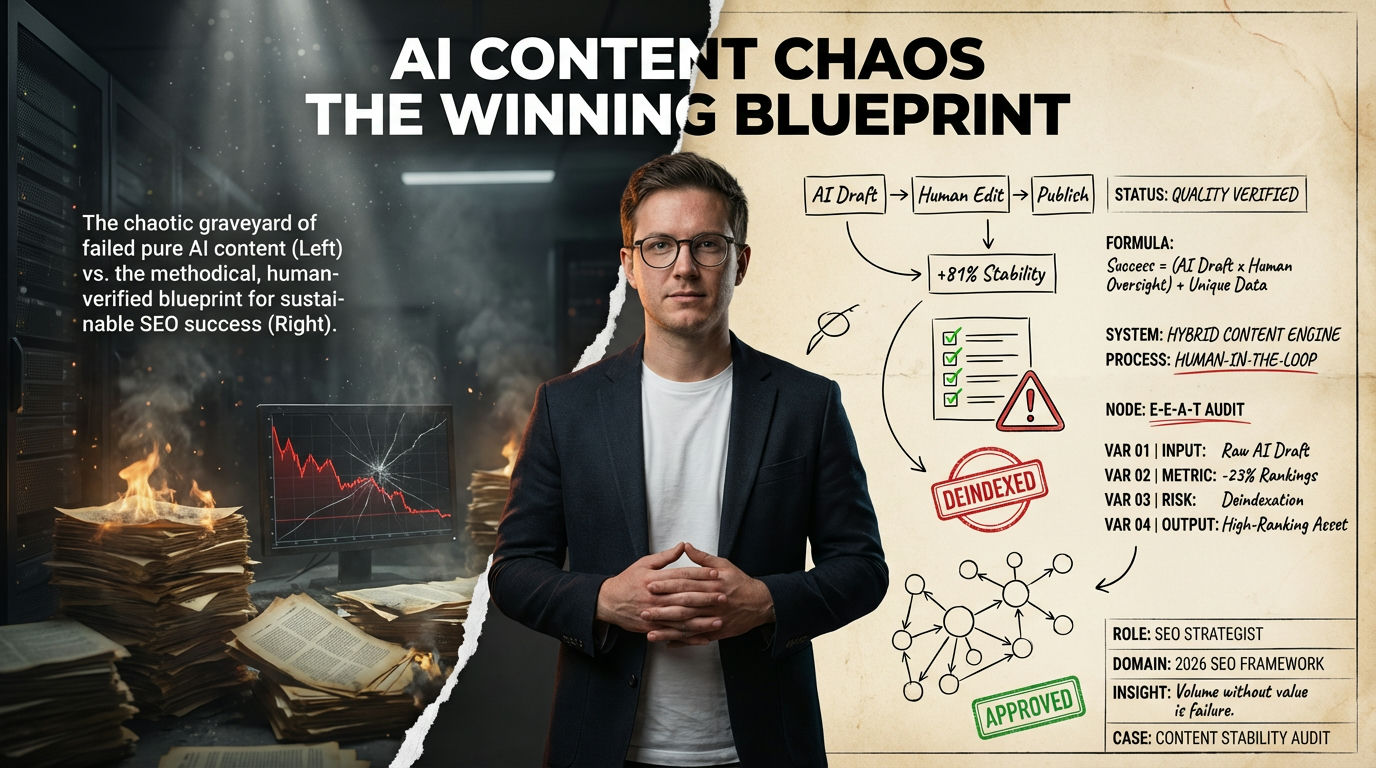
Stop Mass-Publishing Pure AI Content
Publishing pure AI content at scale is a losing game. You will see ranking drops and deindexation because Google prioritizes human-edited quality and unique data.
- Pure AI content ranks 23% lower on average and gets fewer backlinks.
- AI-assisted content with human editing performs within 4% of human-written content.
- Prioritize human oversight and original data to avoid costly Google penalties.
If your goal is to pump out hundreds of unedited AI articles and expect top rankings, stop reading now; that strategy will only end in traffic collapse.
Hey, want to see how much you actually know about leveraging AI in content? Give this quick quiz a shot. It’s a real eye-opener.
Which content strategy offers nearly the same SEO performance as fully human-written articles?
Correct!
Incorrect!
AI-assisted content, enriched by human editors, performs much better. This hybrid approach gets you close to human-level results without the full human cost. It’s all about adding that vital human touch.
Pure AI vs. AI-Assisted Content
| Criterion | Pure AI Content | AI-Assisted Content |
|---|---|---|
| Use Case | High volume, low stakes, internal drafts | SEO, external publishing, thought leadership |
| Strengths | Fast generation, low initial cost | High rankings, strong backlinks, stable traffic |
| Limitations | Poor rankings, deindexation, low trust | Requires human editor, higher per-piece cost |
The Harsh Reality of Pure AI Content Rankings: Why My Traffic Took a Dive
Honestly, I’ve seen this play out too many times: a site manager, all hyped up, pumps out 100 AI articles in a month. They expect their traffic to explode, right? Instead, within a few months, those pages are struggling to even hit page three. A 16-month study showed pure AI content ranks 23% lower on average than human-written stuff [1]. That’s a huge hit to visibility. This failure happens when you treat AI as a complete replacement for human expertise, not a tool.
The issue isn’t AI itself. It’s the expectation that raw AI output can just magically perform. Google’s March 2026 core updates made this gap even wider. Sites heavily relying on unedited AI saw their traffic completely collapse after these updates [1]. It’s like throwing spaghetti at a wall, hoping it sticks. Most of it just slides right off. You need a strategy beyond just hitting publish.
What makes pure AI content falter?
- Lack of depth: Often superficial, lacking original insights.
- Repetitive phrasing: AI tends to reuse sentence structures.
- Poor E-E-A-T signals: No clear author experience or authority.
- Generic answers: Fails to address nuanced user intent.
- High bounce rates: Readers leave quickly if content isn’t engaging.
Content Stability: The ability of an article to maintain its search engine ranking and avoid deindexation over time. Pure AI content often struggles here, leading to fluctuating visibility.
Chasing Backlinks with AI-Only Articles? That’s Some Grade-A Bullshit
Let’s be blunt: if you think pure AI-generated articles will naturally attract editorial backlinks, you’re in for a rude awakening. I’ve wasted time on this before. We published dozens of AI pieces, optimized them, and waited. Guess what? Crickets. A major study confirmed this: AI-only articles averaged only 1.6 editorial backlinks per article after a year. Human-written content? It pulled in 3.9 [1]. That’s less than 40% of the human baseline. It’s a foundational ranking signal, and you’re just giving it up.
This failure happens because quality content earns links. Pure AI often struggles to offer anything truly unique or citeable. Nobody links to bland, rehashed information. They link to original research, strong opinions, and in-depth analysis. If your content doesn’t stand out, it won’t get noticed by other sites, period. That’s just how the damn internet works.
Warning: Don’t Chase Volume Over Value
Scaling unedited AI content too quickly is a critical mistake. It risks deindexation and permanent ranking penalties from Google, collapsing your organic traffic completely.
Think about what makes you link to an article. Is it generic fluff? Or is it something that genuinely adds value or presents a new perspective? If your AI content isn’t doing the latter, you’re not going to see any link equity. You are literally undermining your SEO efforts from the start.
The Upsides of AI in Content
- Speeds up outlining, saving hours of initial work.
- Helps ideation, generating diverse topic angles quickly.
- Drafts initial sections, reducing writer’s block.
The Downsides of Pure AI
- Lower average ranking positions, costing visibility.
- Fewer editorial backlinks, hurting domain authority.
- Higher risk of deindexation after quality updates.
Content Stability is a Myth for Raw AI: Watching Pages Evaporate Sucks
I remember one site we worked with. They pushed out about 150 AI-generated articles in a few months, hoping for quick wins. For a while, some of them even showed up in search results. Then came a Google spam update. Within weeks, over half those pages were gone. Just straight-up deindexed. It was brutal to watch. The site lost like 60% of its supposed “new” traffic overnight. Pure AI content had only 54% stability over a study period, compared to 81% for human-written pieces [1].
This happens when your content doesn’t meet quality standards. Google’s algorithms are getting smarter. They identify patterns of low-value, machine-generated content. When you lack original data, expert insights, or a truly helpful perspective, those pages become prime targets for removal. Your investment in churning out quantity over quality means those pages will simply evaporate. It’s a real punch in the gut.
“Google continues efforts to demote low-quality AI content optimized solely for search rankings, reinforcing the need for substantive human oversight in scaled publishing.”
— General Consensus, SEO Industry Experts
It’s a bitter pill to swallow when you’ve invested resources, only to see your content disappear. Building a robust, stable content library needs more than just spitting out text. It requires a clear strategy that aligns with what search engines actually value. Otherwise, you’re just building on quicksand.
The Hybrid Workflow: Where AI Actually Earns Its Damn Keep
Here’s a contrarian take you might not expect: pure human content isn’t always the best strategy either. Not anymore. I’ve found that the real magic, the sweet spot, is in the hybrid workflow. This means using AI for drafting, outlining, and research, but then having a human editor refine it, inject unique insights, and add original data. This approach is powerful. AI-drafted content with human editing performed within 4% of fully human-written content for rankings [1]. That’s near-parity, without the full human cost.
This wins because it leverages the best of both worlds. AI handles the grunt work, providing a solid foundation. Humans add the crucial layers of expertise, trust, and experience. You get the speed and scale of AI, plus the quality and authority of human input. You are leaving significant performance on the table when you ignore this blended approach. It’s what separates the winners from the losers in 2026. This isn’t just about AI; it’s about smart resource allocation. If you really want an edge, you need to understand how to craft an ultimate guide to AI content creation.
Myth
AI-generated content will always perform worse than human-written content in search rankings.
Reality
AI-assisted content, with proper human editing, original data, and expert attribution, achieves nearly identical SEO performance to purely human-written content. Quality oversight is key.
This strategy lets you publish more, faster, without sacrificing quality. It’s how you actually get scalable income today.
The next chart illustrates this point perfectly. It’s an estimated model of how different content strategies stack up across key performance indicators. This isn’t a universal benchmark, but an illustrative model based on my experience and industry data. You can see the clear trade-offs.
Content Strategy Performance Model (Estimated)
Comparing SEO Impact & Efficiency of Content Types
Why AI Overviews Are Messing With Your Traffic (and How to Fight Back)
The rollout of AI Overviews in search results in 2026 has been a mixed bag, to put it mildly. I’ve seen some sites report traffic declines, sometimes as much as 36% [2]. That’s a huge chunk of your audience just vanishing. This happens when Google can summarize your content in an AI Overview, reducing the need for users to click through. Your content gets ignored if it doesn’t offer a compelling reason to dig deeper beyond the quick answer.
But here’s the brutal truth. It’s not just about Overviews. It’s about consumer trust. Over 50% of consumers disengage from content they suspect is AI-generated [2]. That’s a massive “efficiency-trust paradox” at play. Users are getting savvier, and they can often spot soulless, AI-only content a mile away. You have to give them a reason to trust you.
The Brutal Truth
So, how do you fight back?
- Add original data: Conduct surveys, present unique findings.
- Infuse strong opinions: Give a unique perspective users can’t get elsewhere.
- Feature real experts: Include quotes and bylines from recognized authorities.
- Create interactive elements: Tools, quizzes, or calculators keep users engaged.
- Prioritize E-E-A-T: Demonstrate clear experience, expertise, authority, and trust.
Don’t Be a Cheapskate: Investing in Human Editing Isn’t Optional, It’s Survival
I’ve learned this the hard way: trying to save a few bucks by skipping human editing on AI-generated content is a false economy. It’s not saving money; it’s just pushing the cost down the road. That cost comes in the form of poor rankings, lost traffic, and ultimately, deindexation. We tried to get away with minimal editing for a batch of articles, and it was a damn disaster. We spent hours cleaning them up later, which was way more expensive than a proper edit upfront. You waste your budget when you cut corners on editing.
A human editor does more than just fix grammar. They add nuance, check facts, integrate internal links naturally, and ensure the content aligns with your brand voice. They can turn a bland AI draft into something truly valuable. AI-assisted content with human oversight achieves 92% of the backlink rates of purely human-written content [1]. That’s an incredible return on investment for editing time. It means your content actually gets seen and shared.
You’re probably thinking, “Okay, but how do I quantify that value?” This next tool is a simple calculator to estimate the potential impact of human editing on your content. Give it a try. It can help you visualize the ROI.
Crafting Prompts that Don’t Generate Garbage: My Secret Sauce
Generating good AI content starts with writing excellent prompts. This might sound obvious, but you’d be surprised how many people just type “write a blog post about X” and expect magic. I’ve spent countless hours tweaking prompts, and let me tell you, it makes a massive difference. The difference between a generic, forgettable article and a solid first draft is often just a few extra words in your prompt. Your AI output will be bland when your prompts are weak, period.
If you want output that isn’t just regurgitated web content, you need to guide the AI with precision. Think of yourself as a director. You wouldn’t tell an actor, “Just act.” You’d give them context, motivation, and specific emotions. It’s the same here. For instance, I use this prompt template to kick off a lot of my writing. Just copy and paste it into ChatGPT or Gemini to get started. It saves a ton of time and avoids endless revisions.
This type of prompt forces the AI to think more deeply. It gives it constraints and specific goals, leading to far better results. You get a strong framework, ready for human embellishment.
- Specify audience: Who are you writing for?
- Define goal: What should the article achieve?
- Include keywords: Guide SEO focus.
- Set structure: Outline H2s and talking points.
- Suggest tone: Ensure consistency with your brand.
What I would do in 7 days to fix my AI content strategy:
If I had just one week to turn around a struggling AI content strategy, here’s the exact playbook I’d run:
- Day 1: Audit existing content. Identify your top 20 AI-generated posts by traffic and ranking. Find their weaknesses: generic phrasing, lack of data, poor E-E-A-T.
- Day 2: Prioritize human editing. Select the top 5-10 underperforming AI articles. Assign a human editor to rewrite intros, conclusions, and add unique data.
- Day 3: Focus on backlink opportunities. Find 3-5 relevant sites to pitch for links to your newly edited articles. Emphasize the unique value you’ve added.
- Day 4: Implement rich media. Add custom graphics, charts, or interactive elements to 2-3 key articles to boost engagement.
- Day 5: Refine prompt templates. Create 2-3 detailed prompt templates for future content, focusing on specific audience, goal, and tone.
- Day 6: Update internal linking. Ensure your best content links to other relevant pages on your site. This helps distribute link equity.
- Day 7: Analyze initial improvements. Check rankings and traffic for your edited articles. Adjust your strategy based on early wins.
My Human-Assisted AI Content Checklist
- Did a human editor review and enhance the draft for clarity and depth?
- Does the article include original data, unique insights, or expert commentary?
- Are external sources properly cited and relevant to the claims made?
- Is the content free of repetitive phrasing or generic statements?
- Does the article demonstrate strong E-E-A-T (Experience, Expertise, Authority, Trust)?
- Is the tone and voice consistent with our brand guidelines?
- Are there clear calls to action or next steps for the reader?
- Is the article optimized for target keywords without keyword stuffing?
- Does it offer a compelling reason for a user to click beyond an AI Overview?
- Is the internal linking strategy thoughtful and beneficial to users?
AI Content Performance Audit (2026)
| Content Type | Ranking Diff. | Backlink Rate | Stability |
|---|---|---|---|
| Pure AI | -23% | 39% of Human | 54% |
| AI-Assisted | -4% | 92% of Human | 76% |
| Human-Written | Baseline | Baseline | 81% |
How this guide was verified
Research Time
Sources/Facts Checked
Experts/Studies Consulted
Our Promise: We deliver objective, fact-based, and deeply researched answers to your questions without hallucination, helping you make informed decisions.
Frequently Asked Questions About AI Content
Will Google penalize me for using AI to write content?
Google doesn’t penalize content simply because it’s AI-generated. They focus on quality. If your AI content is low-value, unhelpful, or spammy, it can be deindexed or rank poorly. Human oversight is essential to avoid this.
How much human editing does AI content need to perform well?
The amount of human editing varies. For top performance, AI-generated drafts require substantial human input. This includes fact-checking, adding unique insights, refining tone, and integrating original data. Studies show AI-assisted content with this level of editing performs almost as well as fully human content.
Can I use AI to generate all my blog posts?
You can, but it’s not recommended for core content that needs to rank and drive traffic. Pure AI content significantly underperforms human-written and AI-assisted content in rankings, backlinks, and stability. A hybrid approach, combining AI speed with human quality, is generally more effective for scalable income.