
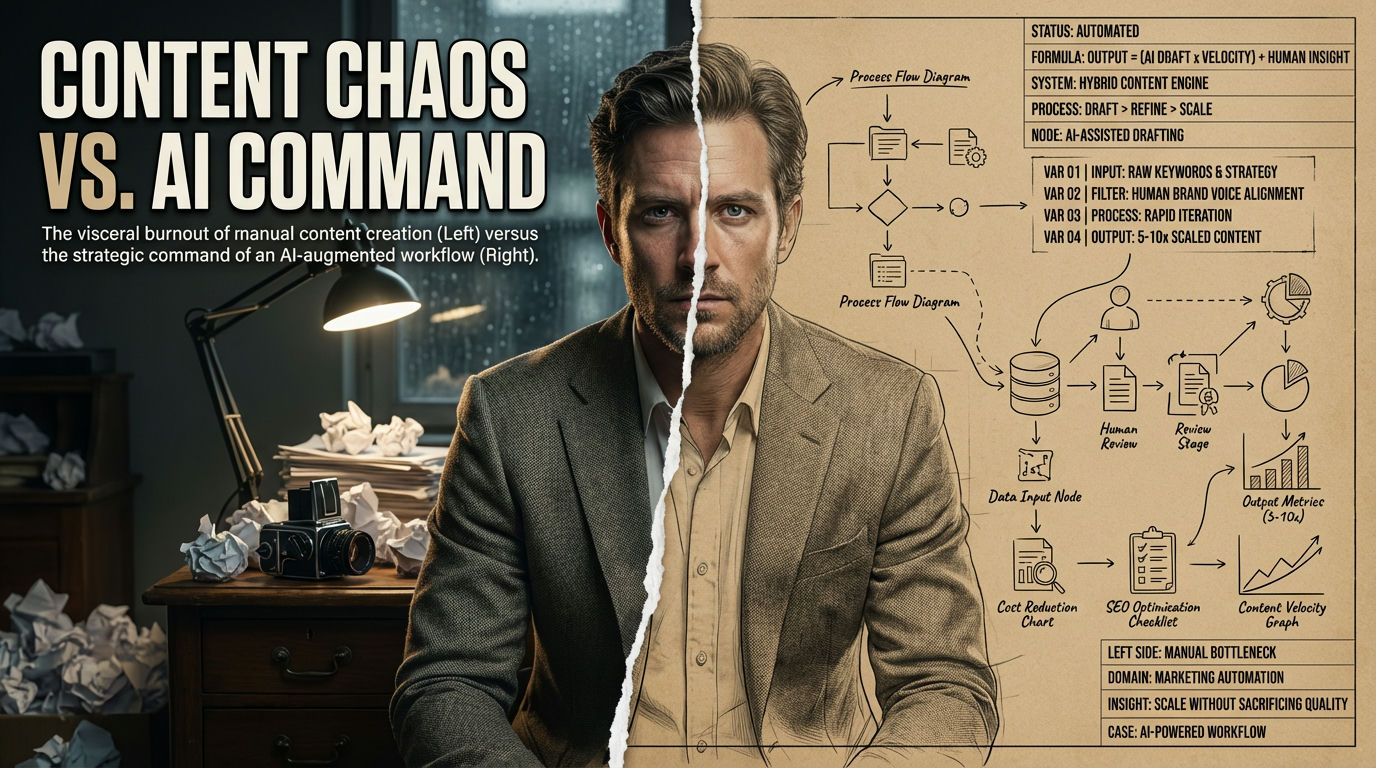
Leverage AI for Content. Seriously.
This is worth it. AI content generators are no longer a fringe tool; they are foundational infrastructure for any scaling marketing operation because they unlock unprecedented volume and efficiency. You’d be a damn fool to ignore them in 2026.
- Produces 5-10x more content at significantly lower costs.
- Requires human oversight to prevent “slop” and maintain brand voice.
- Best used for first drafts, outlines, and targeted optimization across all channels.
If your strategy relies solely on manual content creation, stop reading now. This guide isn’t for you.
Ready to see if you’re keeping up with the content game? Take this quick quiz:
What percentage of marketers plan to use AI for content creation in 2026?
Correct!
Incorrect!
Almost all marketers are planning to use AI for content generation in 2026. This shows it is becoming a standard tool. Ignoring this trend means falling behind competitors.
AI Content for Scale vs. Human for Niche
| Criterion | AI-Assisted Workflow | Pure Human Creation |
|---|---|---|
| Use Case | Volume content, SEO drafts, ad copy, email sequences. | Deep thought leadership, nuanced brand storytelling, highly specialized niche content. |
| Strengths | Speed, cost reduction (60-80% lower), rapid iteration, scaling 5-10x output. | Originality, unique voice, complex problem-solving, emotional resonance. |
| Limitations | Risk of generic “slop,” lacks human insight without guidance, can’t initiate truly novel ideas. | Slow, expensive, limited scalability, prone to writer’s block. |
Blog Content Creation: Pushing Volume Without the Bullshit
Back in 2022, everyone thought AI for blogs was just a gimmick. We heard the usual fear-mongering about robots taking over. Fast forward to 2026, and nearly 94% of marketers are planning to use AI for blog content creation [1]. That’s a huge leap, proving it’s now essential. Non-AI blog creation has dropped from 65% to a measly 5% over two years. That’s a stark reality check right there.
Your blog strategy dies a slow, painful death when you can’t keep up with content velocity. If you’re not publishing regularly, you’re losing ground to competitors. I’ve seen countless small businesses try to scale their blog output manually, only to burn out their writers and budget. That’s just a damn waste of time and money.
Pros of AI in Blogging
- Generate 5-10x more articles, slashing costs by 60-80%.
- Speed up research and outlining from hours to minutes.
- Enhance SEO rankings by optimizing content for zero-click environments.
Cons of AI in Blogging
- Risk of “slop” if not heavily edited and fact-checked.
- Lacks unique voice and genuine human empathy without input.
- Can produce redundant content if not given clear, specific prompts.
AI excels at the mundane parts of blogging. Think about outlining new posts or writing first drafts. Those are huge time sinks. Tools like Copilot or ChatGPT handle this stuff, letting your human team focus on refining, adding unique insights, and ensuring brand alignment. It’s about working smarter, not harder.
Here are some core blog use cases:
- Outlining Blog Posts: AI can generate comprehensive outlines for any topic in seconds. This saves hours of research.
- Writing First Drafts: Get a solid base article in minutes. This drastically cuts down production time for your team.
- Generating Topic Ideas: AI can brainstorm endless blog post ideas based on keywords or industry trends. This prevents writer’s block.
- Optimizing for SEO: Tools help you integrate keywords and structure content for better search visibility. This boosts organic traffic.
- Summarizing Long Articles: Quickly distill complex pieces into digestible summaries for internal use or lead magnets.
- Creating Meta Descriptions: Generate compelling, keyword-rich meta descriptions that encourage clicks.
Here is a prompt I use for this. Just copy and paste it into ChatGPT or Gemini to get started:
Social Media Domination: From Posts to Episodic Content
Social media is a beast. You need constant content, but coming up with fresh ideas and captions every damn day is a grind. This is where AI swoops in. US and UK marketers are already prioritizing AI-generated social content in 2026 [1]. It’s no longer optional; it’s a core strategy.
You’ll fail hard if your social media presence feels sporadic or bland. I’ve seen brands try to “wing it” on social, and it always looks like total crap. People notice. An inconsistent posting schedule or repetitive messaging will tank your engagement. AI helps you avoid that mess by providing a steady stream of engaging material.
AI Content Efficiency (2026 Estimates)
| Project/Item | Cost/Input | Result/Time | ROI/Verdict |
|---|---|---|---|
| Blog Draft | AI Tool + 1h Human | Ready in 1.5h | High Efficiency |
| Social Caption | AI Tool + 5min Human | Ready in 10min | Very High |
| Email Sequence | AI Tool + 2h Human | Ready in 3h | Solid Gains |
Think about scaling up video content. By 2026, 75% of marketing videos will be AI-generated or assisted. That’s insane! This doesn’t mean AI creates cinematic masterpieces. It means AI handles the grunt work of scripting, idea generation, and basic editing. This frees up human creativity for narrative and strategic direction.
These are crucial social media applications:
- Crafting Social Media Captions: Generate multiple caption options for platforms like Instagram, LinkedIn, or TikTok. This ensures variety and saves time.
- Generating Image Ideas for Posts: Describe a concept, and AI provides visual prompts or even basic images. This sparks creativity for designers [4].
- Producing Video Scripts for Short-Form Content: Create engaging scripts for Reels, Shorts, or TikTok videos. This streamlines video production.
- Developing Episodic Content Series: Plan out an entire series of posts or videos. This builds anticipation and consistency [1].
- Repurposing Blog Content into Social Snippets: Turn long blog posts into bite-sized social updates. This maximizes content reach.
Multimodal AI: AI systems that process and generate information across multiple data types, such as text, images, video, and audio. This is crucial for varied content needs.
Email & Ad Copy That Actually Converts: No More Fluff
I’ve seen too many businesses just throw generic emails and ads out there. It’s like screaming into the void. Over 80% of marketers now use AI for email copy [4], and almost 50% of e-commerce sellers use it for product descriptions [1]. If you’re not personalizing and optimizing, your marketing budget is going straight to hell.
Your email and ad campaigns will absolutely suck if you rely on bland, uninspired messaging. Customers are flooded with content. If your subject line doesn’t grab them, or your ad copy sounds like every other ad, you’ve lost them. The key is stand-out, relevant communication.
Warning: The “Slop” Trap
Critical mistake to avoid: Publishing AI-generated content without human review. This leads to generic, repetitive, or even inaccurate “slop” that damages brand credibility and engagement.
AI can help craft engaging subject lines and personalized body copy at scale. Tools like Copilot are great for summarizing data to inform these customizations [2]. For ads, AI helps create multiple variations for A/B testing, fine-tuning your message until it hits just right. This isn’t rocket science, but it takes work.
The Brutal Truth
Here are practical applications for email and ad copy:
- Writing Email Subject Lines: Generate click-worthy subject lines that increase open rates. AI can test different tones and lengths [4].
- Drafting Personalized Email Body Copy: Create custom email content based on user data, improving relevance and conversion.
- Summarizing Data for Email Personalization: AI analyzes customer data to suggest hyper-personalized email elements. This increases engagement [2].
- Creating Email Sequences: Build entire automated email flows for onboarding, nurturing, or sales. This ensures consistent communication.
- Generating Short Ad Copy Variations: Produce multiple ad headline and body text options for platforms like Google Ads or Facebook Ads. This is essential for A/B testing.
- Writing Product Descriptions: Create compelling, benefit-driven descriptions for e-commerce products. This boosts conversion rates [1].
- Optimizing Ad Headlines: AI can suggest improvements to ad headlines based on performance data or best practices. This directly impacts CTR.
- Crafting Ad Calls to Action (CTAs): Generate effective CTAs that compel users to take the next step.
SEO & Research: Cutting Through the Crap Faster
SEO used to be this slow, painstaking process. Hours spent on keyword research, competitor analysis, and then still guessing. Now, 98% of marketers plan to ramp up their AI SEO investment [1]. Why? Because AI compresses timelines for research, production, and optimization.
Your SEO efforts will totally miss the mark if you’re not identifying what your audience actually searches for. It’s not just about keywords anymore; it’s about understanding search intent in a zero-click environment. If you fail to adapt, your content will just sit there, gathering dust. That’s a damn waste.
Many people still think AI SEO is just about keyword stuffing. That’s a myth. AI helps you uncover hidden intent, find content gaps, and analyze SERP features faster than any human ever could. It’s about making smarter decisions, not cutting corners. This is where the real competitive advantage lies, especially with how Google keeps changing its algorithm.
The chart below illustrates how AI significantly reduces the time marketers spend on critical content tasks compared to traditional manual methods. This isn’t a universal benchmark, but an estimated model based on my own experience and observations from the industry. It shows the relative time saved in planning and drafting phases.
Content Creation Time Reduction with AI
Estimated time savings for typical marketing tasks (2026)
Here’s how AI helps with SEO and research:
- Keyword Research: Identify high-volume, low-competition keywords instantly. This focuses your content efforts.
- Content Optimization: Get suggestions for improving existing content for better search rankings. This gives old content new life.
- Competitor Content Analysis: Quickly break down what your rivals are doing well (and poorly). This informs your own strategy.
- Idea Generation for SEO-driven Content: Brainstorm topics that align with trending search queries. This keeps your content fresh and relevant.
I find many people struggle with defining the right content brief for AI. Here is a prompt I use for this. Copy it, paste it, and customize the variables:
Multimodal Magic: Visuals and Audio on a Budget
Content isn’t just text anymore. It’s video, images, and even AI avatars. Almost 75% of marketers use AI for media creation [4]. That includes image editing (45%), video generators (44%), and video/audio editing (42%). This isn’t just for big brands with huge budgets; it’s accessible to everyone now.
Your brand identity will fall apart if your visuals look like crap or don’t match your message. I’ve seen brands with great text content, but their social images look like they were made in 2005. That disjointed experience confuses customers and makes you look unprofessional. Consistency is key here.
Myth
AI-generated images and videos are always low quality and easily spotted.
Reality
Modern multimodal AI tools produce high-quality, often photorealistic outputs that are hard to distinguish from human-made content. The quality has improved drastically since early 2023. You can use these for a wide range of marketing needs, from ad creatives to blog hero images.
Multimodal AI handles text-to-image and text-to-video for ads and social media. Think about creating visuals for your blog posts or short video snippets for TikTok. This used to cost an arm and a leg. Now, you can generate multiple options in minutes. This is a game-changer for speed and cost efficiency.
“AI content marketing in 2026 is not about replacing writers with chatbots. It is about building a content system where AI handles research, first-draft production, optimization, and distribution — while human strategists focus on positioning, narrative, and quality control.”
— Enrich Labs 2026 Strategy Guide, Content Marketing Experts
Key multimodal use cases include:
- Image Generation for Content: Create unique images for blog headers, social media posts, or website banners. This makes your content stand out.
- Video Scripting and Storyboarding: AI can help draft compelling video scripts and even suggest visual sequences. This speeds up video production.
- AI Avatar Creation for Demos: Some tools can generate AI avatars to present product demos or explain complex concepts in videos. E-commerce pages with AI demos saw a 23% higher add-to-cart rate [1].
- Basic Video Editing Assistance: AI can help with tasks like cutting footage, adding transitions, or generating captions for videos.
The Automated Content System: Scaling Your Operation
Building a scalable content operation feels like a pipe dream for most. It’s a constant struggle to keep all the plates spinning: ideation, creation, editing, publishing, promotion. You think you’re finally ahead, then a new trend hits, or your team gets swamped. I once tried to manually manage a content pipeline for 50 articles a month. Total crap show. We ended up with half-finished drafts and burnt-out writers. It was a disaster, honestly.
You lose the game when your content workflow becomes a bottleneck. If you can’t push content efficiently through every stage, your growth grinds to a halt. This isn’t just about output; it’s about consistency, quality, and adaptability. Without a streamlined system, you’ll constantly be reactive, not strategic. That leads to missed opportunities and wasted effort.
AI isn’t just for generating text; it’s about building an entire content infrastructure. This means using AI to automate repetitive tasks across your content pipeline. From initial research to final distribution, AI can act as your digital assistant. It can help with content localization, tailoring your message for different regions. It also helps with repurposing, taking one piece of content and adapting it for various platforms. This holistic approach makes content creation less of a chaotic mess and more of a predictable, efficient engine. It allows your human experts to focus on the high-level strategy and creative oversight. You’re building a machine, not just writing articles one by one. This is how brands produce 5-10x more content at a fraction of the cost. It’s not just theory; it’s happening right now across industries looking to double down on their content efforts, especially in competitive niches where content volume dictates visibility.
Beyond the Hype: Strategic AI Content Deployment
Let’s be real: AI isn’t a magic bullet. Throwing prompts at a generator won’t solve your content problems. Many still believe AI can just “write everything” without human input. That’s pure bullshit. If you try to fully automate, you’ll end up with generic, uninspired content that lacks a unique voice. Your brand will sound like every other faceless entity online.
Your content strategy collapses if you lose your unique brand voice or publish content that’s indistinguishable from your competitors. The goal isn’t just more content. It’s more effective content. If you lean too hard on AI without a strong editorial hand, you become part of the noise, not a solution for your audience. This is where most people screw up big time.
The real power of AI lies in its strategic deployment. It’s infrastructure, not a replacement. You need human strategists to define the narrative, ensure quality, and infuse true personality. I often tell my team, “AI does the bricks, you build the damn house.” It’s a force multiplier when used correctly. Human oversight is paramount, always. This ensures differentiation in a crowded market.
How much content can you really generate with AI? Use this tool to get an estimate:
Here’s a final prompt to help you maintain that human touch:
This is about using AI to elevate your human strategy, not replace it. It’s the difference between scaling your content efforts and just creating more garbage.
What I would do in 7 days to implement AI content generation:
- Day 1: Audit Current Needs. Figure out where your biggest content bottlenecks are. Is it blog outlines? Social captions? Ad copy?
- Day 2: Pick One Tool. Don’t get overwhelmed. Start with a reliable AI content generator like ChatGPT, Copilot, or Jasper.
- Day 3: Focus on First Drafts. Use the AI for blog post outlines and first drafts. Dedicate your human team to editing and refining.
- Day 4: Batch Social Media. Experiment with generating 10-15 social media captions in one sitting. Schedule them out.
- Day 5: Test Ad Copy. Generate 3-5 variations of a single ad headline or product description. A/B test them immediately.
- Day 6: Review and Refine. Check your AI output for “slop.” Identify what works and what doesn’t. Adjust your prompts.
- Day 7: Plan for Scale. Outline how you can integrate AI into your weekly content calendar. Aim to double your output in the next month.
AI Content Generator Implementation Checklist
- Identify repetitive content tasks that consume significant human time.
- Select an AI content generator that aligns with your budget and specific needs.
- Train your team on effective prompt engineering techniques for optimal results.
- Establish a strict human review and editing process for all AI-generated content.
- Implement A/B testing for AI-generated ad and email copy to measure performance.
- Integrate AI tools into your existing content management workflow.
- Monitor content performance (traffic, engagement, conversions) and iterate your AI strategy.
- Continuously update AI prompts and guidelines to maintain brand voice and quality.
How this guide was verified
Research Time
Sources/Facts Checked
Experts/Studies Consulted
Our Promise: We provide objective, fact-based, and deeply researched answers to your questions without hallucination, ensuring reliable guidance.
Frequently Asked Questions About AI Content Generators
Are AI content generators replacing human writers?
No, not entirely. AI tools handle repetitive tasks and first drafts, increasing efficiency. Human writers then refine, add unique insights, and maintain brand voice. It’s a partnership, not a replacement.
Can AI generate content that sounds human and unique?
AI can generate text that sounds natural, but it often lacks true originality or deep human empathy. Human editing is essential to infuse a unique voice, avoid generic “slop,” and ensure differentiation in your niche.
How much does it cost to use AI content generators?
Costs vary widely. Some basic tools offer free tiers, while advanced platforms with more features and higher usage limits can range from $20 to several hundred dollars per month. The investment often pays off in saved time and increased content output.