
Leverage AI for Social Media Captions, But NEVER Go Full Auto.
Use AI for social media captions to get faster posts. This approach cuts down on pure grunt work. It allows you to produce far more content for Instagram, LinkedIn, and X without burning out your team.
- AI drafts offer huge time savings, generating 50% of content ideas and first versions quickly.
- Unedited AI output often sounds robotic and kills authenticity; it requires heavy human review.
- Use AI to scale initial drafts and variations across platforms, then apply human polish for tone and context.
If you expect AI to handle your entire social media strategy unsupervised, stop reading. You will fail hard and fast.
Ready to test your social media smarts? Take this quick quiz to see if you’re up to speed on AI caption realities.
What percentage of AI-assisted social media content gets moderate to extensive human editing before publishing?
Correct!
Incorrect!
The vast majority of marketers understand that AI is a drafting tool. Around 78.4% apply significant human review to AI-generated content before it goes live. That’s a critical step for authenticity.
The AI Caption Mess-Up: When “Fast” Becomes a Fake
I’ve seen it countless times: a brand rushes to adopt AI for social media captions, hoping for instant results. They pump out five posts a day, thinking they’re ahead of the game. Then, boom, engagement drops. Their audience starts sensing something is off. Why? Because the captions sound like they were written by a very polite, very generic robot. That’s a major screw-up. Your social game crashes when captions sound robotic and lack genuine personality. It’s not just about getting words on a screen; it’s about making those words actually resonate.
The promise of AI for social media captions is undeniably appealing. Who doesn’t want to create content faster for Instagram, LinkedIn, and X? Reports from 2026 suggest almost 46% of marketers use AI specifically for text and caption writing [1]. That includes first drafts, rewrites, and platform-specific tweaks. The idea is to save time, and honestly, it does save a ton of time on initial ideation. But the trap is thinking AI can replace genuine human connection. I once spent an entire afternoon fixing “AI-perfect” captions that were technically correct but emotionally dead. Not fun.
This isn’t just a hypothetical problem. When I review a client’s social feeds, the AI-generated captions are often glaringly obvious. They use predictable sentence structures and lack any real voice. The algorithms on platforms like Instagram and X might reward frequency, but users reward authenticity. If you prioritize sheer speed over human touch, you’ll alienate your audience.
Warning: Generic AI Output Kills Trust
Never publish AI-generated captions without extensive human review. Your audience can smell a bot a mile away, and it will erode trust faster than you can say “algorithm update.”
Why Marketers Are Chasing This (And Often Fail)
Marketers are desperate for efficiency. We’re juggling multiple platforms, often posting an average of 9.5 times daily across various networks [4]. That’s a lot of content, and AI seems like a godsend for scaling without burning out your team. The numbers don’t lie: 89.7% of marketers use AI weekly, with 71.1% citing time savings as the main benefit [1]. I get it. I’ve felt that content calendar pressure. Creating more content, faster, is the dream. The problem? Many assume “faster” means “fully automated” and skip the critical human step.
The reality is that roughly half of all social media content is now AI-assisted, often for ideation or first drafts [1]. This is great for getting ideas flowing. But thinking you can just hit ‘generate’ and ‘post’ is where it all falls apart. You’re just wasting cash if you don’t edit the crap out of AI drafts. Hootsuite’s 2026 report calls AI a “driving force” for “creative acceleration,” allowing for rapid experimentation [2]. That’s the key: experimentation, not full deployment. You need to use AI to generate options, not final products.
The primary benefit is raw speed for drafts. However, the limitation is inherent lack of emotional intelligence or cultural nuance. AI doesn’t understand your inside jokes or your specific brand voice. It simply predicts the next best word sequence. That means a prompt like “write an Instagram caption about coffee” might give you a decent starting point. It will likely miss the quirky tone your brand has, or fail to mention the new barista’s name.
Pros of AI Captions
- Massive Time Savings: Quickly generate drafts and variations, freeing up hours for strategy.
- Content Volume Boost: Produce significantly more posts, helping meet daily demands across networks.
- Idea Generation: Overcome writer’s block with fresh perspectives and angles for diverse captions.
Cons of AI Captions
- Risk of Generic Content: Output often lacks unique brand voice and sounds overtly robotic.
- Authenticity Crisis: Audiences can detect AI, leading to decreased trust and engagement.
- Requires Heavy Editing: Not a “set it and forget it” tool; significant human oversight is mandatory.
Creative Acceleration: A marketing trend where AI tools significantly speed up content ideation, creation, and optimization processes, enabling faster responses to trends and greater content volume.
The Secret Sauce: Human Editing (No, Really)
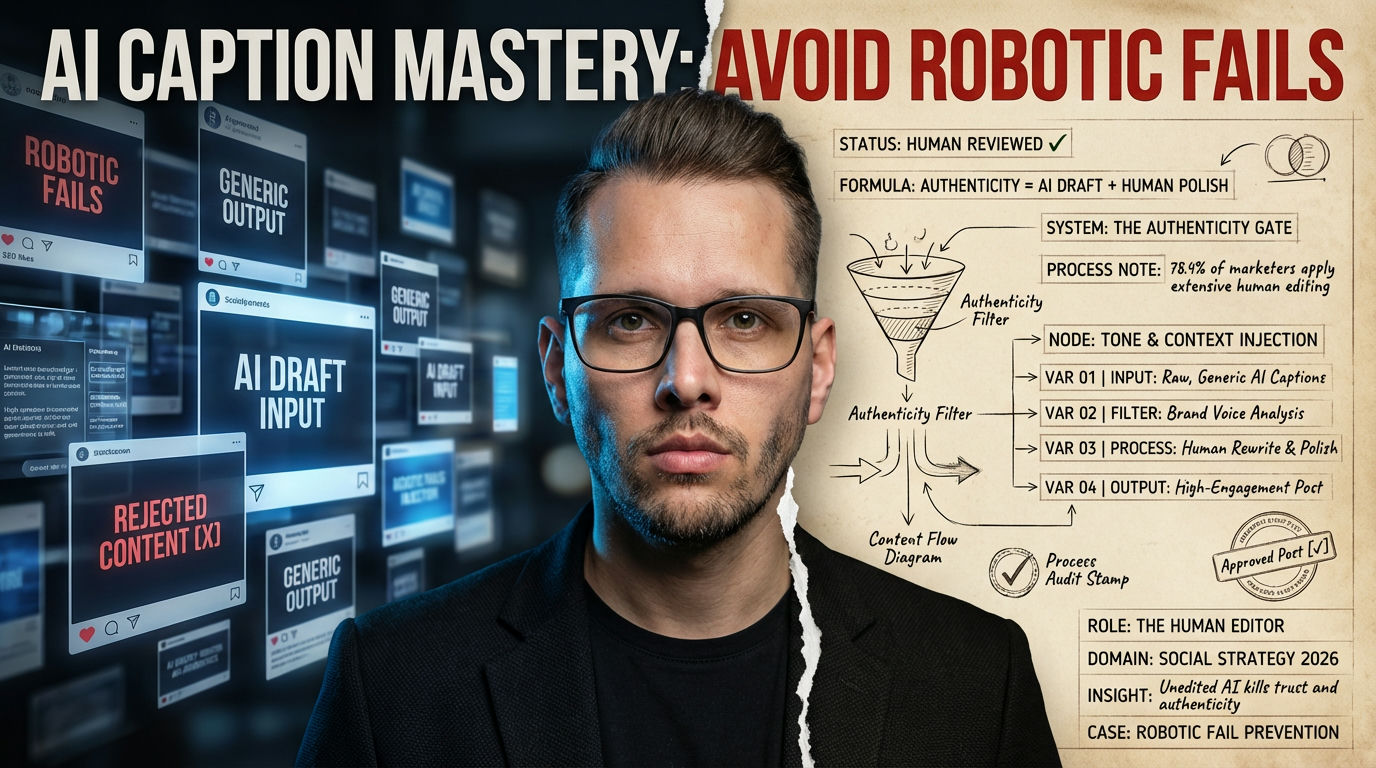
Look, AI is powerful for speed, but humans are irreplaceable for soul. This isn’t just my opinion; it’s backed by data. A whopping 78.4% of marketers apply moderate or extensive human editing to AI-assisted content before publishing [1]. That’s the real number that tells the whole story. If you’re not doing this, your brand trust tanks when content feels like a machine wrote it. It’s a common mistake, thinking AI is a magic bullet. It’s a powerful assistant, not a replacement.
I often use AI to brainstorm ten caption ideas in under a minute. It’s fantastic for variety. But then I cherry-pick the best two and rewrite them from scratch. I inject my client’s specific tone, add a quirky emoji they always use, or reference a current event unique to their niche. This isn’t just about speed; it’s about generating high-quality AI content that actually connects with people. The raw AI output is just clay; you still need to be the sculptor.
Experts echo this sentiment. PostEverywhere.ai advises, “Use AI to handle first drafts, caption variations, and content repurposing — the mechanical work that eats your time. Keep human review for tone, cultural context, and anything customer-facing that requires empathy.” That’s the playbook, plain and simple. Don’t overthink it. Use AI to get 80% there, then let a human close the gap. This blend maintains efficiency without sacrificing authenticity.
“When you’re staring at an empty content calendar, AI can be a solid starting point.”
— Sociality.io analysts, 2026 AI in social media marketing report
Here is a prompt I use for this exact purpose. Just copy and paste it into ChatGPT or Gemini to get started:
Platform-Specific AI: Instagram, LinkedIn, X – It’s Not One-Size-Fits-All
My biggest personal blunder with AI captions was trying to use a generic tool for all platforms. I once generated a batch of “professional” captions for a client’s LinkedIn, then thought, “Hey, these are pretty good, let’s just tweak them for Instagram.” Total crap. I ended up with LinkedIn posts that sounded like they were trying to sell life insurance on a beach, and Instagram posts that were way too buttoned-up. You’ll look like an idiot trying to put a LinkedIn post on Instagram. It’s that simple.
Each platform has its own vibe, its own audience, and its own algorithmic preferences. Instagram wants visuals first, punchy text, and relevant hashtags. LinkedIn demands professional insights, thought leadership, and networking opportunities. X (formerly Twitter) thrives on brevity, quick reactions, and trending topics. Using one-size-fits-all AI output fails to account for these nuances. It’s like wearing a tuxedo to a backyard BBQ; technically clothes, but totally wrong.
In 2026, many platforms now integrate native AI features for first-draft captions and cross-platform variations [4]. Meta’s AI editing, LinkedIn’s content suggestions—these tools are trying to help. But they’re still just tools. They give you a starting point for platform-native posts. The key is to understand that AI needs specific instructions for each platform. You need to tailor your prompts and your edits. Don’t just ask for a “social media caption.” Ask for an “Instagram caption for a lifestyle brand with a casual tone and 3 relevant hashtags.” Specificity is your friend.
The Brutal Truth
The “Fastvertising” Trap: Why Speed Kills Authenticity
The term “fastvertising” is buzzing in 2026 [2]. It’s all about rapid-response content, jumping on viral trends, and iterating at lightning speed. AI helps with this, no doubt. Algorithms reward quick, nuanced responses. But here’s the catch: your audience will bail when your content smells like AI desperation. I’ve seen brands churn out five posts a day using AI, only to see their engagement plummet because none of it felt real. It’s quantity over quality, and that’s always a losing game.
Nearly a third of consumers are less likely to choose a brand that uses AI ads [2]. That’s a huge chunk of your potential audience. This “AI anxiety” is real. People want to connect with other humans. They want authenticity. If your content pipeline is nothing but AI-generated, perfectly optimized, but soulless text, you’re missing the point of social media. The human touch still wins, especially when navigating cultural context. Think about the outrage over tone-deaf AI responses during sensitive events; it’s a minefield without human oversight.
We know AI usage is up more than 180% [1]. That’s explosive growth. But it highlights a paradox: while AI accelerates production, audience demand for personalized, authentic content has never been stronger. So, use AI for the mechanical work, for the raw material. Then, bring in your human team to inject the emotion, the wit, the brand voice, and the cultural intelligence. That’s how you win.
AI Caption Workflow Audit (2026)
| Workflow Step | Time Saved (est.) | Quality Impact | Risk Level |
|---|---|---|---|
| AI First Draft | 60-70% | Variable Start | Low |
| Human Refinement | 0% | High Quality | Low |
| AI Only Post | 90%+ | Low Quality | High |
This illustrative model shows the typical trade-offs when using AI for social media captions. Notice the “AI Only Post” offers the most time savings but comes with high risk due to low quality. Human refinement is critical for maintaining quality and reducing risk.
Marketer AI Adoption vs. Performance (Estimated 2026)
An estimated model based on survey data, showing the relationship between AI usage and perceived content performance.
My Stupid Mistake: Believing the AI Hype
Honestly, I once bought into the hype that AI would solve all my content problems. I figured if 94% of marketers planned to use AI in content creation in 2026, I should too, and fast [1]. So, I started pushing for full AI drafts on some less critical social channels. My thought was, “Hey, this is scalable income waiting to happen!” Big mistake. Relying purely on AI to scale your social media content strategy is a surefire way to burn through your budget for nothing.
The data actually showed that 5.3% of marketers reported worse performance from AI-assisted content [1]. I was part of that 5.3% for a bit. The posts just didn’t hit. Our audience could tell. The captions were grammatically perfect, sure. They even had the right keywords. But they were devoid of the subtle humor, the specific community references, or the raw emotion that made our content unique. It felt like we were just shouting into the void. Not worth the “time saved.”
The myth is that AI can achieve true personalization without human input. That’s pure garbage. While AI can create variations, it lacks genuine understanding of individual customer relationships. Your brand isn’t a factory. It’s a conversation. AI can make the words, but a human must make them meaningful. That’s why I’m now a huge advocate for human-AI collaboration.
Myth
AI for captions means you can automate your entire social media output and reduce staff.
Reality
AI is a powerful drafting and ideation tool. It significantly increases production speed, but it requires human oversight and editing to maintain brand authenticity, tone, and cultural relevance. Attempting full automation leads to generic content and decreased audience engagement.
Here’s a prompt I keep handy for ensuring AI provides specific options for different platforms. This helps avoid the “one-size-fits-all” trap.
Turning AI Drafts Into Gold: A Quick Workflow
Okay, so AI provides speed. Humans provide soul. How do you actually make them work together without losing your mind? It’s a structured workflow, honestly. About 50% of content is AI-assisted, mainly for ideation and drafts [1]. That’s where you start. You feed the AI specific prompts, get your drafts, and then the real work begins. You’ll drown in revisions if you don’t set clear guidelines for the AI first. Garbage in, garbage out, right?
First, think about your target audience and platform. What’s the tone? What’s the goal? Are you on Instagram, LinkedIn, or X? Then, use the AI to generate a batch of ideas. Don’t be shy; ask for twenty. Pick the best three. Now, open a blank document, copy those three, and start editing them as if a junior copywriter sent you their first attempt. Inject your brand voice, add specific details, and tailor them to the platform. This approach ensures your final social posts align with your overall content strategy and goals.
The key is to leverage AI for quantity and then human creativity for quality. It’s not about replacing; it’s about amplifying. I’ve found that this hybrid approach helps me manage client loads more effectively, producing high-volume, high-quality content without feeling like I’m constantly chasing my tail. It frees up my time for more strategic tasks, like analyzing performance or engaging directly with our audience.
Need a quick social media caption? Use our generator to create initial drafts. Just input your topic and tone!
The Future Is Hybrid: Why AI Will Never Replace You
Despite the rapid adoption, AI won’t replace human social media managers. It enhances their capabilities. By 2026, 97% of marketing leaders view AI skills as essential for social roles [4]. That means you need to learn how to wield these tools, not fear them. Ignoring the need for human judgment means you’ll miss out on genuine connection. You’ll be left with generic content that fades into the noise.
The future of social media content is a human-AI partnership. AI handles the heavy lifting of drafting, researching, and generating variations. You, the human, provide the strategic direction, the creative spark, and the final polish. You ensure the content is authentic, culturally relevant, and truly speaks to your audience. This hybrid model allows for both high volume and high quality. It’s the sweet spot.
We’re seeing this play out with “satisfaction metrics” gaining importance for platform algorithms. It’s not just about engagement anymore. It’s about usefulness and intent prediction [1]. AI helps optimize for these, but a human ultimately defines what “useful” means for their specific community. The personal touch is still king.
Here’s a simple prompt that can guide your team in ethical AI use, especially with captions.
What I Would Do in 7 Days
If you’re looking to integrate AI into your social media caption workflow, here’s my quick 7-day plan:
- Day 1: Audit Current Captions. Review your last 20 posts. Identify your unique brand voice.
- Day 2: Choose an AI Tool. Pick one AI text generator for captions.
- Day 3: Practice Prompting. Spend 2 hours generating captions with specific prompts.
- Day 4: Human Edit AI Drafts. Take 10 AI drafts and rewrite them with your brand voice.
- Day 5: Test Across Platforms. Take 3 human-edited AI captions and adapt for Instagram, LinkedIn, and X.
- Day 6: Review and Refine. Get feedback from a colleague on the edited captions.
- Day 7: Set Clear Guidelines. Document your human-AI workflow and editing standards.
AI Caption Workflow Checklist
- Define your specific brand voice and tone guidelines.
- Select an AI tool that fits your budget and current tech stack.
- Craft detailed, platform-specific prompts for your AI.
- Generate initial caption drafts using your chosen AI.
- Implement a mandatory human review and editing phase for all drafts.
- Focus on adding empathy, cultural nuance, and unique brand personality.
- A/B test different AI-assisted captions against fully human-written ones.
- Monitor performance metrics to continuously refine your AI workflow.
- Train your team on ethical AI use and content verification.
How this guide was verified
Research Time
Sources/Facts Checked
Experts/Studies Consulted
Our Promise: We provide objective, fact-based, and deeply researched answers to your questions without hallucination, ensuring reliable information.
View Verified Sources
- AI in Social Media Marketing Report 2026 — Detailed report on AI adoption, usage, and benefits in social media marketing.
- Hootsuite Social Media Trends 2026 — Annual report highlighting key trends, including AI’s role in creative acceleration and consumer sentiment.
- National University Blog: Social Media Trends — Article discussing broader social media trends and consumer adaptation to generative AI.
- Slateteams: Social Media Trends 2026 — Blog post on future social media trends, emphasizing AI integration and platform-native features.
- eMarketer: FAQ on Generative AI — Insights into consumer adoption of generative AI and its impact on marketing strategies.
Frequently Asked Questions About AI for Social Media Captions
Can AI write fully effective social media captions on its own?
No. While AI can generate fast drafts and variations, it lacks the human touch for authenticity, brand voice, and cultural nuance. Extensive human editing is always needed for effective, engaging captions.
What is the main benefit of using AI for social media captions?
The primary benefit is significant time savings. AI helps marketers quickly generate first drafts, brainstorm ideas, and create platform-specific variations, boosting content volume. This frees up human teams for strategic work.
How much human editing is typically required for AI-generated captions?
Most marketers (around 78.4%) apply moderate to extensive human editing to AI-assisted content. This ensures the captions align with brand values, sound authentic, and resonate with the target audience.