
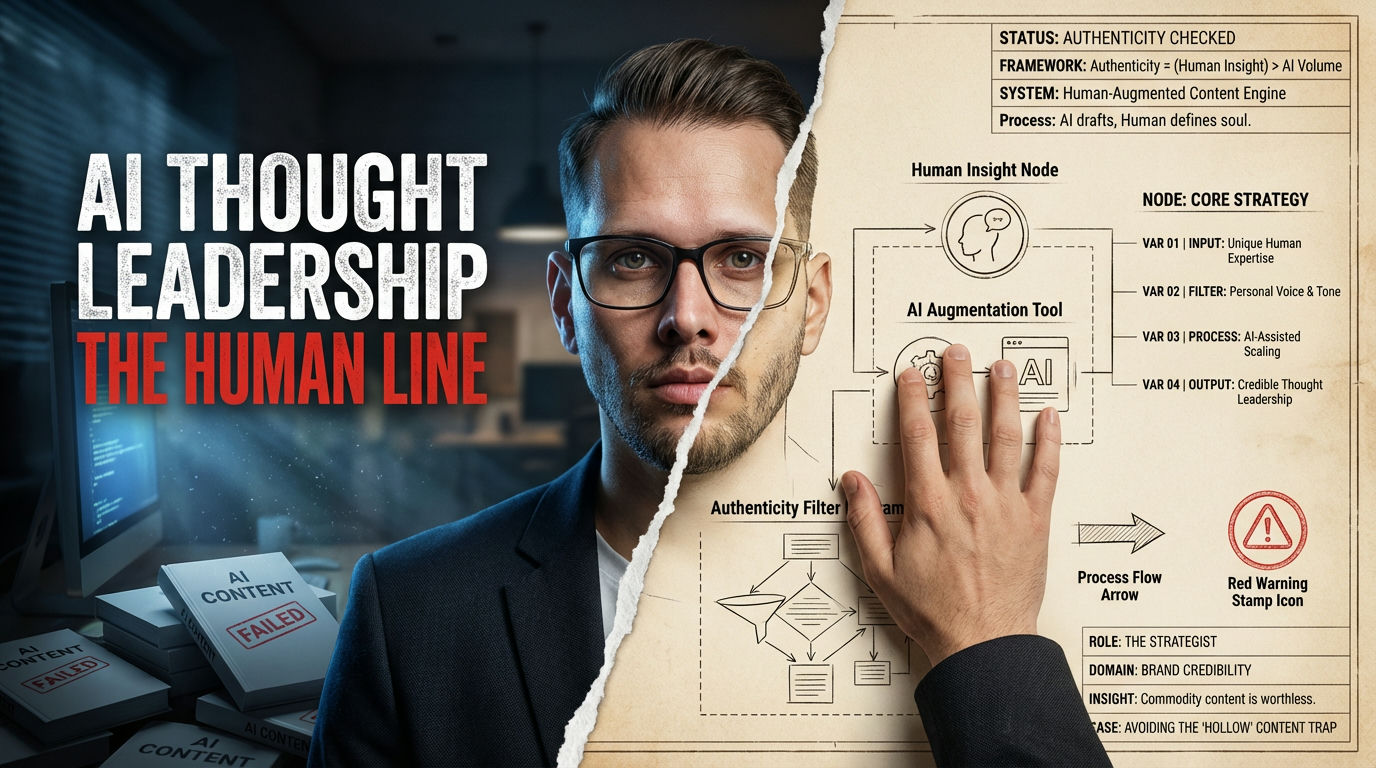
Leverage AI for Distribution, Not Core Ideas.
Use AI content generators for thought leadership if you own the core insights and strategy. It’s simply not worth it if you expect AI to generate your unique perspective.
- AI boosts content distribution and early drafts, saving real time.
- It struggles to create genuinely novel or deeply experienced insights.
- Best for scaling existing human-generated ideas to wider audiences.
If your goal is to publish unedited, entirely AI-generated content as your personal thought leadership, stop reading. It will fail.
Ready to test your knowledge about AI in thought leadership? Take this quick quiz to see how you stack up.
Which aspect of thought leadership content is AI most likely to devalue if overused?
Correct!
Incorrect!
AI excels at speed and structure. Its weakness lies in replicating genuine, deeply-held human expertise and the authenticity that builds trust. Over-reliance can make your content feel generic.
Human-Led vs. AI-Led Thought Leadership
| Criterion | Human-Led (AI-Augmented) | AI-Led (Human-Edited) |
|---|---|---|
| Primary Use Case | Deep insights, strategic direction | Scaling commodity content, distribution |
| Strengths | Originality, trust, personal voice | Speed, volume, SEO visibility |
| Limitations | Slower production, higher cost | Generic output, low credibility risk |
The AI Hype vs. Your Brand’s Soul: When Not to Be a Robot
Look, the AI hype train is moving fast. Everyone wants to talk about using AI content generators. I’ve personally seen countless marketers jump on board, thinking it’s a magic bullet for thought leadership. The hard truth is, your brand’s soul dies when you let AI write your unique insights without heavy human hand-holding. It sounds extreme, but this fails when your content starts sounding exactly like everyone else’s.
Thought leadership demands a distinct voice. It needs real experience. Automating that entire process turns your content into generic garbage. Remember Ryan Law, Director of Content at Ahrefs? He straight-up says, “AI makes commodity content worthless.” He’s right. If your content doesn’t stand out, it simply gets lost.
The real goal isn’t just producing more content. It’s about producing meaningful content that positions you as an expert. Using AI for initial drafts or research summaries can be a huge time-saver. It means you spend less time on the mundane stuff. But the final layer, that personal touch, the unique story – that has to come from you. Otherwise, you’re just another bot in the feed.
Pros of AI in Thought Leadership
- Increased speed and volume – Draft outlines and summaries much faster.
- Enhanced distribution reach – AI can help adapt content for various platforms.
- Data-driven optimization – Tools identify trending topics and keywords.
Cons of AI in Thought Leadership
- Loss of authentic voice – Content often sounds generic and impersonal.
- Diluted credibility risk – Readers detect AI-generated fluff quickly.
- Ethical transparency issues – Not disclosing AI use can erode trust.
Where the Automation Train Derailed My Project
I once thought I was pretty clever, trying to automate an entire series of B2B thought leadership articles. I mapped out the topics, threw them into a powerful AI, and let it generate full drafts. My mistake was assuming “good enough” from the AI was actually good enough for expert-level content. That project totally blew up in my face when my target audience, senior executives, gave me feedback saying the articles felt “hollow” and “lacked genuine insight.” It was a damn expensive lesson.
This failure happened because I bypassed the most critical step: deep human ideation and storytelling. The AI produced grammatically correct text, sure. It even hit keyword targets. But it couldn’t tell a real story about overcoming a specific business challenge. It couldn’t inject that dry humor or a hard-won lesson learned from years in the trenches. The content felt manufactured.
We ended up having to scrap most of the AI-generated drafts. We spent another week brainstorming unique angles and personal anecdotes. It was a massive waste of time and resources. The trap here is believing efficiency automatically equals quality in a field demanding originality. You lose trust and look like a fraud.
Warning: The Plagiarism Trap
Never publish AI content without rigorous fact-checking and originality scans. AI tools can sometimes “hallucinate” information or inadvertently replicate existing content, leading to serious credibility and legal issues for your brand.
The Trap of Generic Output: Why “Good Enough” is Bullshit
People keep saying AI is “good enough” for most content. Honestly, that’s just a lazy take. For thought leadership, “good enough” is utter bullshit. Your goal isn’t just to fill a content calendar. It’s to be seen as an authority. If your insights are indistinguishable from what any other AI can generate, you’re not a leader; you’re just noise. This approach fails when your content doesn’t offer anything new or unique to the conversation, making readers skim past it.
Ryan Law nailed it: commodity content is worthless. I’ve seen countless firms churn out article after article using AI, and guess what? They get zero traction. They wonder why nobody cares. It’s because their “thought leadership” reads like a Wikipedia summary. It lacks the sharp opinions, the battle-tested strategies, and the personal anecdotes that only a human can bring. You need to provide a fresh perspective, not a rehashed one.
Your audience isn’t looking for average. They’re looking for an edge, a different way of thinking, or a solution to a problem they haven’t solved yet. That requires a human brain, digging deep. Use AI to assist with research or rephrasing, but never let it dictate the core value proposition.
Myth
AI will automate all content creation for thought leaders by 2026.
Reality
AI is a powerful augmentation tool, but human strategists and subject matter experts remain crucial for unique insights and authentic voice in thought leadership. It’s a partnership, not a replacement. Studies show that human creative allocation has dropped to 25%, but AI systems also only comprise 40% of marketing spend [4].
Real Expertise Isn’t Prompt Deep: Building Authority
Building real authority means you can’t rely on prompts alone. I mean, sure, you can craft a killer prompt, but if you don’t actually know the subject inside out, the AI won’t either. It’ll just give you a polished version of what’s already out there. That won’t cut it for establishing thought leadership. Your authority crumbles when your content reveals a lack of genuine, firsthand understanding.
I’ve spent hours poring over industry reports, talking to experts, and testing out strategies. That’s how I build my unique take. An AI doesn’t have those conversations. It doesn’t get that gut feeling when a strategy is about to go sideways. It’s pulling from existing data, not creating new knowledge from lived experience. That unique perspective is what people pay for.
The statistics are clear. Over 90% of pages in AI Overviews already contain AI-generated content. This just means you need to be even better at distinguishing your human insights. If you’re not bringing something truly original to the table, AI Overviews will simply summarize a generic version of your content. That’s a brutal truth to swallow.
Many businesses are using AI content generation to scale up their presence. This illustrative model shows how adopting AI can impact the perceived authenticity and reach of your thought leadership content. This isn’t a universal benchmark, but an estimate based on observed market trends and feedback.
Impact of AI Integration on Thought Leadership
Estimated model: Authenticity vs. Reach in 2026
Let’s look at some real-world impact.
AI Content Impact Review (2026)
| Project/Item | Input | Result | Verdict |
|---|---|---|---|
| Blog Post Drafts | AI generated outlines | 80% faster | Positive |
| Social Media Posts | AI for variations | 32% more conversions | Strong Win |
| Expert Articles | AI for full drafts | Lacked depth | Negative |
Strategic Content: When to Let AI Drive (and When to Censor It)
Okay, so AI isn’t your thought leader. We get it. But it’s still a damn powerful tool if you use it smart. The trick is knowing exactly when to let it take the wheel and when to slam on the brakes. For instance, AI can churn out a killer first draft of a blog post, saving you hours of staring at a blank screen. But the moment you hit “publish” without your unique edits, that’s where the content goes to hell. Your content strategy fails when you blindly trust AI to represent your distinct perspective without critical human intervention.
I’ve seen marketing teams use AI to generate dozens of ideas for a content series. This works great for brainstorming volume. Then, a human expert selects the most promising angles and injects their specific insights. AI can then help with keyword research, ensuring your thought leadership content actually gets seen in the SERPs. The goal is to make your content visible, but also valuable. You can explore a deeper dive into content generator uses in this guide to AI content generators.
Think of AI as a hyper-efficient research assistant and a fast typist. It pulls information, structures arguments, and even rephrases sentences for clarity. It does the heavy lifting of commodity content. But it’s on you to provide the strategic direction, the “aha!” moments, and the personal anecdotes that transform information into true thought leadership.
The Brutal Truth
Thought Leadership: Content that establishes an individual or organization as an authority and innovator in their field, often by offering unique insights, predictions, or solutions to industry challenges.
Here is a prompt I use for this. Just copy and paste it into ChatGPT or Gemini to get started:
Guardrails, Not Gates: Implementing Responsible AI
You need to put guardrails in place, not just throw up gates and ban AI completely. That’s a losing strategy in 2026. Every enterprise leader I talk to is figuring this out. Many organizations now have a Chief AI Officer, formalizing accountability for AI content ethics. This proactive stance is essential because your AI integration fails when you lack clear policies and human oversight, risking brand reputation.
We’re seeing 88.7% of leaders with AI safeguards in place now. That’s a good start. But a safeguard isn’t just a piece of software; it’s a human process. It involves editorial review, brand guidelines, and a commitment to authenticity. You can use AI to research competitor content or analyze market trends to inform your strategy, which is smart. The key is that the final output still feels like it originated from a human expert.
Think about it like this: AI can provide incredible tools for data analytics, which underpins strong thought leadership. In fact, 65% of organizations use AI for data analytics where content generation supports decision-making insights [2]. That’s a huge win. But then a human still needs to interpret that data and tell the story. That’s where the unique perspective comes in.
“Executives view AI as a once-in-a-generation shift, but stress governance—nearly 80% prioritize Responsible AI.”
— Fortune 1000 Executive Benchmark Survey, 15th Annual AI & Data Leadership Survey [4]
Here is a prompt I use for this. Just copy and paste it into ChatGPT or Gemini to get started:
Crafting Your AI-Powered Thought Leadership Blueprint
Alright, you’re not going to let AI turn you into a boring corporate drone. Good. Now, let’s build a blueprint that actually works. The real magic happens when you pair AI’s efficiency with your irreplaceable human brainpower. This isn’t about choosing one or the other. It’s about a smart, hybrid approach that amplifies your unique voice. Your thought leadership fails if you don’t clearly define roles for both human expertise and AI assistance throughout your content workflow.
Start with your unique insights. What do you truly believe? What have you experienced that nobody else has? That’s your gold. Use AI to research supporting data, generate alternative headlines, or draft outlines to get started. For example, 88% of B2B SaaS marketers use AI daily, often for these initial tasks, leading to 32% higher conversion rates for AI-integrated campaigns [3]. That’s a hell of an ROI.
Then, inject your personality. Tell a story. Add a controversial opinion. Edit mercilessly to ensure it sounds like you. Finally, leverage AI again for distribution. Use it to adapt your core message into social media posts, email snippets, or even a podcast script. This integrated strategy helps your AI content generator efforts truly shine.
Think of AI as your content production co-pilot. You’re the captain, setting the destination and steering the ship. The co-pilot handles navigation, checklists, and communication. It’s a team effort.
Here is a prompt I use for this. Just copy and paste it into ChatGPT or Gemini to get started:
What I would do in 7 days
If I were kicking off a new thought leadership strategy with AI today, here’s my week-long action plan:
- Day 1: Define Your Voice. Spend a day writing down your unique perspectives, stories, and what makes you different. No AI allowed.
- Day 2: Brainstorm with AI. Use an AI content generator to expand on your core ideas. Generate outlines, headlines, and keyword ideas.
- Day 3: Human-First Draft. Write the initial human-driven draft of your first thought leadership piece, focusing on your unique angle.
- Day 4: AI Polish and Expand. Feed your human draft into AI. Ask it to expand on points, suggest rephrasing, or add supporting facts.
- Day 5: Deep Human Edit. Critically review and edit the AI-assisted draft. Inject more personal anecdotes, refine arguments, and ensure your authentic voice shines through.
- Day 6: AI for Distribution. Use AI to create social media posts, email blurbs, and other distribution assets from your finished article.
- Day 7: Launch and Learn. Publish your content and track engagement. Use feedback to refine your human-AI workflow for the next piece.
Your AI Thought Leadership Checklist
- Confirm core insights are 100% human-generated and unique.
- Establish clear guidelines for AI use in content creation.
- Implement a rigorous human review process for all AI-assisted content.
- Prioritize authenticity and original thought over mere content volume.
- Use AI to enhance distribution, not to replace your unique voice.
- Regularly audit AI-generated content for accuracy and brand alignment.
How this guide was verified
Our Promise: We deliver objective, fact-based, and deeply researched answers to your questions without hallucination.
View Verified Sources
- LinkedIn’s Top AI Content Voices — Provides expert opinions on AI in content creation.
- AI Statistics and Trends by ThoughtSpot — Offers key data and trends related to AI adoption in enterprise.
- State of AI in the Enterprise by Deloitte — Insights into AI implementation and strategies within businesses.
- The State of AI: Key Insights from JDSUPRA — Discusses executive perspectives and governance around AI.
- Content Marketing Stats by The Digital Elevator — Presents statistics relevant to content marketing and audience consumption habits.
Frequently Asked Questions about AI and Thought Leadership
Can AI fully replace human thought leaders?
No, AI cannot fully replace human thought leaders. While AI excels at generating text, compiling data, and optimizing for search, it lacks the unique lived experience, emotional intelligence, and authentic perspective that define true thought leadership. Humans must provide the core insights.
What are the risks of over-relying on AI for thought leadership content?
Over-reliance on AI carries several risks. These include producing generic, unoriginal content that dilutes your brand’s unique voice and credibility. There is also the risk of factual inaccuracies (hallucinations) and ethical concerns around transparency, which can erode trust with your audience.
How can I use AI effectively to support my thought leadership efforts?
Effectively use AI by focusing on augmentation, not replacement. Leverage AI for tasks like brainstorming ideas, generating content outlines, summarizing research, optimizing headlines, and repurposing content for various distribution channels. Always inject your unique insights and perform thorough human editing before publishing.